All species › Cranes, rails and allies › Rails, gallinules and coots › Rufous-necked Wood Rail
Position in the tree Birds Aves › Birds with a flexible palate Neognathae › All other modern birds Neoaves › Birds of the elements Elementaves › Cranes and waders Gruimorphae
Rufous-necked Wood Rail | Aramides axillaris
Roodnekbosral | Rascón cuello rufo
The Rufous-necked Wood Rail is a medium-sized wood rail with a chestnut head, neck and breast, a grey patch on the upper back and black rear parts. It lives mainly in mangroves and coastal swamp forest and often comes out onto open mud at low tide. In the guide area it occurs along both coasts, from north-western Mexico and the Yucatán Peninsula to Panama.

Voice
A loud, penetrating series of short, hard notes, pik-pik-pik-pik or kee-kee-kee, often repeated and sometimes by several birds together, mainly at dusk. Also a sharp kek when alarmed.
Recording: Roland Rumm — CC BY-NC-SA 4.0 · converted to mono · xeno-canto
Identification
28–31 cm, a slender wood rail on long legs. Head, neck, breast and flanks are bright chestnut; the throat is paler, sometimes whitish. On the upper back there is a blue-grey patch separating the chestnut neck from the olive-brown back and wings. Belly, rump, undertail coverts and the short tail are black to blackish grey. The underwing is rufous with black bars. The bill is greenish-yellow, the eye red and the legs coral-red. The sexes are alike; juveniles are duller, with a greyer breast.
Confusion species
Russet-naped Wood Rail Aramides albiventris and Grey-cowled Wood Rail Aramides cajaneus are larger, with a grey neck and head and only the breast rufous. Uniform Crake Amaurolimnas concolor is smaller and entirely brown, without grey and black. Clapper Rail Rallus crepitans and Mangrove Rail Rallus longirostris of the same mangroves are greyish brown, with a long, slightly decurved bill and barred flanks.
Habitat
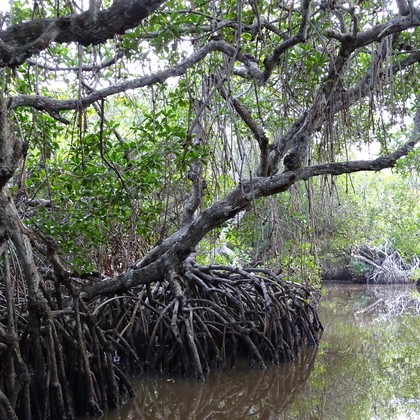
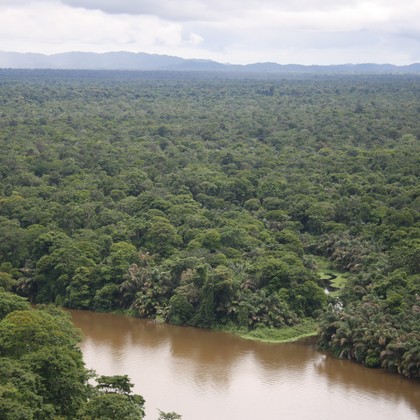
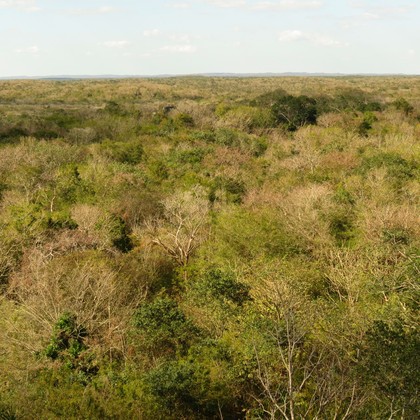
Mainly mangroves and coastal swamp forest, also brackish marsh, riparian woodland along lagoons and rivers and, on the Yucatán Peninsula, humid seasonal forest and wooded areas around cenotes far from the coast. Forages on mud among mangrove roots and at the forest edge for crabs, other invertebrates and seeds, often at low tide. Walks with the tail cocked and flees into cover on foot when disturbed. The nest is a cup of twigs and leaves in a shrub or low tree.
Where the bird is most at home, classified by the vegetation units of Mexico and Central America.


Range and movements
On the Pacific side from Sinaloa and Nayarit south along the coast of Mexico, Guatemala, El Salvador, Honduras, Nicaragua and Costa Rica to Panama; on the Atlantic side on the Yucatán Peninsula, in Belize, along the Caribbean coast of Guatemala and Honduras, on the Bay Islands and locally further south. Everywhere local and closely tied to mangroves. Outside the guide area along the coasts of northern South America to Ecuador and the Guianas, and on Trinidad.
- Resident
- Summer visitor (c. Apr–Sep)
- Winter visitor (c. Oct–Mar)
- Passage (Mar–Apr, Oct–Nov)
- dark = core range, pale = thinly spread
How and when to look
Boat trips through the mangroves around San Blas in Nayarit offer a good chance, especially at low water, when birds walk over the mud. In Belize and on the Yucatán Peninsula also in mangroves and coastal woodland along lagoons. Usually the hard call series is noticed first.
Conservation status
Least Concern. In the guide area locally fairly common in well-developed mangroves. Clearance of mangroves for shrimp farming, tourism and building reduces its habitat.
Scientific name
Aramides axillaris | Lawrence, 1863
Lawrence described the species in 1863 and placed it straight away in the genus where it still stands. The genus Aramides was introduced in 1845 by Pucheran. Aramides is Aramus (Limpkin) with Greek -oidēs 'resembling': 'Limpkin-like'. axillaris is Latin for 'of the armpit', after the rufous axillaries under the wing. The specimen the first description was based on came from Barranquilla, Colombia.