All species › Passerines › Cardinals and allies › Varied Bunting
Position in the tree Birds Aves › Birds with a flexible palate Neognathae › All other modern birds Neoaves › Landbirds Telluraves › Falcons, parrots and passerines Australaves › Falcons and passerines Eufalconimorphae › Parrots and passerines Psittacopasserae
Varied Bunting | Passerina versicolor
Veelkleurengors | Colorín morado
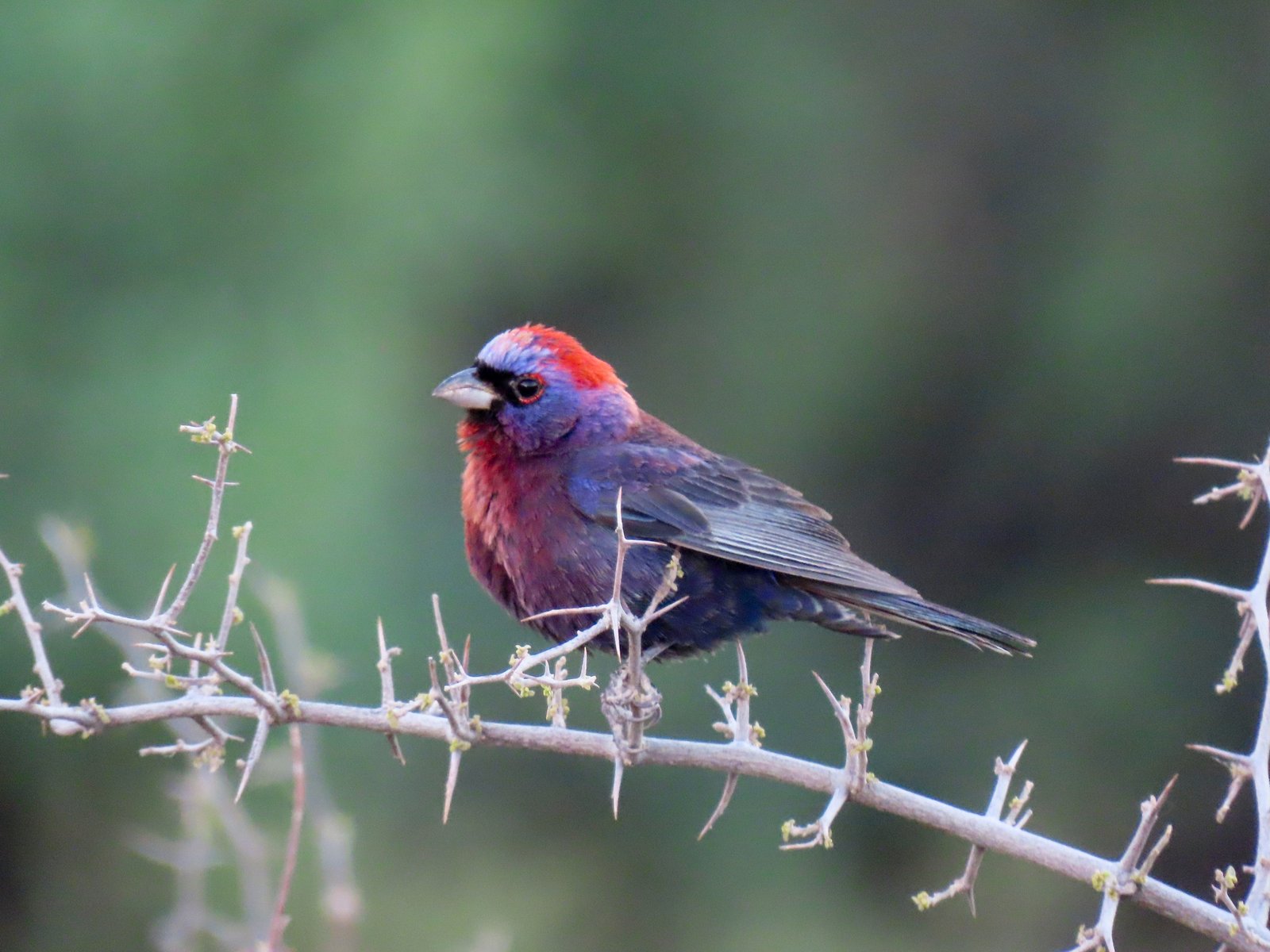
The Varied Bunting is a Passerina bunting of dry scrub in which the male is dark plum-purple with a red nape and blue crown and rump; the female is plain greyish brown. It lives from the south-western United States to southern Mexico. In the guide area it is mainly found in northern and western Mexico.
Voice
The song is a fairly fast, hoarse and somewhat scratchy warble, less clear than that of Painted Bunting and without the paired notes of Indigo Bunting. The call is a sharp spik or chip.
Recording: Richard E. Webster — CC BY-NC-SA 4.0 · shortened to the first 60 s, mono · xeno-canto
Identification
12–14 cm. A small bunting with a short, conical bill with a slightly curved upper edge. The male is dark plum-purple with a red patch on the nape, a blue to bluish-purple crown, cheek and rump, and black lores; in poor light the whole bird looks blackish. The female is plain greyish brown, slightly paler below, without streaks and without distinct wing bars. Young males resemble the female.
Confusion species
The female Indigo Bunting Passerina cyanea is warmer brown, with faint streaks on the breast and pale wing bars. The female Lazuli Bunting Passerina amoena has a warm buff breast and distinct pale wing bars. Blue Grosbeak Passerina caerulea is larger, with a heavy bill and chestnut wing bars. The male Indigo Bunting is uniform blue with no red nape.
Habitat
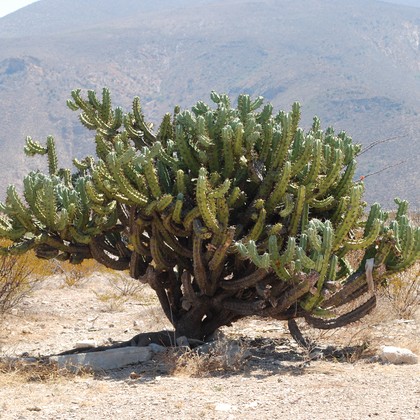
Thorn scrub, dry thickets and scrubby slopes, dry ravines and washes in desert and semi-desert, also the shrub layer of tropical dry forest; often near water. From sea level to about 1800 m. It feeds hidden in dense scrub on seeds, insects and fruit.
Where the bird is most at home, classified by the vegetation units of Mexico and Central America.


Range and movements
From southern Arizona, New Mexico and Texas south through northern and western Mexico, including southern Baja California, along the Pacific slope and the dry interior to Oaxaca and Chiapas. In north-eastern Mexico to Tamaulipas and San Luis Potosí. Birds from the north of the breeding range move south in winter.
- Resident
- Summer visitor (c. Apr–Sep)
- Winter visitor (c. Oct–Mar)
- dark = core range, pale = thinly spread
How and when to look
In summer males sing from an exposed branch in thorn scrub, for example around Álamos in Sonora and in the dry valleys of Sinaloa and Oaxaca. The species is most active after the first summer rains.
Conservation status
Not threatened (LC). Widespread and locally common; vulnerable to the loss of scrub through grazing and agriculture.
Scientific name
Passerina versicolor | (Bonaparte, 1838)
Bonaparte described the species in 1838 as Spiza versicolor; because it was later moved to another genus, the author and year stand in brackets. The genus Passerina was introduced in 1816 by Vieillot. Passerina comes from the Latin passerinus 'sparrow-like', from passer 'sparrow'. versicolor is Latin for 'changing colour, variegated', after the male's red, blue and purple sheen. The specimen the first description was based on came from near Temascaltepec, Mexico.