All species › Swifts › Hummingbirds › Violet-capped Hummingbird
Position in the tree Birds Aves › Birds with a flexible palate Neognathae › All other modern birds Neoaves › Birds of the elements Elementaves › Nightjars and swifts Strisores
Violet-capped Hummingbird | Goldmania violiceps
Violetkapkolibrie | Colibrí de Goldman
The Violet-capped Hummingbird is a small hummingbird of the ridges of central and eastern Panama and extreme north-western Colombia. The male has a glittering violet-blue crown and a reddish-brown tail. The species lives in humid forest at middle elevations and at a few sites regularly visits feeders.

Voice
A rapid, low series of chirping notes, and as a call an irregular series of nasal, fairly low notes, often while feeding.
No recording with a suitable Creative Commons licence is available for this species yet.
Identification
9 cm, with a straight black bill with a pink base to the lower mandible. The male is glittering green, with a violet-blue crown, white undertail coverts and a slightly forked, dark reddish-brown tail with pale edges. The female is green above and whitish below, with grey spots on the throat and green spots on the flanks; the tail is reddish-brown with white tips.
Confusion species
Violet-headed Hummingbird Klais guimeti has a white spot behind the eye; in the male the throat is also violet-blue, and the tail is green with grey tips. Crowned Woodnymph Thalurania colombica is larger and has a blue-black tail; males in eastern Panama have a green crown and a violet belly. The male Violet-bellied Hummingbird Chlorestes julie has a violet belly and a green crown. Pirre Hummingbird Goldmania bella lacks the violet crown and has a rufous or cinnamon face.
Habitat
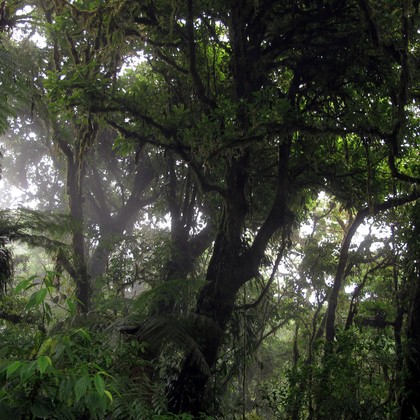
Interior and edges of humid foothill and montane forest, at about 600 to 1200 m, most often around 900 m. It feeds in the understorey and middle strata at flowers of shrubs and epiphytes and catches small insects. It also visits gardens with flowers and feeders at the forest edge.
Where the bird is most at home, classified by the vegetation units of Mexico and Central America.


Range and movements
In the guide area only in Panama, on a few separate ridges: Cerro Azul and Cerro Jefe east of Panama City, Cerro Chucantí and the mountains of Darién. Outside the guide area in extreme north-western Colombia, in Chocó.
- Resident
- dark = core range, pale = thinly spread
How and when to look
At feeders and flowering gardens in Cerro Azul and along the road to Cerro Jefe, about an hour's drive from Panama City; also on Cerro Chucantí.
Conservation status
Near Threatened. The range is small and the population is probably declining. Forest on the lower slopes is gradually disappearing, partly through building around Cerro Azul, but part of the habitat is still little affected.
Scientific name
Goldmania violiceps | Nelson, 1911
Nelson described the species in 1911 and placed it straight away in the genus where it still stands. He introduced the genus Goldmania in that same work. Goldmania honours the American zoologist and conservationist Edward Alphonso Goldman (1873–1946), who collected widely in Mexico and Panama. violiceps is Latin, from viola 'violet' and -ceps '-crowned', after the male's violet crown. The specimen the first description was based on came from Cerro Azul, northwest of Chepo, Panama, c. 900 m.