All species › Gamebirds › Guans, curassows and chachalacas › West Mexican Chachalaca
Position in the tree Birds Aves › Birds with a flexible palate Neognathae › Fowl Galloanserae
West Mexican Chachalaca | Ortalis poliocephala
West-Mexicaanse chachalaca | Chachalaca pálida
The West Mexican Chachalaca is, together with Rufous-bellied Chachalaca, the largest chachalaca in the guide area and endemic to south-western Mexico, from Jalisco to western Chiapas. Flocks live in dry forest and thorn scrub along the Pacific side and in the dry interior of Morelos and Puebla. Characteristic are the whitish belly and the broad pale tail tips.

Voice
Flocks sing a loud, hoarse and rhythmic chorus of throaty sounds, chur-uh-uh-uhr, with birds answering each other, mainly at dawn. Also cackling and grating calls.
Recording: Manuel Grosselet — CC BY-NC-SA 4.0 · converted to mono · xeno-canto
Identification
59–69 cm; a large, slender chachalaca with a long, broad tail. The crown and nape are dull brownish grey, the upperparts pale olive-brown. The breast is greyish olive, the belly whitish with an ochre wash that becomes warmer towards the undertail coverts. The tail is dark with a green gloss and broad pale ochre tips to the outer feathers. There is bare red skin around the eye and on the throat. Male and female are alike.
Confusion species
Rufous-bellied Chachalaca Ortalis wagleri has a chestnut belly and chestnut tail tips; it lives north of this species and the two meet in Jalisco. White-bellied Chachalaca Ortalis leucogastra is smaller, with a browner head and white tail tips, and only begins in south-eastern Chiapas. Crested Guan Penelope purpurascens is darker, with white streaks on the neck and breast and a red dewlap.
Habitat
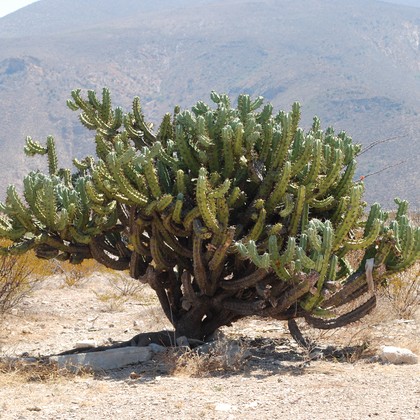
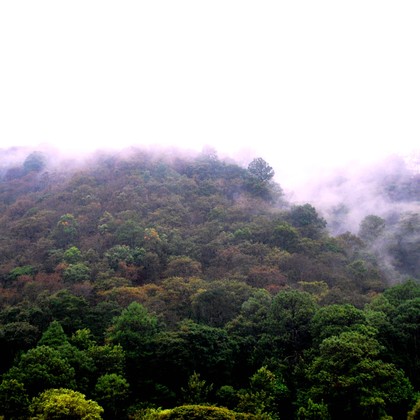
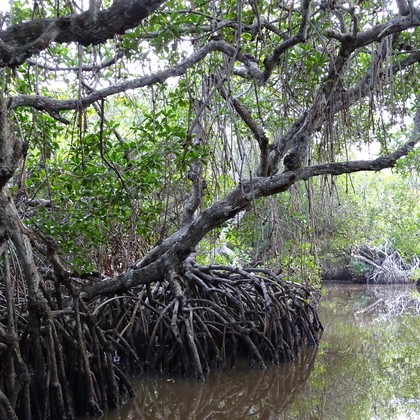
Tropical dry forest, thorn scrub and secondary forest, also riparian forest, mangroves, palm plantations and locally pine-oak forest; from sea level to about 2400 m, mainly in the lower parts. It lives in groups that search the treetops and shrubs for fruit, leaves and flowers and rarely come to the ground.
Where the bird is most at home, classified by the vegetation units of Mexico and Central America.



Range and movements
Endemic to south-western Mexico: from Jalisco through Colima, Michoacán and Guerrero to Oaxaca and western Chiapas, inland to Morelos, the south of the state of México and south-western Puebla. In northern Jalisco it borders the range of Rufous-bellied Chachalaca.
- Resident
- dark = core range, pale = thinly spread
How and when to look
In the dry forest of the Jalisco coast, such as around Chamela, near Colima and near Huatulco in Oaxaca, and inland in Morelos. Flocks readily come to fruiting trees near villages and roads.
Conservation status
Not threatened. The species is fairly common within its range and holds up well in logged and secondary dry forest, although the tropical dry forest of western Mexico is declining strongly.
Scientific name
Ortalis poliocephala | (Wagler, 1830)
Wagler described the species in 1830 as Penelope poliocephala; because it was later moved to another genus, the author and year stand in brackets. The genus Ortalis was introduced in 1786 by Merrem. Ortalis is Greek for 'chick, young hen'. poliocephala is Greek, from polios 'grey' and kephalē 'head', after the grey head. The specimen the first description was based on came from Mexico (not specified).