All species › Passerines › Thrushes and allies › Western Bluebird
Position in the tree Birds Aves › Birds with a flexible palate Neognathae › All other modern birds Neoaves › Landbirds Telluraves › Falcons, parrots and passerines Australaves › Falcons and passerines Eufalconimorphae › Parrots and passerines Psittacopasserae
Western Bluebird | Sialia mexicana
Blauwkeelsialia | Azulejo garganta azul
The Western Bluebird is a small thrush of open oak and pine woodland in the mountains. The male has a deep blue head and throat, a chestnut breast and often a chestnut patch on the back. Outside the breeding season it wanders in small flocks in search of berries. In the guide area it occurs in the highlands of northern and central Mexico.

Voice
The call is a soft, short pew or few, often in flight. The song is simple and consists of a few soft call notes in sequence, mainly in the twilight before sunrise.
Recording: Paul Driver — CC BY-NC-SA 4.0 · converted to mono · xeno-canto
Identification
15–18 cm. Stocky, with a short thin bill. Male with head, throat, wings and tail deep blue; breast and flanks chestnut, belly greyish; usually a chestnut patch on the upper back, which is sometimes absent. Female grey-brown with a grey throat, a white eye-ring, a dull orange breast and blue wings and tail. Juveniles grey-brown with white drop-shaped spots.
Confusion species
Eastern Bluebird Sialia sialis has an orange throat, a white belly and an all-blue back. Mountain Bluebird Sialia currucoides has no orange or chestnut; the male is sky-blue with a pale belly, the female grey-brown with at most a tinge of orange on the breast, and it has longer wings. Lazuli Bunting Passerina amoena is smaller, has a conical bill and white wing bars.
Habitat
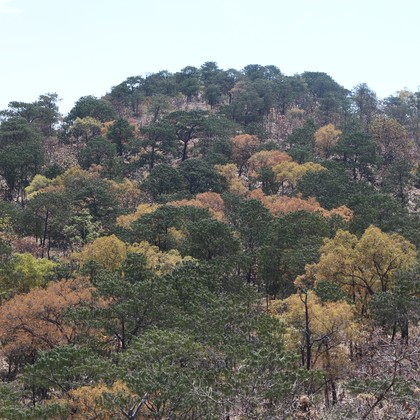
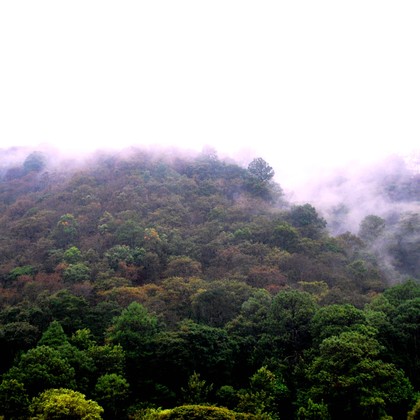
Open oak, pine-oak and pine woodland, forest edges and clearings with scattered trees in the mountains, mostly between 1500 and 3000 m; in winter also in juniper scrub, orchards and open country at lower elevations. It eats insects, caught from a low branch on the ground, and in winter mainly berries of mistletoe, juniper and other plants. It nests in a tree cavity, often an old woodpecker hole.
Where the bird is most at home, classified by the vegetation units of Mexico and Central America.


Range and movements
Breeds in western North America, from south-western Canada to the south-western United States. In the guide area resident in the Sierra Madre Occidental, the Sierra Madre Oriental and on the central plateau of Mexico, south to Michoacán, Puebla and western Veracruz, and in the mountains of northern Baja California. In winter scattered in lower country in northern Mexico.
- Resident
- dark = core range, pale = thinly spread
How and when to look
Regularly seen in open pine-oak woodland along the road from Durango to Mazatlán and in the Sierra de San Pedro Mártir in Baja California. In winter often in small flocks at shrubs with mistletoe and berries.
Conservation status
Not threatened. Locally fairly common in open montane woodland; sensitive to the loss of old trees with cavities.
Scientific name
Sialia mexicana | Swainson, 1832
Swainson described the species in 1832 and placed it straight away in the genus where it still stands. The genus Sialia was introduced in 1827 by Swainson. Sialia comes from Greek sialis, an unidentified bird mentioned by Athenaeus and Hesychius, so called from its cry. mexicana is Latin for 'Mexican', after the origin of the first described specimen. The specimen the first description was based on came from Mexican Plateau (not specified further).