All species › Passerines › Thrushes and allies › Mountain Bluebird
Position in the tree Birds Aves › Birds with a flexible palate Neognathae › All other modern birds Neoaves › Landbirds Telluraves › Falcons, parrots and passerines Australaves › Falcons and passerines Eufalconimorphae › Parrots and passerines Psittacopasserae
Mountain Bluebird | Sialia currucoides
Bergsialia | Azulejo pálido
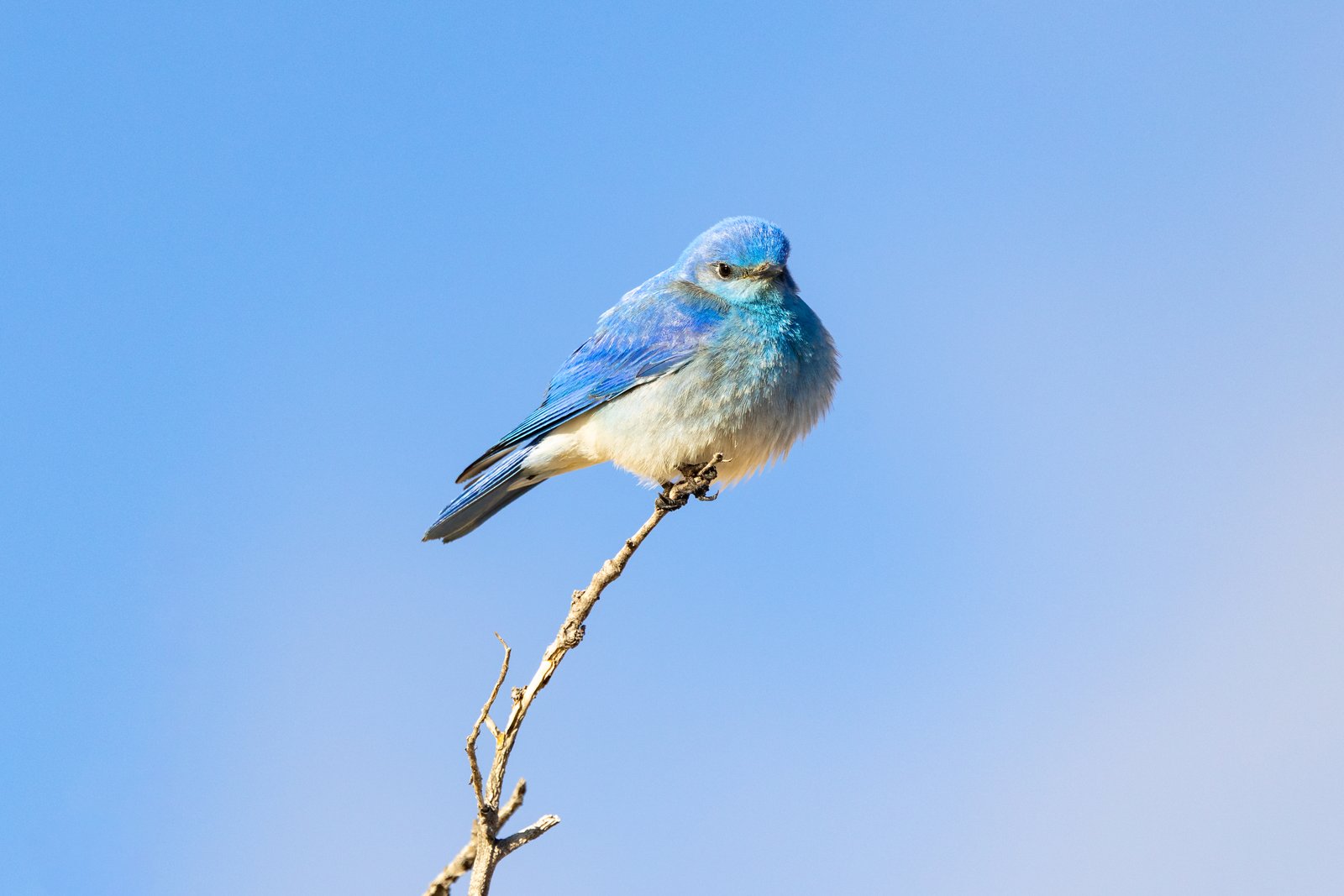
The Mountain Bluebird is a slender, long-winged thrush of open grassland and shrub plains. The male is entirely sky-blue with no orange. It often hunts by hovering over the grass and then drops onto prey. In the guide area it is a winter visitor to northern Mexico, sometimes in flocks of dozens of birds.
Voice
In winter mainly a soft, slightly hoarse chur or a thin few, often in flight. Rarely sings in the guide area.
Recording: Paul Marvin — CC BY-NC-SA 4.0 · shortened to the first 60 s, mono · xeno-canto
Identification
16–20 cm. Slimmer and longer-winged than the other bluebirds, with a slightly longer, thin bill and a fairly long tail. Male sky-blue above, paler blue below with a whitish belly. Female grey-brown with a white eye-ring, blue wings and tail and a greyish breast, sometimes with a faint buff tinge. The long wing tips reach well beyond the base of the tail.
Confusion species
Males of Western Bluebird Sialia mexicana and Eastern Bluebird Sialia sialis have a chestnut or orange breast. Females of those species have a more distinctly orange breast, shorter wings and a stockier build. A female Mountain Bluebird can recall Townsend's Solitaire Myadestes townsendi, but that species is larger, longer-tailed, and has buff wing bands and white outer tail feathers.
Habitat
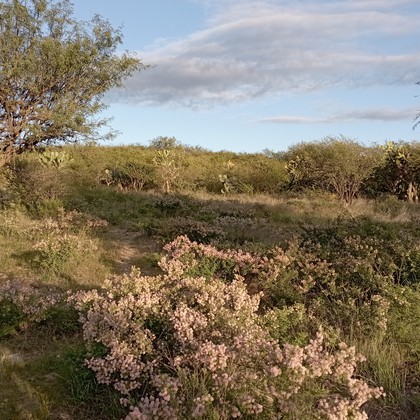
In winter open grassland, semi-desert grassland, shrub plains with juniper, fields, pasture and fallow land, from lowlands to high plateaus. It hunts insects by hovering or from a low perch; in winter it also eats many berries, especially of juniper and mistletoe. It wanders in flocks.
Where the bird is most at home, classified by the vegetation units of Mexico and Central America.


Range and movements
Breeds in western North America, from Alaska and western Canada to the south-western United States. Winters from the south-western United States to northern Mexico. In the guide area mainly in northern Baja California, Sonora, Chihuahua, Coahuila and Durango, more scarcely south to Zacatecas and San Luis Potosí; numbers vary greatly from year to year.
- Winter visitor (c. Oct–Mar)
- dark = core range, pale = thinly spread
How and when to look
In winter best found in the grasslands around Janos in north-western Chihuahua, where flocks perch on fence posts and wires along the roads or hover over the grass.
Conservation status
Not threatened. Widespread in North America; in the guide area a winter visitor in varying numbers. Conversion of grassland to farmland reduces the suitable wintering habitat.
Scientific name
Sialia currucoides | (Bechstein, 1798)
Bechstein described the species in 1798 as Motacilla s. Sylvia Currucoides; because it was later moved to another genus, the author and year stand in brackets. The genus Sialia was introduced in 1827 by Swainson. Sialia comes from Greek sialis, an unidentified bird mentioned by Athenaeus and Hesychius, so called from its cry. currucoides means 'resembling curruca', from Linnaeus's name for the Lesser Whitethroat and the Greek -oidēs 'resembling'. The specimen the first description was based on came from western North America (not specified further).