All species › Passerines › Spindalises › Western Spindalis
Position in the tree Birds Aves › Birds with a flexible palate Neognathae › All other modern birds Neoaves › Landbirds Telluraves › Falcons, parrots and passerines Australaves › Falcons and passerines Eufalconimorphae › Parrots and passerines Psittacopasserae
Western Spindalis | Spindalis zena
Westelijke spindalis | Tángara cabeza rayada
The Western Spindalis is a small, stocky fruit-eater; the male has a black-and-white striped head. Its range is centred on the Bahamas, Cuba and Grand Cayman; in the guide area only a distinct subspecies on the island of Cozumel off Quintana Roo occurs. The spindalises together form their own family, Spindalidae.

Voice
The call is a very high, thin tseet. The song is a series of thin, high, insect-like notes, often given from a treetop.
Recording: FREDERIC Lionel — CC BY-NC-SA 4.0 · converted to mono · xeno-canto
Identification
15–17 cm. Male with black head and two broad white stripes: a supercilium and a stripe below the eye. Throat yellow with a narrow black central stripe; nape, breast and rump orange to rusty orange, belly greyish white. Back olive-green. Wings black with white edges and a white patch at the base of the primaries; tail black with white in the outer feathers. The female is dull olive-grey, with faint pale stripes on the head and a small white wing patch. Bill short, conical and grey.
Confusion species
On Cozumel the male has no real look-alike. Bananaquit Coereba flaveola also has a dark head with a white supercilium and a yellow breast, but is smaller, with a thin, curved bill and no orange. The female may resemble a female Summer Tanager Piranga rubra, which winters on Cozumel, but that species is larger and plain yellowish olive, with a heavier, pale bill and no head stripes.
Habitat
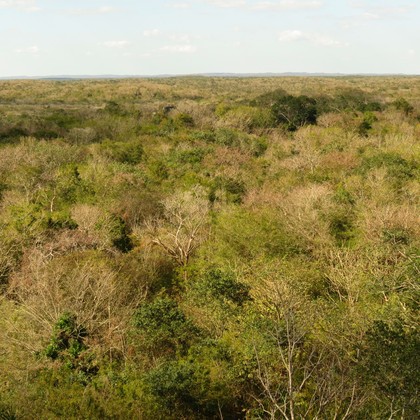
Semi-deciduous forest, forest edges, scrub, gardens and yards with fruit trees on Cozumel. It eats mainly fruit and berries, supplemented by flowers, buds and insects; it often gathers with other fruit-eaters in fruiting trees.
Where the bird is most at home, classified by the vegetation units of Mexico and Central America.


Range and movements
Bahamas, Cuba and Isla de la Juventud, Grand Cayman and Cozumel; exceptionally in southern Florida. In the guide area only on Cozumel (Quintana Roo), where a distinct subspecies lives.
- Resident
- dark = core range, pale = thinly spread
How and when to look
On Cozumel best found at fruiting trees along forest edges and in gardens, for example around the ruins of San Gervasio and at El Cedral; often first detected by its high call.
Conservation status
Not threatened (LC). On Cozumel a fairly common resident; hurricanes can temporarily cause severe damage to the forest and fruit trees.
Scientific name
Spindalis zena | (Linnaeus, 1758)
Linnaeus described the species in 1758 as Fringilla Zena; because it was later moved to another genus, the author and year stand in brackets. The genus Spindalis was introduced in 1837 by Jardine & Selby. Spindalis comes from the Greek spindalos or pindalos, an unidentified Indian bird said to be akin to the attagas (a gamebird). zena comes from the Greek zēna or zēnē, a kind of finch, probably the European Goldfinch. The specimen the first description was based on came from New Providence, Bahamas.