All species › Passerines › Wrens › White-bellied Wren
Position in the tree Birds Aves › Birds with a flexible palate Neognathae › All other modern birds Neoaves › Landbirds Telluraves › Falcons, parrots and passerines Australaves › Falcons and passerines Eufalconimorphae › Parrots and passerines Psittacopasserae
White-bellied Wren | Uropsila leucogastra
Witbuikwinterkoning | Chivirín vientre blanco
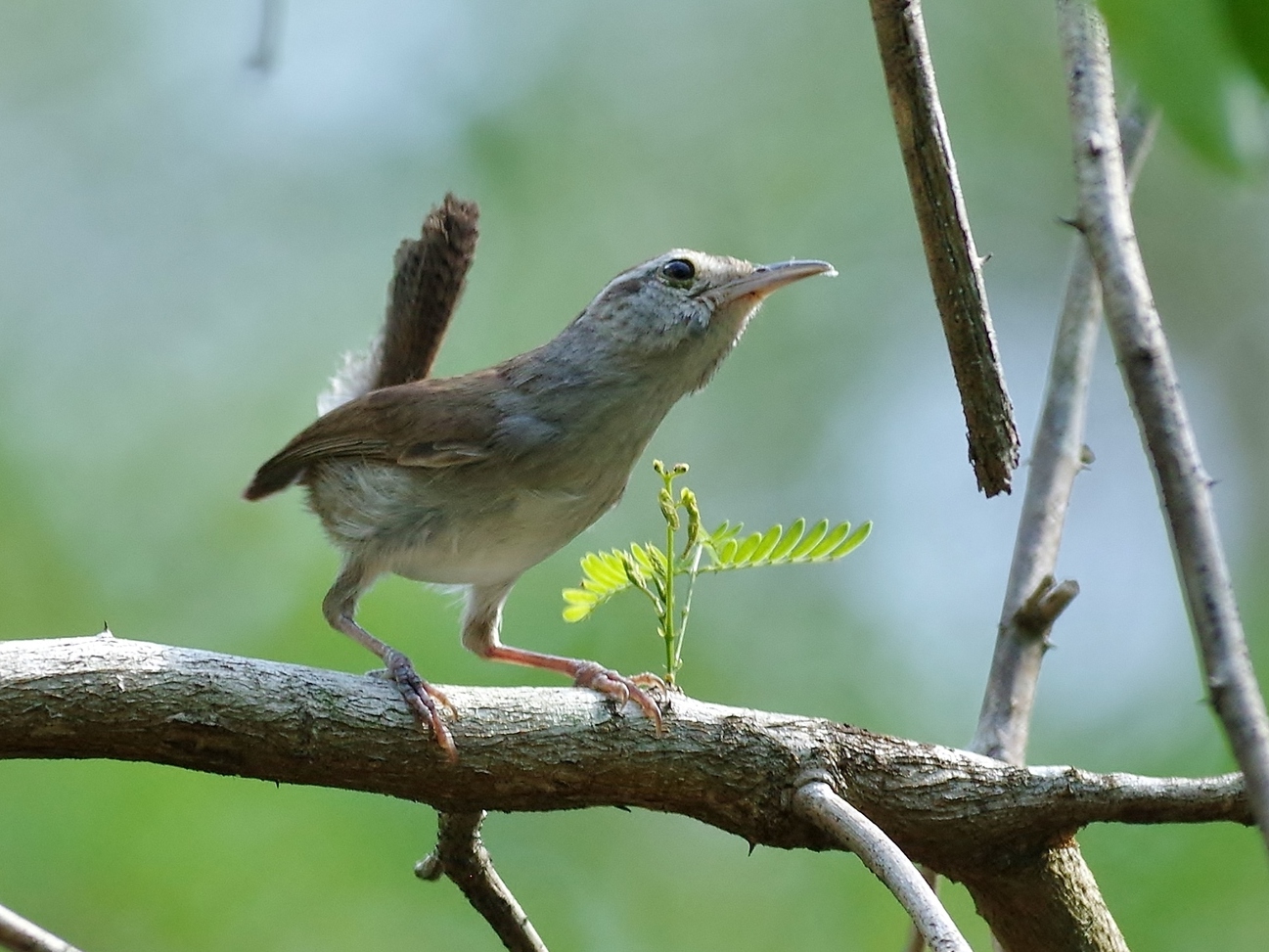
The White-bellied Wren is a small greyish-brown wren with white underparts and a white supercilium, the only species in the genus Uropsila. It lives in dry and humid lowland forest and scrub, mainly on the Gulf slope of Mexico and the Yucatán Peninsula. Pairs often sing antiphonally from dense cover.
Voice
A loud, clear song of short, varied whistled phrases, often in duet. Calls include a dry, rattling chatter and sharp ticking notes.
Recording: Whitney Neufeld-Kaiser — CC BY-NC-SA 4.0 · converted to mono · xeno-canto
Identification
9–10 cm. Upperparts greyish brown, wings and short tail with dark bars; the tail is often cocked. A narrow white supercilium above a dark eye-stripe, cheeks white with fine dark streaks. Underparts mostly white, flanks and undertail coverts buffy brown, the undertail coverts barred dark. Bill thin and fairly short. Male and female are alike.
Confusion species
Southern House Wren Troglodytes musculus and Northern House Wren Troglodytes aedon are browner, with buffy-brown underparts and a faint supercilium. White-breasted Wood Wren Henicorhina leucosticta has a very short tail and a black-and-white streaked face, and lives on the forest floor. Spot-breasted Wren Pheugopedius maculipectus is larger and has a black-spotted breast.
Habitat
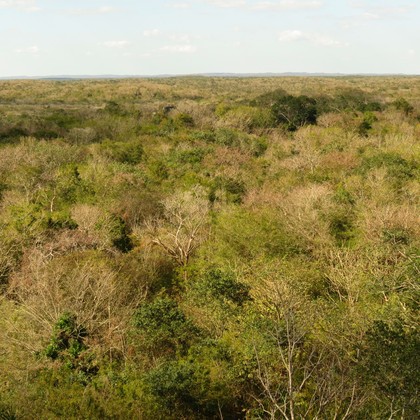
Undergrowth and lower levels of dry and semi-deciduous forest, humid lowland forest, mature secondary forest, gallery forest and dense scrub, from sea level to about 1000 m. It forages in dense shrubs and vine tangles for insects and spiders. Builds a domed nest in a shrub.
Where the bird is most at home, classified by the vegetation units of Mexico and Central America.




Range and movements
Gulf slope of Mexico from the north-east, through the Yucatán Peninsula to Belize and northern Guatemala, with isolated populations on the Pacific slope of western Mexico and in Honduras. Does not occur outside the guide area.
- Resident
- dark = core range, pale = thinly spread
How and when to look
Regularly heard in dry forest on the Yucatán Peninsula, for example around Calakmul and in the Petén. The loud duet gives the birds away, and they then often show themselves low in the vegetation.
Conservation status
Not threatened. Fairly common in suitable forest and scrub; declines where forest is cleared completely.
Scientific name
Uropsila leucogastra | (Gould, 1837)
Gould described the species in 1837 as Troglodytes leucogastra; because it was later moved to another genus, the author and year stand in brackets. The genus Uropsila was introduced in 1873 by Sclater & Salvin. Uropsila is Greek, from oura 'tail' and psilos 'slender', after the short, thin tail. leucogastra is Greek, from leukos 'white' and gastēr 'belly', after the white belly. The specimen the first description was based on came from Tamaulipas, Mexico.