All species › Passerines › Nuthatches › White-breasted Nuthatch
Position in the tree Birds Aves › Birds with a flexible palate Neognathae › All other modern birds Neoaves › Landbirds Telluraves › Falcons, parrots and passerines Australaves › Falcons and passerines Eufalconimorphae › Parrots and passerines Psittacopasserae
White-breasted Nuthatch | Sitta carolinensis
Witborstboomklever | Sita pecho blanco
The White-breasted Nuthatch is the largest nuthatch of the guide area, with a black crown and a clean white face and breast. Like all nuthatches it climbs both upwards and head-first down trunks and branches. In Mexico it is a resident of montane oak and pine-oak forest.

Voice
Nasal, repeated calls such as yenk or yank. The song is a rapid series of even, whistled notes, wee-wee-wee-wee.
Recording: Richard E. Webster — CC BY-NC-SA 4.0 · shortened to the first 60 s, mono · xeno-canto
Identification
13–15 cm. Crown and nape glossy black in the male, duller and greyer in the female. Face around the eye and underparts white, undertail and rear flanks rusty. Back blue-grey, tail short with white in the outer feathers. Bill long, straight and pointed, with a slightly upturned lower mandible.
Confusion species
Pygmy Nuthatch Sitta pygmaea is much smaller, with a greyish-brown cap reaching the eye and buffy underparts. Red-breasted Nuthatch Sitta canadensis is smaller, with a black eyestripe, a white supercilium and rusty underparts.
Habitat
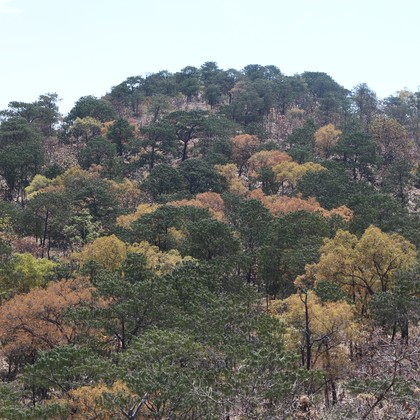
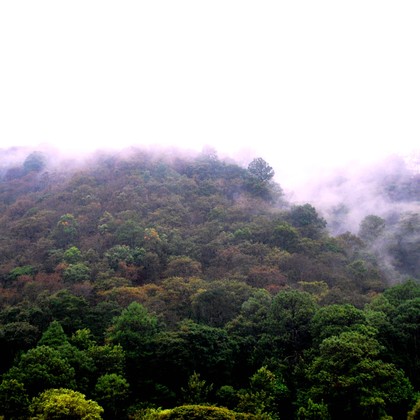
Open oak woodland and montane pine-oak forest, also riparian woodland with large trees and forest edges; especially where old oaks grow. It searches bark and branches for insects and their larvae and also eats seeds and acorns, which it sometimes wedges into bark crevices to hammer open. It nests in a tree cavity.
Where the bird is most at home, classified by the vegetation units of Mexico and Central America.


Range and movements
In the guide area in the mountains of Mexico: northern Baja California and the Sierra de la Laguna in the south of the peninsula, the Sierra Madre Occidental, the Sierra Madre Oriental and the Trans-Mexican Volcanic Belt, south to Oaxaca. Outside the guide area across much of the United States and southern Canada.
- Resident
- dark = core range, pale = thinly spread
How and when to look
Often found in mixed flocks with chickadees and warblers in oak woodland. Listen for the nasal call and look for a bird working head-first down a trunk.
Conservation status
Not threatened. Widespread and fairly common in suitable woodland.
Scientific name
Sitta carolinensis | Latham, 1790
Latham described the species in 1790 and placed it straight away in the genus where it still stands. The genus Sitta was introduced in 1758 by Linnaeus. Sitta is the Ancient Greek name sittē for the nuthatch. carolinensis means 'of Carolina', after the type locality in South Carolina. The specimen the first description was based on came from South Carolina, USA.