All species › Swifts › Swifts › White-chinned Swift
Position in the tree Birds Aves › Birds with a flexible palate Neognathae › All other modern birds Neoaves › Birds of the elements Elementaves › Nightjars and swifts Strisores
White-chinned Swift | Cypseloides cryptus
Witkingierzwaluw | Vencejo barbiblanco
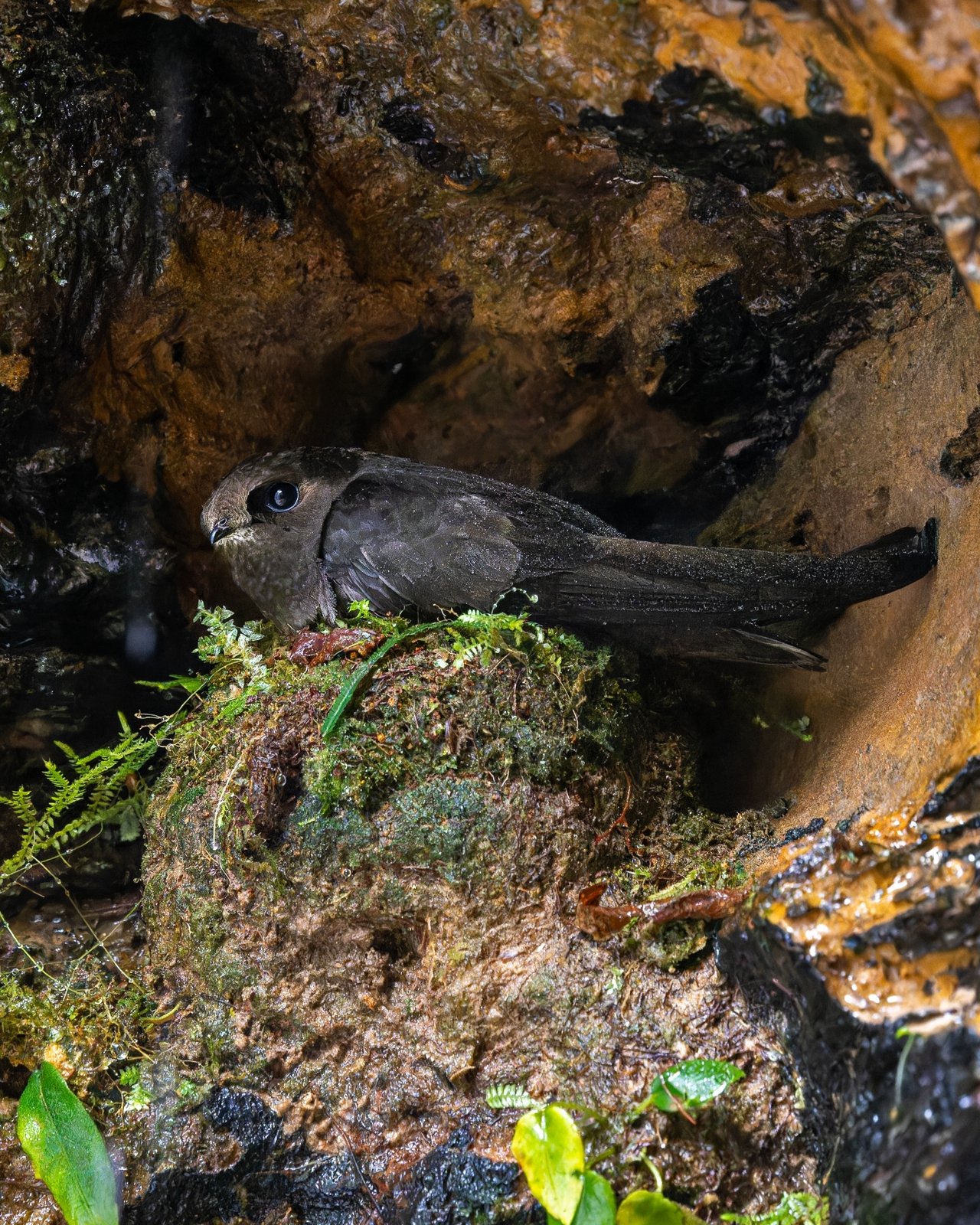
The White-chinned Swift is a stocky, dark swift that occurs very locally in the guide area from Belize to Panama. It often hunts among other swifts over forested hill country and nests behind waterfalls. The white chin that gives it its name can almost never be seen in the field, so many birds go unnoticed or cannot be identified to species.
Voice
A sharp, dry chip, chip, sometimes in quick series, and a short twitter in flocks; poorly known.
Recording: Otte Ottema — CC BY-NC-SA 3.0 · converted to mono · xeno-canto
Identification
14–15 cm, stocky, with a large head, broad-based wings and a short, square tail. The plumage is uniformly dark sooty brown, with a small white or whitish spot on the chin and often a slightly paler forehead; the chin spot is visible only at close range. Male and female are alike; juveniles have whitish fringes to the feathers of belly and undertail. The flight is powerful, with fast, shallow wingbeats alternating with short glides.
Confusion species
American Black Swift Cypseloides niger is slimmer, with narrower, longer wings and a longer tail. Spot-fronted Swift Cypseloides cherriei in Costa Rica and Panama is smaller, with white spots on the forehead and behind the eye. Female and juvenile Chestnut-collared Swifts Streptoprocne rutila without a collar have a slightly longer tail and are slimmer. Chaetura swifts, such as Grey-rumped Swift Chaetura cinereiventris, are smaller, with a pale rump and a shorter, spine-tipped tail.
Habitat
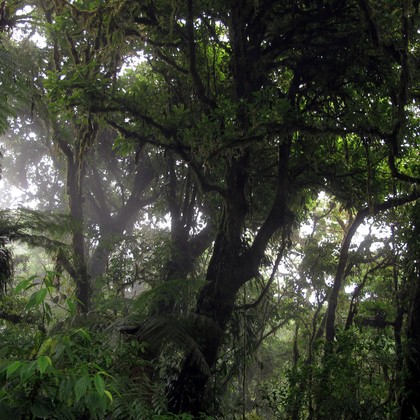
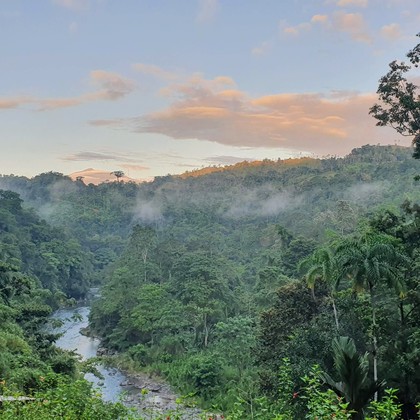
Hunts over humid lowland forest, foothill forest and montane rainforest, over river valleys and clearings near forest, mainly between about 300 and 1500 m, but in bad weather also over the lowlands. Feeds on flying insects. Nests on damp ledges behind or beside waterfalls and in gorges; the nest is a cup of moss and ferns with mud.
Where the bird is most at home, classified by the vegetation units of Mexico and Central America.



Range and movements
Very local on the Caribbean side of Central America. Records from Belize, mainly from the Maya Mountains in Cayo, from northern Honduras (Atlántida), eastern and southern Nicaragua, Costa Rica and Panama, there mainly in Bocas del Toro and Chiriquí and more scattered east to Darién. A few records are known from Guatemala. In Costa Rica on both the Caribbean and Pacific sides of the mountains. Outside the guide area locally from Colombia, Venezuela and the Guianas to Peru and Bolivia.
- Resident
- Summer visitor (c. Apr–Sep)
- Winter visitor (c. Oct–Mar)
- dark = core range, pale = thinly spread
How and when to look
Check flocks of dark swifts over forested valleys near waterfalls, for example in the Maya Mountains of Belize, in the hills of Bocas del Toro or around the volcanoes and foothills of Costa Rica. The compact build, large head and short, square tail are the best features; certainty usually comes only from a sharp photograph.
Conservation status
Not threatened. The species has a large, fragmented range and is scarce or poorly known everywhere. Deforestation of hill country around nest sites may be a local risk.
Scientific name
Cypseloides cryptus | Zimmer, 1945
Zimmer described the species in 1945 and placed it straight away in the genus where it still stands. The genus Cypseloides was introduced in 1848 by Streubel. Cypseloides combines Cypselus, an old genus name for swifts (Greek kupselos), with Greek -oidēs 'resembling': 'swift-like'. cryptus comes from Greek kruptos 'hidden'. The specimen the first description was based on came from Inca Mine, Río Távara, Peru.