All species › Swifts › Swifts › White-collared Swift
Position in the tree Birds Aves › Birds with a flexible palate Neognathae › All other modern birds Neoaves › Birds of the elements Elementaves › Nightjars and swifts Strisores
White-collared Swift | Streptoprocne zonaris
Witkraaggierzwaluw | Vencejo cuello blanco
The White-collared Swift is the most widespread large swift in the guide area. Flocks of tens to hundreds of birds sweep at high speed over mountains, valleys and lowlands, often ahead of approaching rain. They roost and nest in caves, gorges and behind waterfalls and travel long distances by day to their feeding areas; the rush of wings can be heard from low-flying flocks.

Voice
Flocks are noisy. Besides a nasal twittering chee-chee-chee, there are scratchy tseet and chirrio calls and a hissing whiss-whiss; birds in a flock often call together.
Recording: Ricardo José Mitidieri — CC BY-NC-SA 4.0 · converted to mono · xeno-canto
Identification
20–22 cm, large and heavily built, with long, broad, sickle-shaped wings and a short, slightly notched tail. The plumage is black with a faint blue gloss on the back. A white band runs right around the neck and is widest on the breast; at a distance mainly the white breast patch is visible. The sexes are alike. Juveniles are duller, with a narrower, incomplete or grey-mottled collar and pale feather edges.
Confusion species
White-naped Swift Streptoprocne semicollaris of western and central Mexico is even larger and heavier and has only a white band on the nape, with no white on throat and breast. American Black Swift Cypseloides niger is smaller, slimmer and lacks a collar; juvenile White-collared Swifts with a faint collar resemble it, but remain larger and heavier. Chestnut-collared Swift Streptoprocne rutila is much smaller and has a chestnut collar. Martins, such as Grey-breasted Martin Progne chalybea, have broader wings, a forked tail and no white collar.
Habitat
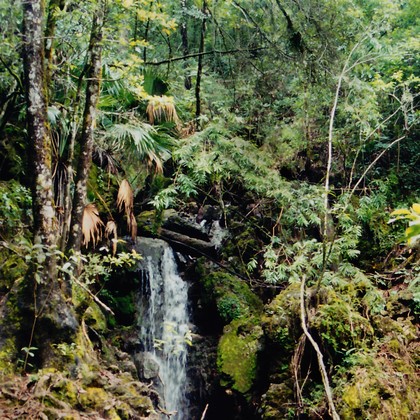
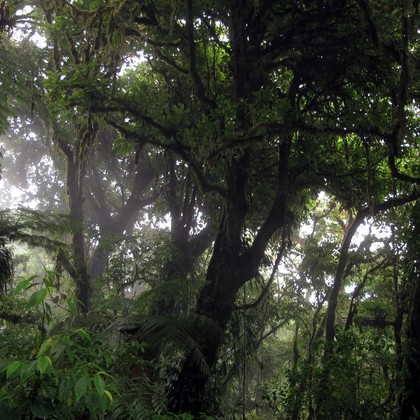
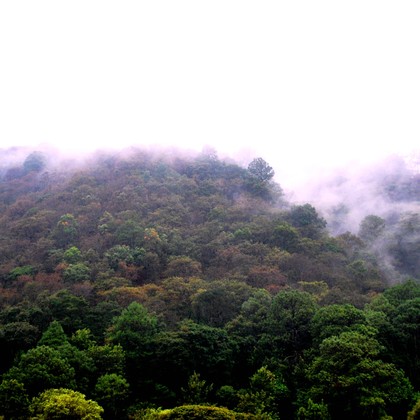
Over montane forest, cloud forest and pine-oak forest, but also hunting over lowland rainforest, foothill forest, savanna, farmland and towns, from sea level to above 3000 m. Feeds on flying insects, often in swarms pushed up ahead of storms. Nests in colonies on ledges in caves, gorges and behind waterfalls; the nest is a flat pad of mud, moss and plant material. Large roosts behind waterfalls are sometimes used by hundreds to thousands of birds.
Where the bird is most at home, classified by the vegetation units of Mexico and Central America.




Range and movements
In Mexico on the Gulf slope from southern Tamaulipas and San Luis Potosí through Hidalgo, Puebla and Veracruz to Tabasco and Chiapas, and on the Pacific slope from Nayarit and Jalisco through Colima and Guerrero to Oaxaca and Chiapas. Further in every country from Guatemala and Belize to Panama, there from Chiriquí to Darién. Largely absent from the dry north of Mexico and the Yucatán Peninsula. Outside the guide area in the Greater Antilles and Trinidad and in South America south to Bolivia, Brazil and northern Argentina.
- Resident
- dark = core range, pale = thinly spread
How and when to look
Seen over almost every forested mountain range in the guide area, for example the Central Valley and the volcanoes of Costa Rica, the mountains of Veracruz and Chiapas or the highlands of Guatemala. The best chances are in changeable weather, when flocks hunt over ridges and valleys ahead of showers; in the evening they arrive in large numbers at roosts by waterfalls.
Conservation status
Not threatened. The species has a very large range and is common in the guide area. Colonies and roosts in caves and behind waterfalls are sensitive to disturbance.
Scientific name
Streptoprocne zonaris | (Shaw, 1796)
Shaw described the species in 1796 as Hirundo zonaris; because it was later moved to another genus, the author and year stand in brackets. The genus Streptoprocne was introduced in 1906 by Oberholser. Streptoprocne is Greek, from streptos 'collar' and Procne, the figure of Greek myth turned into a swallow, after the coloured collar. zonaris is Latin for 'belted', from zona 'girdle, band', after the white collar. The specimen the first description was based on came from Brazil (assumed, not specified).