All species › Passerines › New World sparrows › White-crowned Sparrow
Position in the tree Birds Aves › Birds with a flexible palate Neognathae › All other modern birds Neoaves › Landbirds Telluraves › Falcons, parrots and passerines Australaves › Falcons and passerines Eufalconimorphae › Parrots and passerines Psittacopasserae
White-crowned Sparrow | Zonotrichia leucophrys
Witkruingors | Chingolo coroniblanco
The White-crowned Sparrow is a large, grey-breasted sparrow with a conspicuous black-and-white striped head. It breeds in Alaska, Canada and the mountains and coastal regions of the western United States. In winter it is one of the most numerous sparrows of northern Mexico.

Voice
The song begins with one or two clear whistles, followed by a series of buzzy trills and chirps; regularly heard in winter. The call is a sharp, metallic pink and a thin tseet.
Recording: Don Profota — CC BY-NC-SA 4.0 · converted to mono · xeno-canto
Identification
15–17 cm. Large and slender, with a fairly long tail and a pink, orangey or yellow bill. Adults have a head with broad black and white stripes: a white median crown-stripe, black lateral crown-stripes, a white supercilium and a black eye-stripe. Throat, nape and breast plain grey, flanks pale brown. Back greyish brown with dark streaks, two narrow white wing-bars. Young birds in their first winter show the same head pattern in brown and buff.
Confusion species
White-throated Sparrow Zonotrichia albicollis has a sharply defined white throat, a yellow spot in front of the eye and a grey bill. Golden-crowned Sparrow Zonotrichia atricapilla has a yellow forecrown and no white head-stripes. Lark Sparrow Chondestes grammacus has a chestnut-and-white striped head, a black breast spot and white corners to the tail.
Habitat
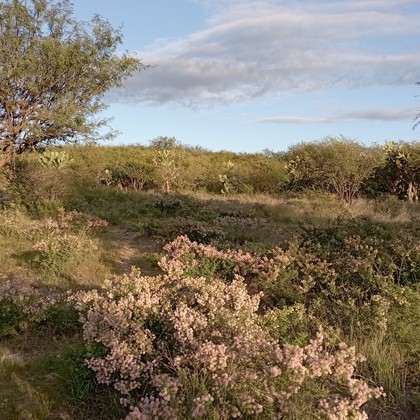
In winter open, dry country with shrubs: high-plateau scrub, semi-desert grassland with bushes, thorn scrub, hedgerows, field edges, pasture, riverside thickets and gardens. It lives in flocks, often with other sparrows, and takes seeds and insects on the ground, usually close to cover.
Where the bird is most at home, classified by the vegetation units of Mexico and Central America.




Range and movements
Breeds in Alaska and northern Canada, in the Rocky Mountains and other mountains of the western United States and along the Pacific coast into California. Winters in the southern and western United States and in Mexico. In the guide area mainly in the north and on the central plateau, from Baja California to Tamaulipas and south to Jalisco, Guanajuato and Hidalgo; scarce further south.
- Winter visitor (c. Oct–Mar)
- dark = core range, pale = thinly spread
How and when to look
In winter on the plateau of northern Mexico often in flocks along the scrubby edges of fields and roadsides; the clear head-stripes and grey breast make it easy to pick out among other sparrows.
Conservation status
Least Concern (LC). Widespread and numerous, but in North America it has declined over the long term. In the guide area a common winter visitor in the north.
Scientific name
Zonotrichia leucophrys | (Forster, 1772)
Forster described the species in 1772 as Emberiza leucophrys; because it was later moved to another genus, the author and year stand in brackets. The genus Zonotrichia was introduced in 1832 by Swainson. Zonotrichia is Greek, from zōnē 'band' and thrix 'hair'. leucophrys is Greek, from leukos 'white' and ophrus 'eyebrow', after the white stripe above the eye. The specimen the first description was based on came from the Severn River, Hudson Bay.