All species › Pelicans, herons and ibises › Ibises and spoonbills › White-faced Ibis
Position in the tree Birds Aves › Birds with a flexible palate Neognathae › All other modern birds Neoaves › Birds of the elements Elementaves › Tropicbirds and waterbirds Phaethoquornithes › Core waterbirds Aequornithes
White-faced Ibis | Plegadis chihi
Witmaskeribis | Morito cariblanco
The White-faced Ibis is a dark ibis with a long, decurved bill and, in breeding plumage, a white border around a red face. It is the western counterpart of the Glossy Ibis. In Mexico it breeds locally on the plateau and in coastal marshes, and in winter large numbers arrive from western North America; further south it is rare.

Voice
Usually silent. In flight and at the colony a low, quacking grrr or ka-onk and soft grunting.
Recording: Manuel Grosselet — CC BY-NC-SA 4.0 · converted to mono · xeno-canto
Identification
46–56 cm. A slender, dark ibis with long legs and a long, decurved bill. Adults in breeding plumage are chestnut with a green and purple metallic gloss on the wings and back. The bare facial skin is pink to red and surrounded by a broad white border of small feathers that continues behind the eye and under the chin. The eye is red and the legs are reddish. Outside the breeding season the white border is largely absent, the head and neck are dark with fine white streaks and the facial skin is dull pink; the eye remains red. Juveniles are duller, with a brown eye. It flies with the neck outstretched in lines or V-formations, often in large flocks.
Confusion species
Glossy Ibis Plegadis falcinellus has a dark eye, dark facial skin with thin pale blue borders that do not continue behind the eye, and grey-green legs. In juveniles and winter birds separation is often difficult, and eye colour and facial skin are decisive. Young American White Ibises Eudocimus albus have a white belly and rump. Long-billed Curlew Numenius americanus is pale brown and has an even longer, thinner bill.
Habitat
Freshwater marshes, shallow lakes, wet grasslands, rice fields, irrigated farmland, flooded pastures and the edges of saline and alkaline lakes; in winter also coastal marshes and lagoons. It forages in flocks, probing mud and shallow water for insects, earthworms, crustaceans and small fish. It breeds in colonies in dense marsh vegetation such as bulrushes and cattails, or in low shrubs over water.
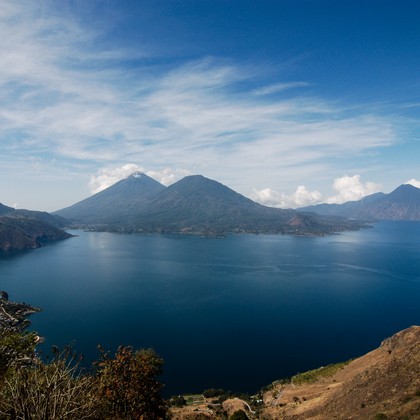
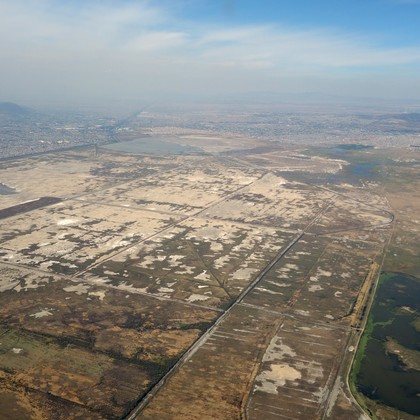
Where the bird is most at home, classified by the vegetation units of Mexico and Central America.




Range and movements
Breeds at a number of sites in Mexico, mainly in marshes and at lakes on the central plateau, for example in Jalisco, Michoacán, Guanajuato and Durango, and locally in coastal marshes. In winter widespread in Mexico, from Baja California and Sonora to Tamaulipas and south to Oaxaca and Chiapas, on the plateau and along both coasts. Rare in Central America, mainly in winter, with records south to Costa Rica. Outside the guide area in the western United States and in South America, in Bolivia, Paraguay, southern Brazil, Uruguay, Argentina and Chile.
- Resident
- dark = core range, pale = thinly spread
How and when to look
Marshes and lakes on the plateau of Jalisco and Michoacán, for example around Lake Chapala and Laguna de Cuitzeo, and irrigated farmland in the north-west give the best chance, especially in winter. In good light the red eye and pink face can be seen outside the breeding season too.
Conservation status
Not threatened. The species has recovered strongly after a decline in the mid-twentieth century caused by pesticides and the loss of wetlands. In Mexico the breeding sites are sensitive to drainage and changes in water level.
Scientific name
Plegadis chihi | (Vieillot, 1817)
Vieillot described the species in 1817 as Numenius chihi; because it was later moved to another genus, the author and year stand in brackets. The genus Plegadis was introduced in 1829 by Kaup. Plegadis is Greek, from plēgas, plēgados 'sickle', after the curved bill. chihi is an onomatopoeic name given to the bird by Vieillot in 1817, based on Félix de Azara's description from Paraguay. The specimen the first description was based on came from Paraguay and the grasslands of Buenos Aires, Argentina.