All species › Pelicans, herons and ibises › Ibises and spoonbills › Glossy Ibis
Position in the tree Birds Aves › Birds with a flexible palate Neognathae › All other modern birds Neoaves › Birds of the elements Elementaves › Tropicbirds and waterbirds Phaethoquornithes › Core waterbirds Aequornithes
Glossy Ibis | Plegadis falcinellus
Zwarte ibis | Morito común
The Glossy Ibis is a dark ibis with a long, decurved bill, glossed chestnut and metallic green in good light. It is the most widespread ibis in the world. In the guide area it is scarce and local but has increased in numbers; it breeds at a few sites and also occurs as a wandering bird and winter visitor, mainly in eastern Mexico and Central America.

Voice
Usually silent. In flight and at the colony a low, hoarse, grunting graa or krrr, and soft quacking.
Recording: Xavier Riera — CC BY-NC-SA 4.0 · converted to mono · xeno-canto
Identification
48–66 cm. A slender ibis with long legs and a long, decurved bill. Adults in breeding plumage are deep chestnut on the head, neck and body, with a metallic green and purple gloss on the wings and back. The bare facial skin between eye and bill is dark slate, bordered above and below by a thin, pale blue line that does not continue behind the eye. The eye is dark brown. The bill is olive-brown, and the legs are green-grey with red 'knees' in the breeding season. Outside the breeding season the head and neck are dark with fine white streaks and the pale blue lines are less distinct. Juveniles are duller brown, with less gloss. It flies with the neck outstretched in lines or flocks, on quick beats alternating with glides.
Confusion species
White-faced Ibis Plegadis chihi is very similar; adults have a red eye, pink to red facial skin and reddish legs, and in breeding plumage a broad white border that runs all round the face, including behind the eye. Outside the breeding season and in juveniles the two can often be told apart only by eye colour and the colour of the facial skin. Green Ibis Mesembrinibis cayennensis is stockier, with shorter legs, and lives in wooded swamps. Limpkin Aramus guarauna is brown with white spots.
Habitat
Freshwater and brackish marshes, wet grasslands, flooded pastures, rice fields, the shores of lakes and lagoons, and coastal marshes. It forages in flocks, often together with White-faced Ibises, American White Ibises and herons, probing mud and shallow water for insects, crustaceans and other small animals. It breeds in mixed colonies in shrubs, mangroves or reedbeds over water.
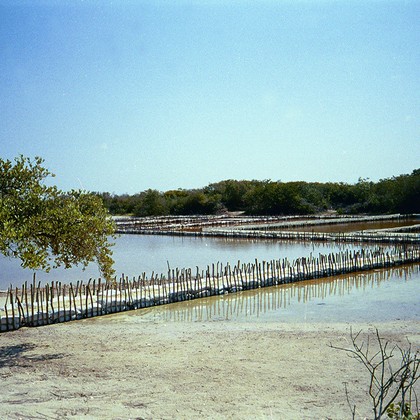
Where the bird is most at home, classified by the vegetation units of Mexico and Central America.



Range and movements
Mainly on the Gulf side of Mexico, from Tamaulipas through Veracruz and Tabasco to Campeche and the Yucatán Peninsula, and scattered in Central America, for example in Belize, Nicaragua and the lowlands of north-western and northern Costa Rica; rare in Panama. Rare on the Pacific side of Mexico. It breeds locally, but the breeding sites in the guide area are poorly known. Outside the guide area along the east coast of North America, in the Greater Antilles and scattered in northern South America, and further in Europe, Africa, southern Asia and Australia.
- Resident
- Summer visitor (c. Apr–Sep)
- Winter visitor (c. Oct–Mar)
- Passage (Mar–Apr, Oct–Nov)
- dark = core range, pale = thinly spread
How and when to look
Large lowland marshes and rice fields on the Gulf coast, for example in Tabasco and southern Veracruz, and the wetlands of north-western Costa Rica, such as Palo Verde, give the best chance. Check flocks of dark ibises carefully for eye colour and the colour of the facial skin.
Conservation status
Not threatened, but probably declining globally. In the guide area increasing and expanding its range. The species is sensitive to the drainage of wetlands and to pesticide pollution.
Scientific name
Plegadis falcinellus | (Linnaeus, 1766)
Linnaeus described the species in 1766 as Tantalus Falcinellus; because it was later moved to another genus, the author and year stand in brackets. The genus Plegadis was introduced in 1829 by Kaup. Plegadis is Greek, from plēgas, plēgados 'sickle', after the curved bill. falcinellus is a Latin diminutive of falx, falcis 'sickle': 'little sickle', likewise after the bill. The specimen the first description was based on came from Java and Sulawesi.