All species › Parrots › African and New World parrots › White-fronted Amazon
Position in the tree Birds Aves › Birds with a flexible palate Neognathae › All other modern birds Neoaves › Landbirds Telluraves › Falcons, parrots and passerines Australaves › Falcons and passerines Eufalconimorphae › Parrots and passerines Psittacopasserae
White-fronted Amazon | Amazona albifrons
Witvoorhoofdamazone | Loro frente blanca
The White-fronted Amazon is the smallest amazon of the guide area, with a white forehead, a blue crown and red around the eye. It lives in dry and semi-open country from north-western Mexico to Costa Rica and is one of the most frequently seen parrots in many places there.

Voice
Shrill, yapping cries, a rapidly repeated kek-kek-kek or yak-yak, mainly in flight; groups are noisy.
Recording: Barry Edmonston — CC BY-NC-SA 4.0 · shortened to the first 60 s, mono · xeno-canto
Identification
23–26 cm. Green with a short, square tail. The forehead is white, the crown behind it blue; the lores and eye-ring are red. The male has red primary coverts and a red alula, visible in flight as a red patch on the leading edge of the wing; in the female these are green and the white on the forehead is often smaller. In flight the flight feathers are blue. The bill is yellowish. Young birds have less white and red on the head.
Confusion species
Yucatan Amazon Amazona xantholora of the Yucatán Peninsula has yellow lores and a black ear patch. Red-lored Amazon Amazona autumnalis is larger, with a red forehead and yellow cheeks. Red-crowned Amazon Amazona viridigenalis and Lilac-crowned Amazon Amazona finschi are larger and have a red or dark red crown without white.
Habitat
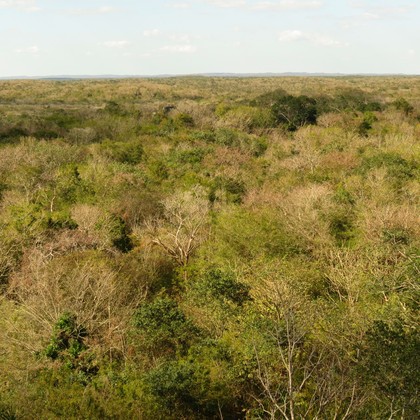
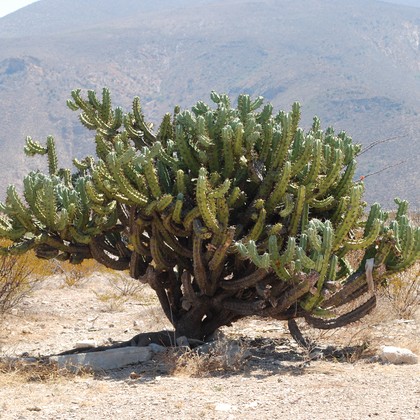
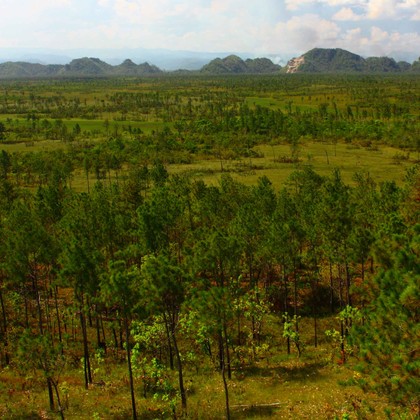
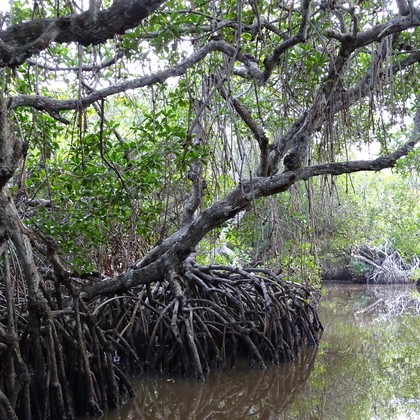
Dry forest, thorn scrub, open woodland, savanna with trees and pine savanna, mangroves, riverine forest and farmland with trees; from sea level to about 1800 m, commonest below 1000 m. It eats seeds, fruit and blossom and also visits maize fields. It nests in a cavity in a tree or cactus.
Where the bird is most at home, classified by the vegetation units of Mexico and Central America.



Range and movements
On the Pacific side from southern Sonora and Sinaloa through Nayarit, Jalisco, Guerrero, Oaxaca and Chiapas to Guatemala, El Salvador, Honduras and Nicaragua, south to Guanacaste in north-western Costa Rica. Also in the southern Gulf lowlands of Mexico (Veracruz, Tabasco) and throughout the Yucatán Peninsula into Belize and the Petén of Guatemala. Single birds and small groups in Mexico City and other cities are escaped or released birds.
- Resident
- dark = core range, pale = thinly spread
How and when to look
In dry country on the Pacific side and on the Yucatán Peninsula small groups fly over calling loudly in the morning and evening; in Guanacaste and around Mérida and Celestún they are often seen then.
Conservation status
Least Concern. Much trapped for the cage-bird trade, but remains common over a large area.
Scientific name
Amazona albifrons | (Sparrman, 1788)
Sparrman described the species in 1788 as Psittacus albifrons; because it was later moved to another genus, the author and year stand in brackets. The genus Amazona was introduced in 1830 by Lesson. Amazona comes from 'Amazone', the French name Buffon gave to various tropical American parrots because they came from the Amazon region. albifrons is Latin, from albus 'white' and frons 'forehead', after the white forehead. The specimen the first description was based on came from southwestern Mexico.