All species › Passerines › Tyrant flycatchers and allies › White-fronted Tyrannulet
Position in the tree Birds Aves › Birds with a flexible palate Neognathae › All other modern birds Neoaves › Landbirds Telluraves › Falcons, parrots and passerines Australaves › Falcons and passerines Eufalconimorphae › Parrots and passerines Psittacopasserae
White-fronted Tyrannulet | Acrochordopus zeledoni
Witkapvliegenpikker | Mosquerito frentiblanco
The White-fronted Tyrannulet is a small, scarce tyrant flycatcher of the canopy of montane forest, olive-green above and yellow below, with a white forehead and white eyebrow below a grey crown. It forages high in the trees for insects, often with mixed flocks, and is easily overlooked. In the guide area it lives in the mountains of Costa Rica and Panama.

Voice
High, thin whistled notes, often in short series; it is usually heard before it is seen.
Recording: Paul Driver — CC BY-NC-SA 4.0 · shortened to the first 60 s, mono · xeno-canto
Identification
11–12 cm, with a short, rather thick bill. Forehead and eyebrow white, crown grey, ear-coverts mottled grey and white. Back olive-green. Wings dark with two distinct yellowish wing-bars and yellow edges to the tertials. Throat whitish, breast yellow washed olive, belly yellow. Male and female are alike.
Confusion species
Sooty-headed Tyrannulet Phyllomyias griseiceps has a dark grey head without a white forehead and lacks distinct wing-bars. Mistletoe Tyrannulet Zimmerius parvus has yellow wing edges without wing-bars and greyish-white underparts. Rufous-browed Tyrannulet Phylloscartes superciliaris has a rufous eyebrow and white underparts.
Habitat
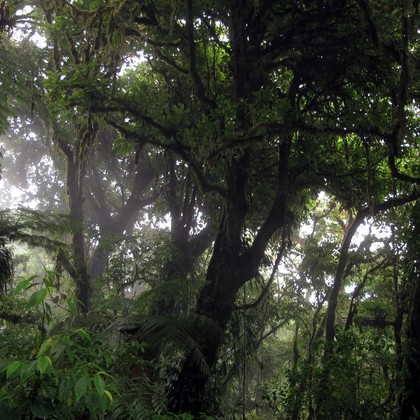
Canopy and edges of humid montane and foothill forest, mainly at middle elevations, also tall trees in clearings. It gleans insects from leaves and twigs, often with mixed flocks of other small songbirds.
Where the bird is most at home, classified by the vegetation units of Mexico and Central America.

Range and movements
In the guide area locally in the mountains of Costa Rica and Panama. Outside the guide area scattered in the Andes from Colombia to Peru and Bolivia and in the mountains of Venezuela; the division of these populations into species differs between sources.
- Resident
- dark = core range, pale = thinly spread
How and when to look
Scarce and inconspicuous; the best chance is by following mixed flocks in the canopy of mid-elevation montane forest in Costa Rica. The white forehead and yellow wing-bars are the key features.
Conservation status
Not threatened according to the global assessment. Scarce and local in the guide area; sensitive to loss of montane forest.
Scientific name
Acrochordopus zeledoni | (Lawrence, 1869)
Lawrence described the species in 1869 as Pogonotriccus (?) zeledoni; because it was later moved to another genus, the author and year stand in brackets. The genus Acrochordopus was introduced in 1905 by Berlepsch & Hellmayr. Acrochordopus is Greek, from akrokhordōn 'wart' and pous, podos 'foot', after the rough-scaled tarsi. zeledoni honours the Costa Rican ornithologist José Castulo Zeledón (1846–1923). The specimen the first description was based on came from Dota, Costa Rica.