All species › Birds of prey › Kites, Old World vultures, eagles and hawks › White-tailed Kite
Position in the tree Birds Aves › Birds with a flexible palate Neognathae › All other modern birds Neoaves › Landbirds Telluraves › Raptors, owls, kingfishers and woodpeckers Afroaves › Hawks and owls Hieraves
White-tailed Kite | Elanus leucurus
Amerikaanse grijze wouw | Milano cola blanca
The White-tailed Kite is a pale grey kite of open country, conspicuous for its hovering: it hangs in one place over the grass on rapidly beating wings with legs dangling before dropping onto a mouse. It occurs throughout the guide area, from Baja California to Panama, and has increased strongly with the clearing of forest and the creation of pasture and rice fields. Outside the breeding season dozens of birds sometimes roost together in a group of trees.
Voice
A soft, whistled kewt or keep, often repeated, and when alarmed a rasping, grating kerrak. Often heard around the nest and the roost.
Recording: José María Loaiza B. — CC BY-NC-SA 4.0 · converted to mono · xeno-canto
Identification
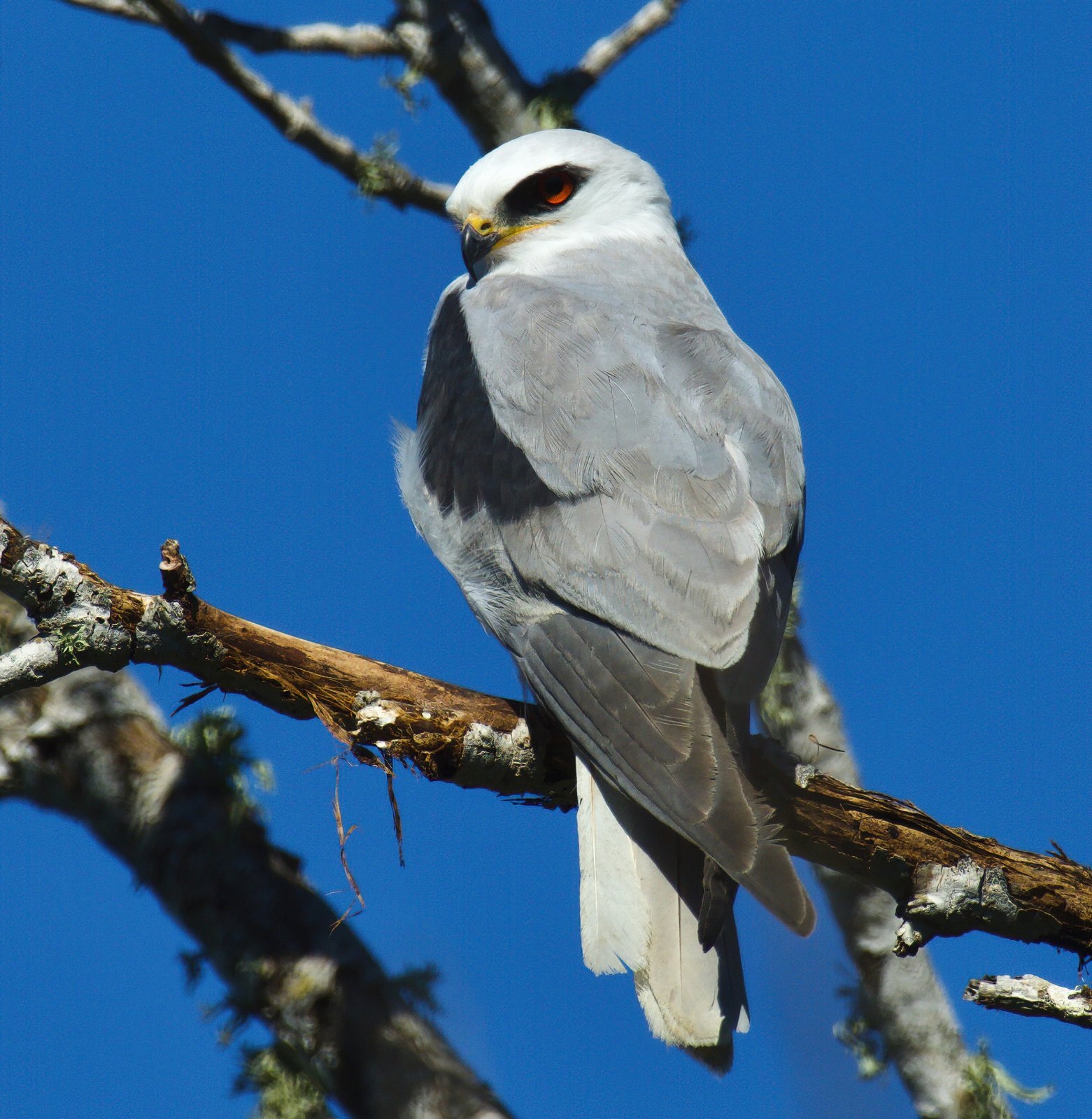
35–43 cm, with long, pointed wings and a fairly long white tail. The upperparts are pale grey, the head and underparts white. A large black patch lies on the shoulder; the eye is red with a small black mark in front of it. In flight a small black patch at the wrist is visible from below and the primaries are dark grey. Young birds have a brownish-streaked breast, a brown crown and a scaly brown-grey back with pale feather edges. Male and female are alike.
Confusion species
The male Northern Harrier Circus hudsonius flies low with wings in a shallow V, has a white rump, dark wingtips and a grey tail, and rarely hovers. The Mississippi Kite Ictinia mississippiensis has a black tail, grey head and underparts and does not hover. The Pearl Kite Gampsonyx swainsonii is much smaller and dark above.
Habitat
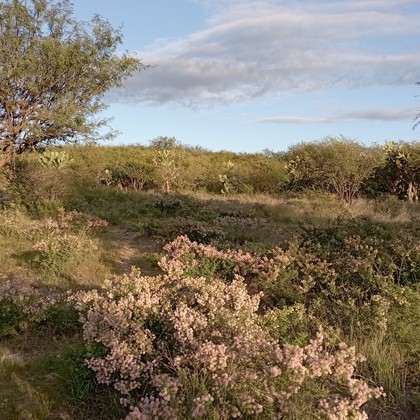
Open grassland, savanna, pasture with scattered trees, cropland, rice fields, marshes and wet grassland, from sea level to the plateaus of central Mexico. It nests in a loose, grass-lined bowl of sticks in the crown of an isolated tree or a copse. It hunts mainly mice and rats, less often lizards, frogs and large insects, which it locates while hovering.
Where the bird is most at home, classified by the vegetation units of Mexico and Central America.


Range and movements
Throughout the guide area in open country, from Baja California, Sonora and Tamaulipas across the plateaus and lowlands of Mexico to Panama; absent from closed forest and high mountains. In Central America it has spread widely since the mid-twentieth century with deforestation. Outside the breeding season birds wander and communal roosts form. Outside the guide area in the western and southern United States and in much of South America.
- Resident
- dark = core range, pale = thinly spread
How and when to look
Its hovering over pasture and roadsides in early morning and late afternoon makes it recognisable at long range, for example over the rice fields and pastures of the lowlands of Veracruz, Tabasco and Guanacaste. In the evening birds gather at communal roosts in trees along marshes and pastures.
Conservation status
Not threatened. In Central America the species benefits from the opening up of forest; locally it suffers from the use of agricultural pesticides.
Scientific name
Elanus leucurus | (Vieillot, 1818)
Vieillot described the species in 1818 as Milvus leucurus; because it was later moved to another genus, the author and year stand in brackets. The genus Elanus was introduced in 1809 by De Savigny. Elanus comes from Greek elanos, the name of a kite. leucurus is Greek, from leukos 'white' and oura 'tail', after the white tail. The specimen the first description was based on came from Paraguay.