All species › Swifts › Swifts › White-throated Swift
Position in the tree Birds Aves › Birds with a flexible palate Neognathae › All other modern birds Neoaves › Birds of the elements Elementaves › Nightjars and swifts Strisores
White-throated Swift | Aeronautes saxatalis
Bonte gierzwaluw | Vencejo pecho blanco
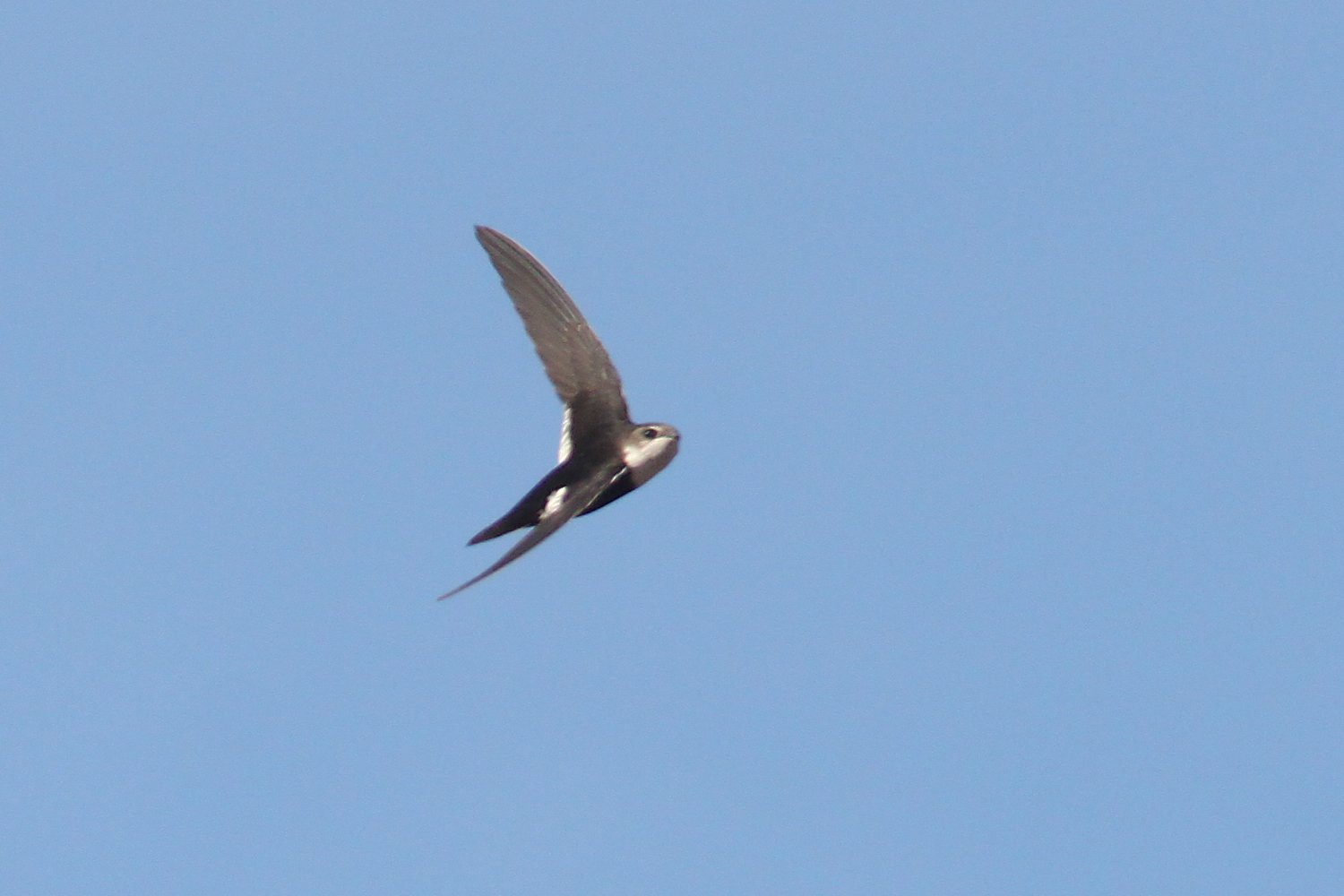
The White-throated Swift is a large, fast swift of the mountains and arid regions of western North America that ranges south through the highlands of Mexico to Honduras. Its black-and-white pattern, with a white throat and belly stripe and white flank patches, makes it easy to recognise. It nests in crevices in steep cliffs and canyons, sometimes also in buildings and bridges, and hunts in groups high in the air, often with loud, descending calls.
Voice
A loud, shrill, descending laugh, jee-jee-jee-je-je-je, often from groups hunting high over canyons or chasing each other around cliffs.
Recording: Paul Marvin — CC BY-NC-SA 4.0 · converted to mono · xeno-canto
Identification
15–18 cm. Slender, with long, narrow, sickle-shaped wings and a fairly long, slightly forked tail that is usually held closed and then looks pointed. The plumage is mostly blackish brown. The throat and centre of the breast are white, and the white continues as a narrow stripe onto the belly. There is a white flank patch on each side of the rump, and the secondaries have a narrow white trailing edge. Male and female are alike.
Confusion species
The Lesser Swallow-tailed Swift Panyptila cayennensis is smaller, with a deeply forked tail, a white throat and collar and no white belly stripe; it lives mainly in the lowlands. The Great Swallow-tailed Swift Panyptila sanctihieronymi has the same pattern as the Lesser Swallow-tailed Swift but is larger, with a very long, deeply forked tail. The White-collared Swift Streptoprocne zonaris is much larger, with a complete white collar and a short tail. The American Black Swift Cypseloides niger is entirely dark. The Violet-green Swallow Tachycineta thalassina also has white flank patches but is green above and entirely white below, with broader wings.
Habitat
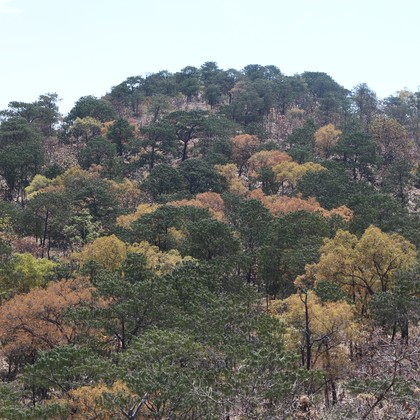
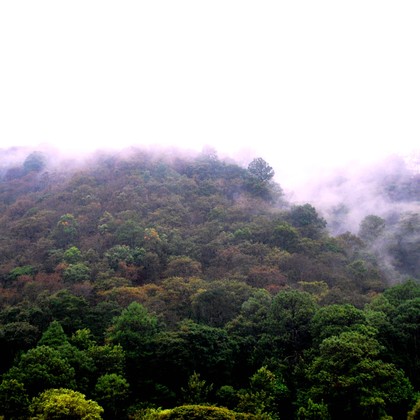
Mountains, canyons and gorges with steep cliffs, in desert, semi-desert, dry scrub and pine-oak forest, from about 500 to over 3000 m; also hunts over valleys, lakes and towns. Lower in winter. Nests and roosts in narrow crevices in cliffs and sometimes in buildings, bridges and dams; the nest is a cup of feathers and plant material glued with saliva.
Where the bird is most at home, classified by the vegetation units of Mexico and Central America.



Range and movements
In Mexico in the mountains of Baja California and the north of the country, the Sierra Madre Occidental and Sierra Madre Oriental, south over the central plateau and the mountains of Oaxaca and Chiapas. Further in the highlands of Guatemala, El Salvador and western and central Honduras; only a single record from Belize. Migrants from the western United States winter in northern and central Mexico. Outside the guide area in the western United States and extreme south-western Canada.
- Resident
- dark = core range, pale = thinly spread
How and when to look
Groups of hunting birds are regularly seen over the cliffs of Cañón de la Huasteca near Monterrey and other canyons in the Sierra Madre Oriental, and over Lake Atitlán in Guatemala. The loud, descending call is often the first sign; the white pattern of the underparts is best seen when the birds skim low along a cliff face.
Conservation status
Not threatened. The species has a large range. In the United States numbers have declined since the 1960s; no clear trends are known from the guide area.
Scientific name
Aeronautes saxatalis | (Woodhouse, 1853)
Woodhouse described the species in 1853 as Acanthylis saxatalis; because it was later moved to another genus, the author and year stand in brackets. The genus Aeronautes was introduced in 1892 by Hartert. Aeronautes is Greek, from aēr 'air' and nautēs 'sailor': 'air-sailor', after the fast, gliding flight. saxatalis is Latin for 'rock-dwelling' (saxum 'rock'), after the cliffs where it nests; the type came from Inscription Rock. The specimen the first description was based on came from Inscription Rock (El Morro), New Mexico, USA.