All species › Woodpeckers and allies › Woodpeckers › Williamson's Sapsucker
Position in the tree Birds Aves › Birds with a flexible palate Neognathae › All other modern birds Neoaves › Landbirds Telluraves › Raptors, owls, kingfishers and woodpeckers Afroaves › Mousebirds, rollers and woodpeckers Coraciimorphae › Trogons and cavity nesters Cavitaves › Hornbills, kingfishers and woodpeckers Picocoraciae › Kingfishers, bee-eaters and woodpeckers Picodynastornithes
Williamson's Sapsucker | Sphyrapicus thyroideus
Bergsapspecht | Chupasavia oscuro
Williamson's Sapsucker is a sapsucker of mountain coniferous forest in which male and female differ so much that they were described as two species in the nineteenth century. In the guide area it is mainly a winter visitor to the mountains of north-western and western Mexico; a small breeding population lives in the Sierra San Pedro Mártir in Baja California. Like other sapsuckers it drills rows of holes in bark and drinks the sap that flows from them.

Voice
A nasal, harsh churr or queeah, rougher than the mewing call of the other sapsuckers. The drum has the typical sapsucker rhythm: a short, fast opening that breaks into a few separate, slower taps. Seldom heard in winter.
Recording: Paul Marvin — CC BY-NC-SA 4.0 · shortened to the first 60 s, mono · xeno-canto
Identification
22–25 cm. The male is glossy black on the head, back and breast, with a white stripe behind the eye, a second white stripe from the base of the bill to the neck, a small red throat patch, a bright yellow belly and black-and-white barred flanks. A large white wing patch and a white rump stand out in flight. The female has a brown head, finely brown-and-black barred back, wings and flanks, a black breast patch and a yellow centre to the belly; she has a white rump but no white wing patch.
Confusion species
The male differs from Yellow-bellied, Red-naped and Red-breasted Sapsuckers in its black back, black crown and lack of red on the head apart from the throat patch. The female can resemble a small Northern Flicker Colaptes auratus, but that species is larger, has a spotted belly without yellow and coloured shafts in the wings and tail.
Habitat
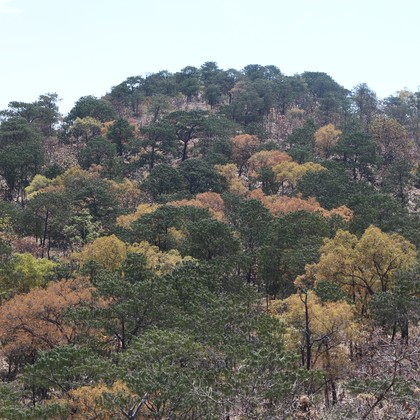
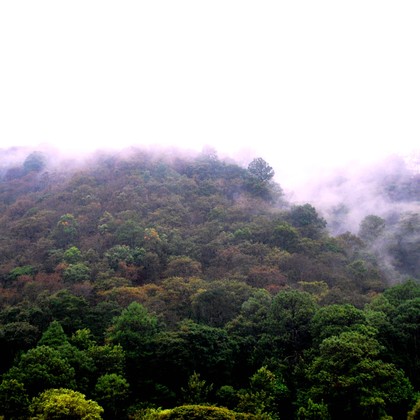
In winter pine-oak and pine forest in the mountains, mainly above about 1500 m, sometimes lower in forest edges and orchards. It takes sap mainly from conifers and also eats insects, especially ants, and some berries. In Baja California it breeds in open, dry coniferous forest with large pines. In winter it is solitary and often inconspicuous.
Where the bird is most at home, classified by the vegetation units of Mexico and Central America.

Range and movements
Breeds in the Sierra San Pedro Mártir in northern Baja California. In winter in the mountains of north-western Mexico, from Sonora and Chihuahua through Sinaloa, Durango and Zacatecas south to Jalisco and Michoacán; rare further east. Outside the guide area it breeds in the mountains of the western United States and southern British Columbia.
- Winter visitor (c. Oct–Mar)
- dark = core range, pale = thinly spread
How and when to look
In winter in the pine forests of the Sierra Madre Occidental, for example in Durango, and in the breeding season in the coniferous forest of the Sierra San Pedro Mártir. Fresh rows of holes in the bark of pines betray its presence.
Conservation status
Not threatened. The breeding population in Baja California is small and isolated.
Scientific name
Sphyrapicus thyroideus | (Cassin, 1852)
Cassin described the species in 1852 as Picus thyroideus; because it was later moved to another genus, the author and year stand in brackets. The genus Sphyrapicus was introduced in 1858 by Baird. Sphyrapicus combines Greek sphura 'hammer' with Picus 'woodpecker': 'hammer woodpecker'. thyroideus is Greek, from thureos 'large oblong shield' and -oidēs 'resembling', after the male's black breast patch. The specimen the first description was based on came from Georgetown, El Dorado County, California.