All species › Tubenoses › Southern storm petrels › Wilson's Storm Petrel
Position in the tree Birds Aves › Birds with a flexible palate Neognathae › All other modern birds Neoaves › Birds of the elements Elementaves › Tropicbirds and waterbirds Phaethoquornithes › Core waterbirds Aequornithes
Wilson's Storm Petrel | Oceanites oceanicus
Wilsons stormvogeltje | Paíño de Wilson
Wilson's Storm Petrel is a small, black-brown storm petrel with a white rump that breeds around Antarctica and on subantarctic islands. After the breeding season it moves north during the austral winter and spends the boreal summer in large parts of the Atlantic, Indian and Pacific Oceans. In the guide area it is a non-breeding visitor at sea, on both sides of the land, but in varying and poorly known numbers.
Voice
Usually silent at sea; feeding groups sometimes give a soft, squeaky twittering. In the colonies grating calls from the nest burrow.
Recording: Fabrice Schmitt — CC BY-NC-SA 4.0 · converted to mono · xeno-canto
Identification
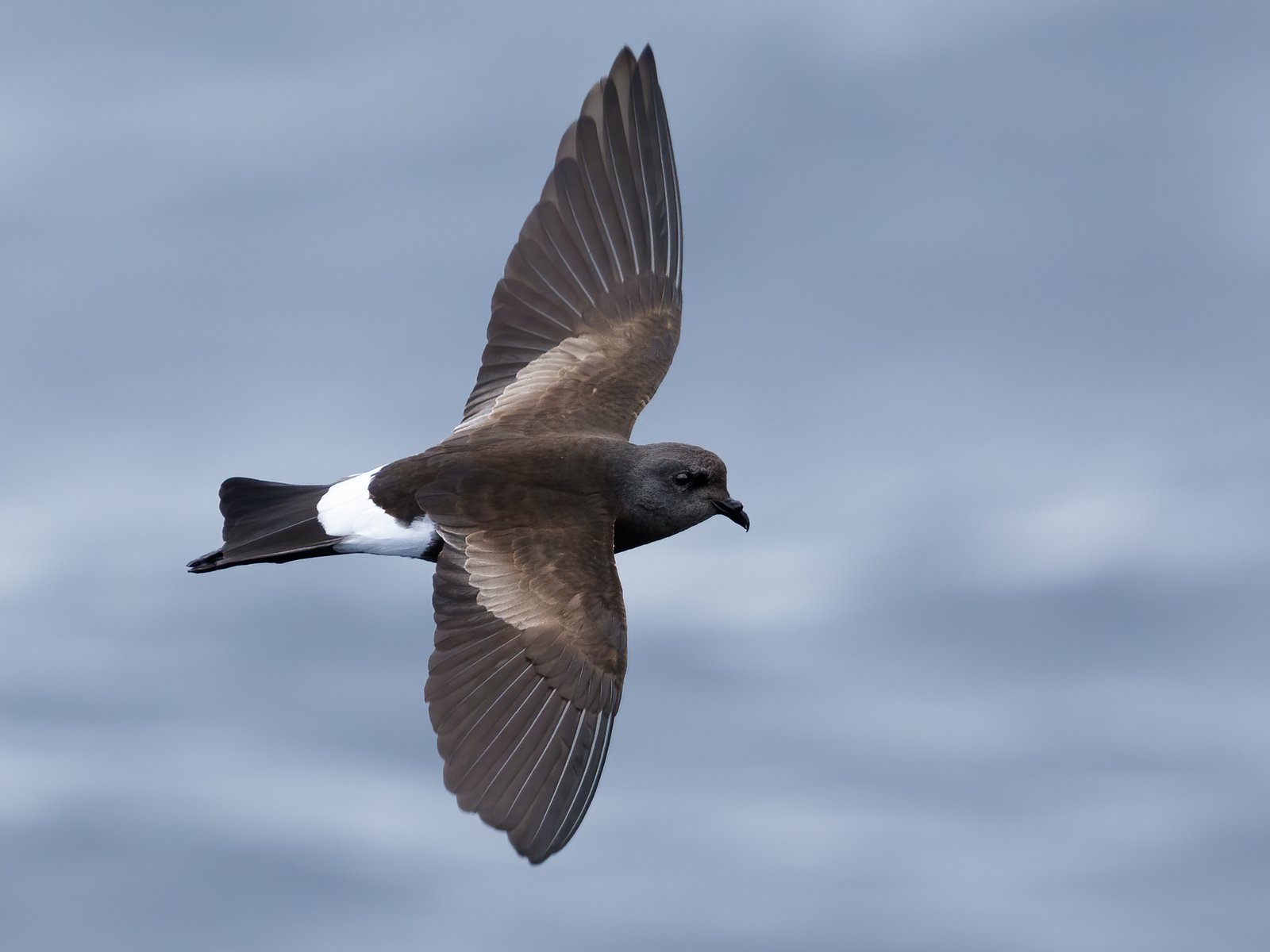
16–19 cm. A small storm petrel with short, fairly broad, rounded wings and a square tail. The plumage is black-brown, with a broad, pure white rump band that extends onto the sides of the undertail coverts. On the upperwing a faint, paler band across the secondary coverts. The long legs project beyond the tail in flight; the webs are yellow, but this is only visible at close range. It flies with fast, fluttering wingbeats and short glides, and when feeding holds the wings raised while the feet appear to patter over the water.
Confusion species
Leach's Storm Petrel Hydrobates leucorhous has longer, more angled wings, a forked tail, a narrower or divided white rump and a bounding flight; the feet do not project. Band-rumped Storm Petrel Hydrobates castro is larger, with longer wings, a narrower white rump band and no projecting feet. Wedge-rumped Storm Petrel Hydrobates tethys on the Pacific side has a large, triangular white rump.
Habitat
At sea, both far offshore over deep water and over the continental shelf, sometimes within sight of land. It picks small crustaceans, small fish and fatty particles from the water surface. It regularly follows ships and is attracted to oil, fish offal and other traces of food on the water.
Where the bird is most at home, classified by the vegetation units of Mexico and Central America.


Range and movements
In the guide area mainly recorded in the boreal summer, both in the Gulf of Mexico and the Caribbean Sea and in the Pacific. On the Pacific side reported off Mexico, Costa Rica and Panama, but irregularly. On the Gulf of Mexico and Caribbean side records are scarce and poorly known. Outside the guide area the species breeds on the Antarctic Peninsula and on subantarctic islands, and migrates north into the North Atlantic, the Indian Ocean and the Pacific.
- Passage (Mar–Apr, Oct–Nov)
- dark = core range, pale = thinly spread
How and when to look
Pelagic trips between May and September that use fish oil or offal to attract seabirds offer the best chance. The short, rounded wings, broad white rump and projecting feet are the best features.
Conservation status
Not threatened (LC). The species is counted among the most numerous seabirds in the world, but total numbers are poorly known. In the guide area a non-breeding visitor whose true numbers are uncertain because few observers go to sea.
Scientific name
Oceanites oceanicus | (Kuhl, 1820)
Kuhl described the species in 1820 as Procellaria oceanica; because it was later moved to another genus, the author and year stand in brackets. The genus Oceanites was introduced in 1840 by Keyserling & Blasius. Oceanites is Greek, Ōkeanitēs: an Oceanid, one of the sea nymphs held to be daughters of Oceanus and Tethys. oceanicus is Latin for 'of the ocean', after its life on the open sea. The specimen the first description was based on came from South Georgia.