All species › Tubenoses › Northern storm petrels › Band-rumped Storm Petrel
Position in the tree Birds Aves › Birds with a flexible palate Neognathae › All other modern birds Neoaves › Birds of the elements Elementaves › Tropicbirds and waterbirds Phaethoquornithes › Core waterbirds Aequornithes
Band-rumped Storm Petrel | Hydrobates castro
Madeirastormvogeltje | Paíño de Madeira
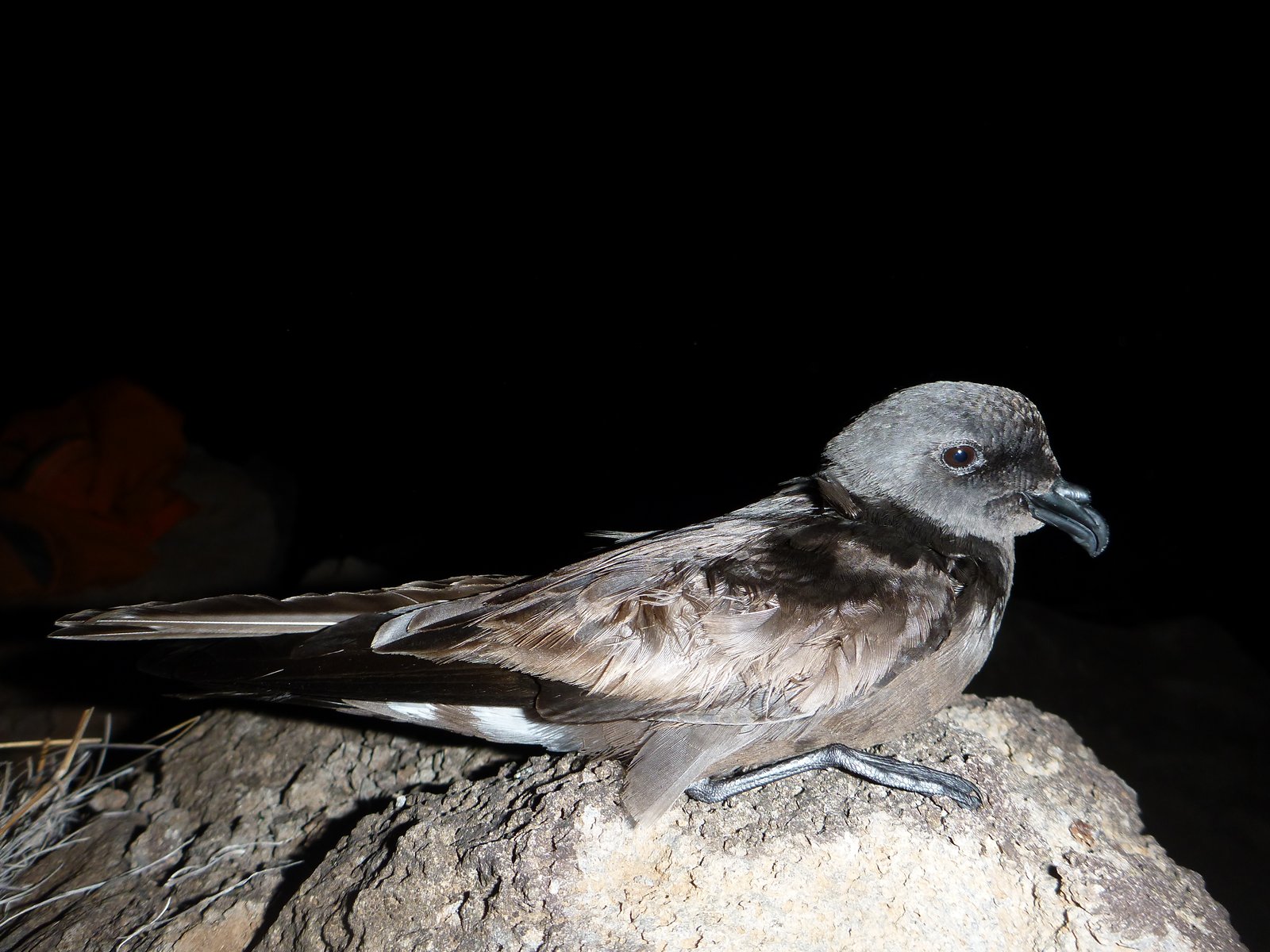
The Band-rumped Storm Petrel is a medium-sized, dark storm petrel with a broad white rump band and a steady, even flight. It breeds on remote oceanic islands in the Atlantic and Pacific and comes ashore only to breed. It does not breed in the guide area: it is a non-breeding visitor to deep water far offshore, mainly in summer in the Gulf of Mexico and scarce on the Pacific side of southern Central America. The name probably covers several barely separable species.
Voice
Almost always silent at sea. At the colonies, which are visited only at night, a soft purring and squeaky chatter comes from the burrows; the sounds differ between breeding populations. No vocalisations are known from the guide area.
Recording: Ben Porter — CC BY-NC-SA 4.0 · converted to mono · xeno-canto
Identification
19–21 cm. A storm petrel with long, fairly broad wings and a short, only slightly notched tail. The plumage is sooty brown to blackish brown, with a faint pale brown band across the upperwing coverts that is less obvious than in Leach's Storm-Petrel. The white rump band is broad, fairly square-cut at the rear and extends onto the sides of the undertail coverts; it is not divided by a dark central line. Male, female and young birds are alike. Flies low and evenly, with shallow, stiff beats alternating with short glides, recalling a small shearwater.
Confusion species
Leach's Storm-Petrel Hydrobates leucorhous has a more deeply forked tail, a more distinct pale wing band and a white rump usually divided by a grey central line; its flight is bounding and erratic, with sudden changes of direction. The Wedge-rumped Storm Petrel Hydrobates tethys of the Pacific is smaller and has a much larger, wedge-shaped white rump patch extending well onto the tail. Townsend's Storm Petrel Hydrobates socorroensis occurs only in north-western Mexico and is smaller, with a narrower rump band. Wilson's Storm Petrel Oceanites oceanicus, which can also turn up in the Gulf of Mexico and off Panama, is smaller, has a square tail and long legs with feet projecting beyond the tail, and often patters its feet on the water.
Habitat
Warm, deep ocean water far beyond the continental shelf, often along fronts and eddies where food is brought to the surface. Takes small fish, small squid and crustaceans from the surface in flight and rarely follows ships. Breeds in burrows and rock crevices on remote islands outside the guide area.
Where the bird is most at home, classified by the vegetation units of Mexico and Central America.

Range and movements
Breeds on the Azores, Madeira, the Canary Islands and the Berlengas, on islands off St Helena and Ascension, off Japan, on Hawaii and on the Galápagos Islands. In the guide area mainly in the summer months over deep water in the northern and central Gulf of Mexico, presumably birds from Atlantic colonies; there are few records close to the Mexican coast. On the Pacific side scarce and irregular off Costa Rica and Panama, probably birds from the Galápagos. Two Atlantic populations, on the Azores and the Cape Verde Islands, have since been split as separate species, and further splits are expected. Because so little observation effort is made on the open sea, the distribution in the guide area is incompletely known.
- Summer visitor (c. Apr–Sep)
- dark = core range, pale = thinly spread
How and when to look
Only seen on boat trips far out to sea, over deep water in the Gulf of Mexico from May to September. Look above all for the calm, even flight with stiff beats and glides and for the broad, undivided rump band.
Conservation status
Not threatened. The world population is spread over many separate colonies, some of them small and locally threatened by introduced rats and cats and by artificial light, which disorients fledglings. At sea, oil pollution and depletion of food resources are risks. Because the species probably consists of several species, the assessment may be stricter per population after further splits.
Scientific name
Hydrobates castro | (Harcourt, 1851) (GBIF: Oceanodroma castro)
Harcourt described the species in 1851 as Thalassidroma castro; because it was later moved to another genus, the author and year stand in brackets. The genus Hydrobates was introduced in 1822 by Boie. Hydrobates is Greek, from hudro- 'water' and batēs 'walker': 'water walker'. castro is not Latin but the bird's local name: the original description records the petrel as the roque de castro of the Madeirans, and that word was taken over as the epithet. The specimen the first description was based on came from the Desertas Islands, Madeira.