All species › Passerines › New World warblers › Worm-eating Warbler
Position in the tree Birds Aves › Birds with a flexible palate Neognathae › All other modern birds Neoaves › Landbirds Telluraves › Falcons, parrots and passerines Australaves › Falcons and passerines Eufalconimorphae › Parrots and passerines Psittacopasserae
Worm-eating Warbler | Helmitheros vermivorum
Streepkopzanger | Chipe gusanero
The Worm-eating Warbler is a plain olive-grey warbler with a buff head marked with sharp black stripes. It breeds on wooded slopes in the eastern United States. In the guide area it is a winter visitor to the understorey of humid forest, where it specialises in probing dead, curled leaves caught in shrubs and vines.

Voice
The song is a dry, rapid, insect-like trill on one pitch. The call is a sharp chip; in flight a thin, repeated zee-zee. In winter mainly the call.
Recording: Bobby Wilcox — CC BY-NC-SA 4.0 · converted to mono · xeno-canto
Identification
13–14 cm. Head warm buff with four black stripes: two along the crown and one through each eye. Upperparts, wings and tail plain olive-grey, without wing bars. Underparts buff, paler towards the belly. Bill fairly long and pointed. The sexes are alike.
Confusion species
Swainson's Warbler Limnothlypis swainsonii has a rufous-brown crown without black stripes, a pale supercilium, a dark eye-stripe and dull white underparts, and lives on the ground. Golden-crowned Warbler Basileuterus culicivorus also has a striped head, but with a yellow or orange central stripe, a greyish-green back and yellow underparts.
Habitat
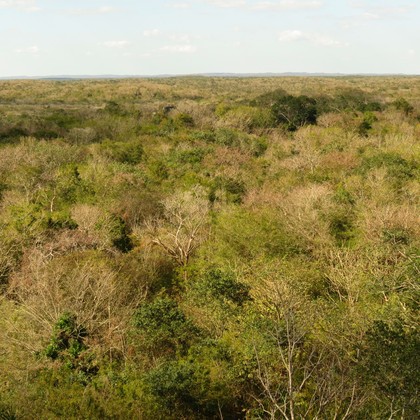
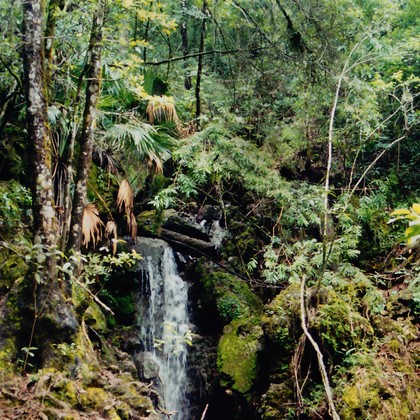
In winter the understorey and mid-storey of humid lowland and foothill forest, semi-humid seasonal forest, mature secondary forest and shade coffee, to about 1500 m. It probes clusters of dead leaves for caterpillars, spiders and other invertebrates, often hanging, and often in mixed flocks with other warblers.
Where the bird is most at home, classified by the vegetation units of Mexico and Central America.




Range and movements
Breeds in the eastern United States. Winters from southern Mexico through Central America to Panama and in the Caribbean, mainly the Bahamas and the Greater Antilles. In the guide area mainly on the Caribbean slope from southern Veracruz to Honduras and on the Yucatán Peninsula; scarcer on the Pacific slope and further south, and scarce in Panama. On passage also in eastern Mexico.
- Winter visitor (c. Oct–Mar)
- dark = core range, pale = thinly spread
How and when to look
Most easily found by checking mixed flocks in the forest understorey for a bird hanging from a cluster of dead leaves and pushing its bill into it.
Conservation status
Not threatened (LC). Fairly common; sensitive to forest fragmentation, both on the breeding grounds and in the wintering area.
Scientific name
Helmitheros vermivorum | (Gmelin, 1789)
Gmelin described the species in 1789 as Motacilla vermivora; because it was later moved to another genus, the author and year stand in brackets. The genus Helmitheros was introduced in 1819 by Rafinesque. Helmitheros is Greek, from helmis, helminthos 'worm' and thēraō 'to hunt': 'worm-hunter'. vermivorum is Latin, from vermis 'worm' and -vorus '-eating': 'worm-eating'; in fact the bird mainly eats caterpillars and other insects. The specimen the first description was based on came from Philadelphia, Pennsylvania (USA).