All species › Passerines › Tyrant flycatchers and allies › Yellow-bellied Tyrannulet
Position in the tree Birds Aves › Birds with a flexible palate Neognathae › All other modern birds Neoaves › Landbirds Telluraves › Falcons, parrots and passerines Australaves › Falcons and passerines Eufalconimorphae › Parrots and passerines Psittacopasserae
Yellow-bellied Tyrannulet | Ornithion semiflavum
Geelbuikvliegenpikker | Mosquerito ventriamarillo
The Yellow-bellied Tyrannulet is one of the smallest tyrant flycatchers of the guide area: a compact little bird with a short tail, a grey crown, a bold white eyebrow and bright yellow underparts. It lives high in the canopy of forest and forest edges and is noticed mainly by its whistled call. It occurs only in the guide area, from south-eastern Mexico to Costa Rica.

Voice
A series of clear, whistled notes that fall in pitch, and a single high whistle.
Recording: Jorge Gabriel Campos — CC BY-NC-SA 4.0 · converted to mono · xeno-canto
Identification
8 cm, with a short tail and a short black bill. Crown slate-grey, with a broad white eyebrow and a dark eye-stripe. Back olive-green. Wings dark olive without distinct wing-bars. Underparts bright yellow from throat to undertail. Male and female are alike.
Confusion species
Brown-capped Tyrannulet Ornithion brunneicapillus has a brown crown and a shorter, less obvious eyebrow; both species occur in Costa Rica. Mistletoe Tyrannulet Zimmerius parvus is larger, with a longer tail, yellow wing edges and greyish-white underparts. Yellow Tyrannulet Capsiempis flaveola has a longer tail and distinct wing-bars.
Habitat
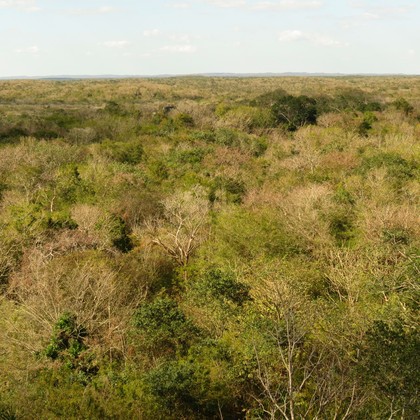
Canopy and edges of humid and semi-humid lowland and foothill forest, secondary forest, gallery forest and trees in semi-open country. It gleans insects among the foliage and also eats small berries.
Where the bird is most at home, classified by the vegetation units of Mexico and Central America.




Range and movements
Endemic to the guide area: from southern Veracruz and Oaxaca through Tabasco, Chiapas and the south of the Yucatán Peninsula, via Belize, Guatemala, Honduras and Nicaragua to northern and central Costa Rica.
- Resident
- dark = core range, pale = thinly spread
How and when to look
In Belize regularly found in forest and at forest edges; the descending whistled series from the canopy is the best lead. The short-tailed, white-browed bird can then often be seen on high branches.
Conservation status
Not threatened. Fairly common in forest and at forest edges within its range.
Scientific name
Ornithion semiflavum | (Sclater & Salvin, 1860)
Sclater & Salvin described the species in 1860 as Tyrannulus semiflavus; because it was later moved to another genus, the author and year stand in brackets. The genus Ornithion was introduced in 1853 by Hartlaub. Ornithion is Greek for 'little bird', diminutive of ornis, ornithos 'bird', after the tiny size. semiflavum is Latin, from semi- 'half' and flavus 'yellow', after the yellow underparts. The specimen the first description was based on came from Choctum, Alta Verapaz, Guatemala.