All species › Passerines › New World warblers › Yellow-rumped Warbler
Position in the tree Birds Aves › Birds with a flexible palate Neognathae › All other modern birds Neoaves › Landbirds Telluraves › Falcons, parrots and passerines Australaves › Falcons and passerines Eufalconimorphae › Parrots and passerines Psittacopasserae
Yellow-rumped Warbler | Setophaga coronata
Mirtezanger | Reinita coronada
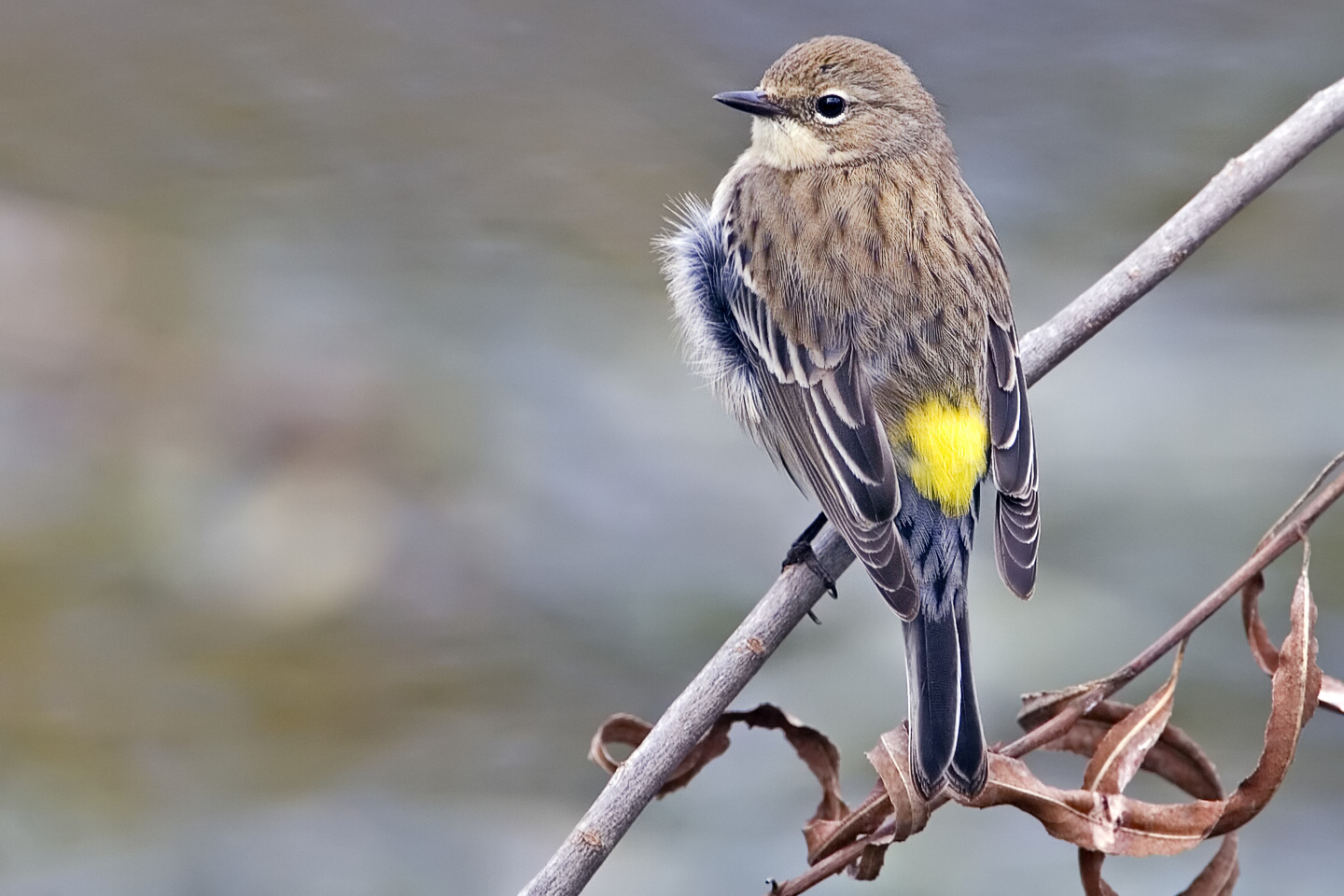
The Yellow-rumped Warbler is a sturdy warbler with a bright yellow rump and yellow patches on the flanks. In winter it is one of the most numerous warblers in Mexico, from the coast to high in the mountains. In addition, a few dark forms breed as residents or short-distance migrants in the mountains of western Mexico, Chiapas and Guatemala.
Voice
The song is a loose, rather weak trill that changes pitch at the end, roughly shwee-shwee-shwee-shwee-chee-chee. The call differs between the groups: a dry, hard chek in the Myrtle group and a sharper chip in the Audubon's group; the flight call is a thin sveet.
Recording: Stanislas Wroza — CC BY-NC-SA 4.0 · converted to mono · xeno-canto
Identification
12–14 cm. In every plumage a bright yellow rump, a yellow patch on the side of the breast and white spots in the outer tail feathers. In winter plumage, as usually seen in the guide area: grey-brown upperparts with dark streaks, one or two narrow white wing bars, a broken eye-ring and dull white underparts with faint streaks. The eastern form (Myrtle group, S. c. coronata) has a white throat that extends behind the ear coverts and a pale supercilium; the western form (Audubon's group, S. c. auduboni) has a yellow or pale throat without a supercilium and, in breeding plumage, a large white wing patch. The residents in the mountains, S. c. nigrifrons in western Mexico and S. c. goldmani in Chiapas and Guatemala, have a yellow throat and much black on breast and head.
Confusion species
Magnolia Warbler Setophaga magnolia also has a yellow rump, but yellow underparts and a white band across the middle of the tail. Cape May Warbler Setophaga tigrina has a yellowish-green rump, a thinner bill and finer streaks. Palm Warbler Setophaga palmarum has yellow undertail coverts and bobs its tail.
Habitat
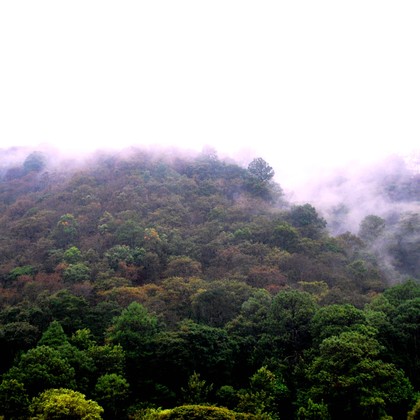
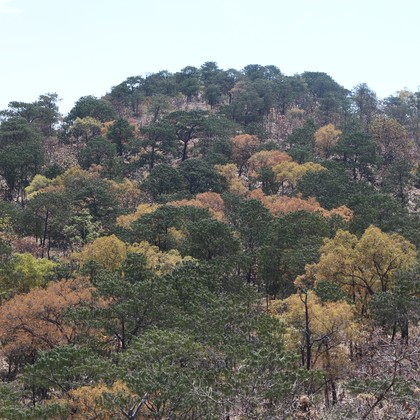
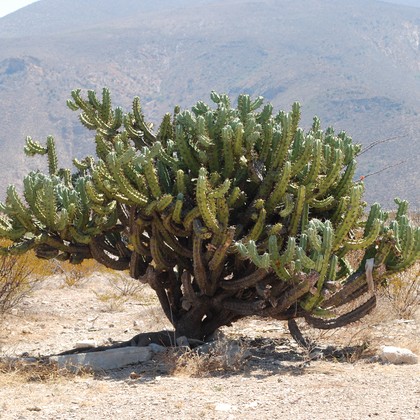
In winter almost any semi-open terrain with trees: pine-oak forest, riparian woodland, scrub, pastures with trees, gardens, parks and villages, from sea level to above 3000 m. It forages in groups for insects, also catches them in flight and eats many berries in winter. The residents breed in coniferous and pine-oak forest in the mountains, mostly above 2000 m.
Where the bird is most at home, classified by the vegetation units of Mexico and Central America.




Range and movements
Breeds in Alaska, Canada and the northern and western United States, and as a resident or short-distance migrant in the Sierra Madre Occidental (from Chihuahua to Durango) and in the highlands of Chiapas and Guatemala. In winter widespread and common throughout Mexico and northern Central America, the Audubon's group mainly in the west and interior, the Myrtle group mainly in the east; scarcer from Honduras and Nicaragua to Panama.
- Resident
- Winter visitor (c. Oct–Mar)
- Passage (Mar–Apr, Oct–Nov)
- dark = core range, pale = thinly spread
How and when to look
In winter the dry chek often reveals a group of Yellow-rumped Warblers in a tree or shrub; when a bird with a yellow rump flies off, the throat and supercilium separate the Myrtle and Audubon's groups.
Conservation status
Not threatened (LC). Very common and widespread; the population is large and stable.
Scientific name
Setophaga coronata | (Linnaeus, 1766)
Linnaeus described the species in 1766 as Motacilla coronata; because it was later moved to another genus, the author and year stand in brackets. The genus Setophaga was introduced in 1827 by Swainson. Setophaga is Greek, from sēs, sētos 'moth' and -phagos '-eating': 'moth-eater'. coronata is from Latin coronatus 'crowned', after the yellow crown patch. The specimen the first description was based on came from Philadelphia, Pennsylvania.