All species › Passerines › New World warblers › Yellow-throated Warbler
Position in the tree Birds Aves › Birds with a flexible palate Neognathae › All other modern birds Neoaves › Landbirds Telluraves › Falcons, parrots and passerines Australaves › Falcons and passerines Eufalconimorphae › Parrots and passerines Psittacopasserae
Yellow-throated Warbler | Setophaga dominica
Geelkeelzanger | Chipe garganta amarilla
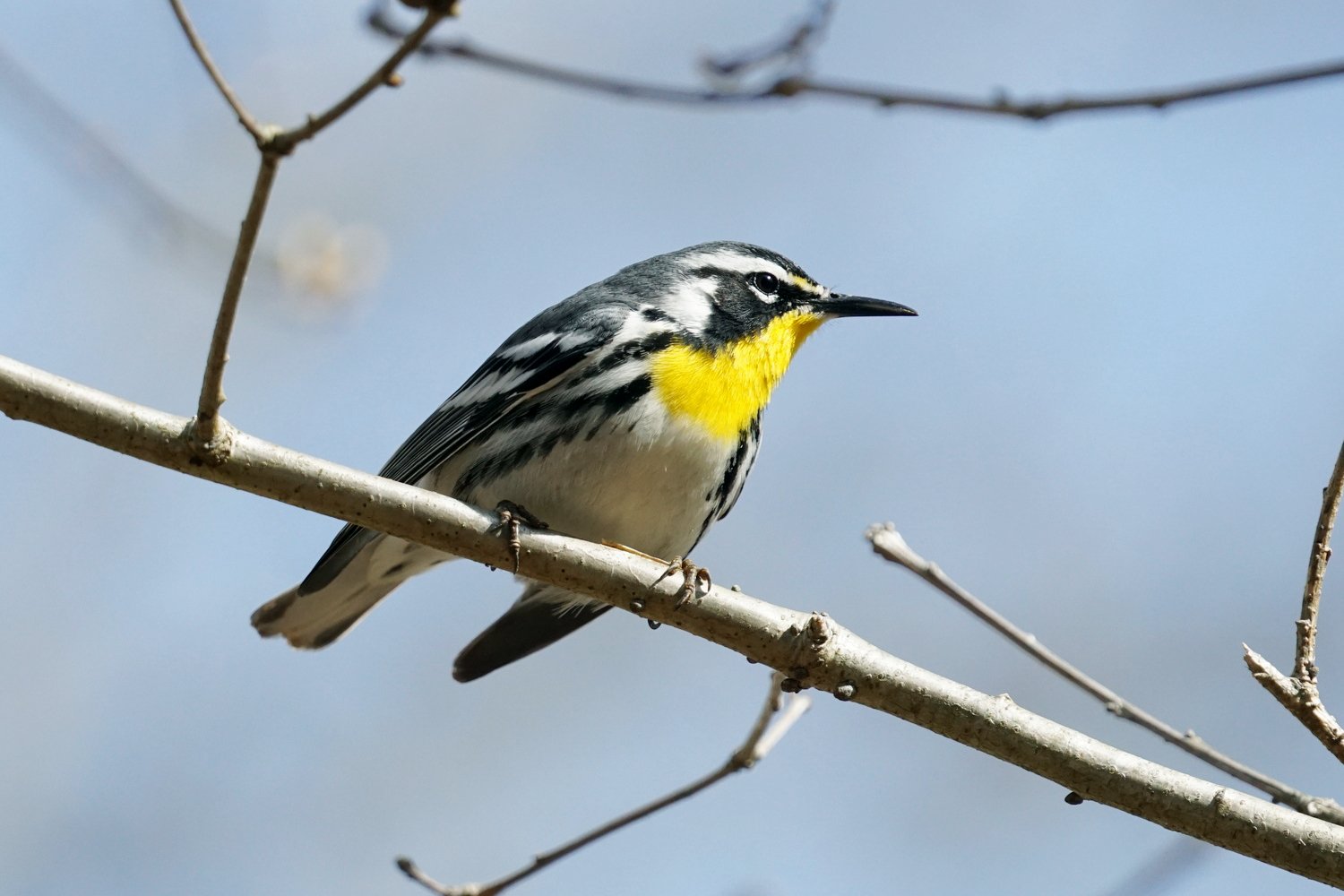
The Yellow-throated Warbler is a grey-and-white warbler with a bright yellow throat, a black mask and a long bill. It breeds in the south-eastern United States. In the guide area it is a fairly common winter visitor, often in palms, pines and garden trees.
Voice
The song is a series of clear, whistled notes that becomes lower and faster and ends with a rising note, roughly teeu teeu teeu tew tew twi; in the guide area heard mainly in spring. The call is a high, soft chip, the flight call a high see.
Recording: Bill Pyle — CC BY-NC-SA 4.0 · shortened to the first 60 s, mono · xeno-canto
Identification
13–14 cm. Long, pointed bill. Unstreaked grey upperparts, two white wing bars, a bright yellow throat and upper breast, a black mask that extends as a triangle onto the neck side, a white supercilium and a white patch on the neck side; white underparts with black streaks on the flanks. The sexes are similar; females and young birds show slightly less black. In the western form S. d. albilora the supercilium in front of the eye is entirely white, in the eastern form S. d. dominica it is often yellow there.
Confusion species
Grace's Warbler Setophaga graciae is smaller, has a shorter bill, a yellow supercilium in front of the eye, no black mask and no white neck patch, and lives in pine forest in the mountains. Blackburnian Warbler Setophaga fusca has an orange-yellow throat and supercilium and pale stripes on the back. Black-and-white Warbler Mniotilta varia also creeps along trunks and branches, but has no yellow.
Habitat
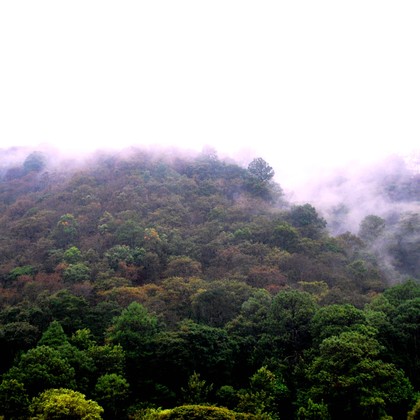
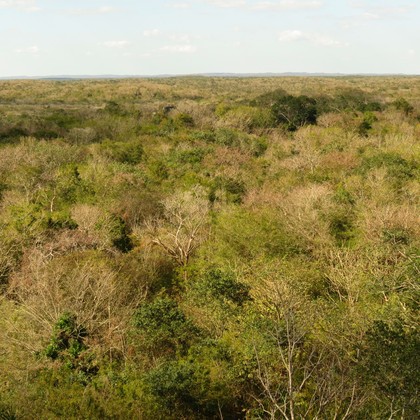
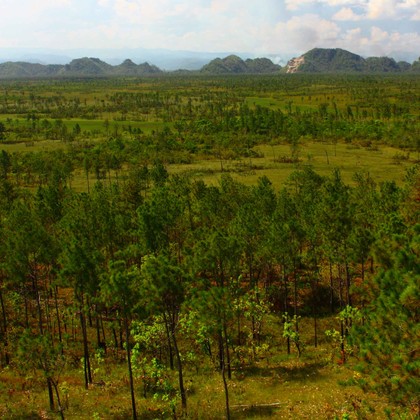
In winter semi-open terrain with tall trees: palms and coconut palms, pine savanna and pine-oak forest, riparian woodland, dry seasonal forest, parks, gardens and villages; mostly below 1500 m. It searches slowly along branches and among palm fronds and pine needles for insects and sometimes creeps along trunks like a treecreeper.
Where the bird is most at home, classified by the vegetation units of Mexico and Central America.




Range and movements
Breeds in the eastern and south-eastern United States. Winters from the south-eastern United States and the West Indies to Central America. In the guide area common on the Gulf coast of Mexico and on the Yucatán Peninsula, and fairly common on the Pacific slope from western Mexico to El Salvador and in northern Central America to Nicaragua; scarce in Costa Rica and rare in Panama.
- Winter visitor (c. Oct–Mar)
- dark = core range, pale = thinly spread
How and when to look
Palms in parks, village squares and hotel grounds are a good place in winter: the bird searches patiently among the frond bases and can often be watched at close range.
Conservation status
Not threatened (LC). Common; the population appears stable and has expanded slightly in the north of the breeding range.
Scientific name
Setophaga dominica | (Linnaeus, 1766)
Linnaeus described the species in 1766 as Motacilla dominica; because it was later moved to another genus, the author and year stand in brackets. The genus Setophaga was introduced in 1827 by Swainson. Setophaga is Greek, from sēs, sētos 'moth' and -phagos '-eating': 'moth-eater'. dominica probably refers to Santo Domingo (Hispaniola), via Brisson's 'Figuier de S. Domingue'; Linnaeus cited Jamaica and Dominica. The specimen the first description was based on came from Hispaniola.