All species › Passerines › New World warblers › Pine Warbler
Position in the tree Birds Aves › Birds with a flexible palate Neognathae › All other modern birds Neoaves › Landbirds Telluraves › Falcons, parrots and passerines Australaves › Falcons and passerines Eufalconimorphae › Parrots and passerines Psittacopasserae
Pine Warbler | Setophaga pinus
Dennenzanger | Chipe pinero
The Pine Warbler is a rather large, unstreaked warbler with a stout bill and two white wing bars. It is tied to pines and largely winters within its breeding range in the south-eastern United States. In the guide area it is a rare winter visitor to north-eastern Mexico.

Voice
The song is a musical trill on one pitch, softer and less dry than that of Chipping Sparrow Spizella passerina, roughly tritritritritritri. The call is a full, somewhat dull chip.
Recording: Rory Nefdt — CC BY-NC-SA 4.0 · converted to mono · xeno-canto
Identification
13–14 cm. Fairly long tail and a relatively thick bill. Unstreaked olive-green upperparts, two distinct white wing bars, a faint yellow supercilium and broken eye-ring and a dark cheek with a pale neck patch. The male has a yellow throat and breast with faint dark streaks on the sides of the breast. Females are duller; young birds in autumn are grey-brown with almost no yellow, but still show the white wing bars and white spots in the tail.
Confusion species
Yellow-throated Warbler Setophaga dominica has grey upperparts, a black mask and a white supercilium. The grey winter plumages of Bay-breasted Warbler Setophaga castanea and Blackpoll Warbler Setophaga striata have streaked upperparts and a shorter tail. Vireos (Vireo) have a thicker, hooked bill and no white spots in the tail.
Habitat
Pine forest and mixed forest with pines; in winter also riparian woodland, parks and gardens with conifers. It searches slowly among the needles and on branches for insects and in winter also eats pine seeds and berries; it regularly comes to the ground.
Where the bird is most at home, classified by the vegetation units of Mexico and Central America.
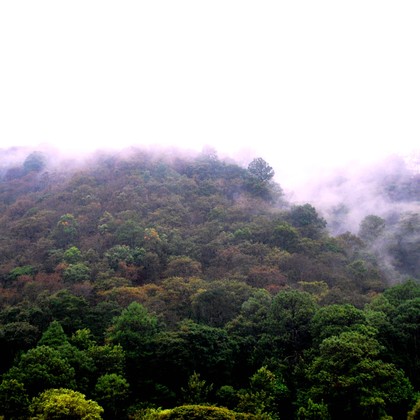
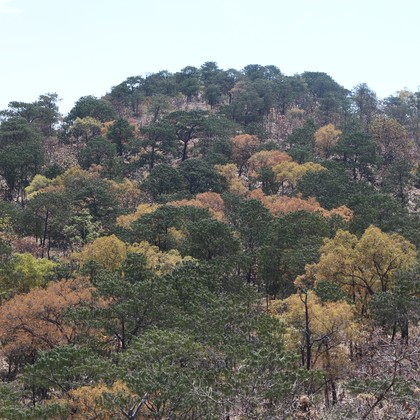


Range and movements
Breeds in eastern North America, from south-eastern Canada to Florida and eastern Texas; separate resident populations live on Hispaniola and in the Bahamas. Winters largely in the south-eastern United States. In the guide area rare in winter in north-eastern Mexico (Tamaulipas, Nuevo León, Coahuila); elsewhere a vagrant.
- Winter visitor (c. Oct–Mar)
- dark = core range, pale = thinly spread
How and when to look
The chance of finding this species is mainly in winter in parks and gardens with pines in north-eastern Mexico; elsewhere a record is exceptional.
Conservation status
Not threatened (LC). Common in the breeding range; the population is increasing.
Scientific name
Setophaga pinus | (Linnaeus, 1766)
Linnaeus described the species in 1766 as Certhia pinus; because it was later moved to another genus, the author and year stand in brackets. The genus Setophaga was introduced in 1827 by Swainson. Setophaga is Greek, from sēs, sētos 'moth' and -phagos '-eating': 'moth-eater'. pinus is Latin for 'pine', after the pine woods the species inhabits. The specimen the first description was based on came from Georgia, United States.