All species › Passerines › New World sparrows › Yellow-thighed Brushfinch
Position in the tree Birds Aves › Birds with a flexible palate Neognathae › All other modern birds Neoaves › Landbirds Telluraves › Falcons, parrots and passerines Australaves › Falcons and passerines Eufalconimorphae › Parrots and passerines Psittacopasserae
Yellow-thighed Brushfinch | Atlapetes tibialis
Geeldijstruikgors | Cerquero musliamarillo
The Yellow-thighed Brushfinch is a dark, slaty brushfinch of the montane forests of Costa Rica and western Panama, with fluffy yellow thighs. It lives in pairs or small family groups in the undergrowth and along forest edges and regularly travels with mixed feeding flocks. It was formerly placed in the genus Pselliophorus.

Voice
The call is a high, thin tseet, often repeated. The song, mainly at dawn and dusk, is a series of high, squeaky notes and short trills.
Recording: Paul Driver — CC BY-NC-SA 4.0 · converted to mono · xeno-canto
Identification
18–20 cm. Mainly dark slate-grey; head, throat and tail blackish. The long, fluffy thigh feathers are bright yellow and stand out against the dark belly, especially on perched birds. Chin and throat with a faint olive-yellow tinge. Bill black, eye dark. The sexes are alike; juveniles are more olive, with less yellow on the thighs.
Confusion species
Yellow-green Brushfinch Atlapetes luteoviridis of western Panama also has yellow thighs but is olive-green with yellowish underparts and a blackish head. Large-footed Finch Pezopetes capitalis is larger and heavier, olive-green with a grey crown and no yellow thighs. Slaty-backed Nightingale-Thrush Catharus fuscater is also dark slate-grey but has an orange bill and legs and a pale eye.
Habitat
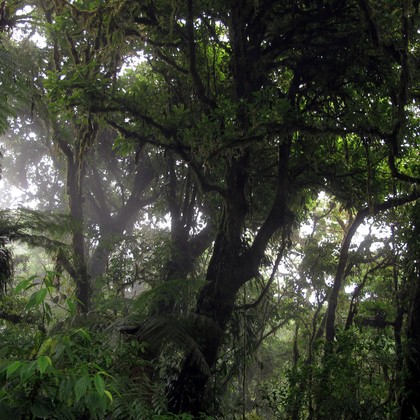
Undergrowth, edges and clearings of montane rainforest and oak forest, also secondary forest, roadside scrub and forest edges near gardens, mostly between about 1200 and 3000 m. It forages low in shrubs and among bamboo for insects, small fruits and seeds.
Where the bird is most at home, classified by the vegetation units of Mexico and Central America.

Range and movements
Endemic to the guide area: mountains of Costa Rica (Cordillera de Tilarán, Cordillera Central and Cordillera de Talamanca) and western Panama (Chiriquí and western Bocas del Toro and the Comarca Ngäbe-Buglé).
- Resident
- dark = core range, pale = thinly spread
How and when to look
Regularly seen along forest edges and roads at San Gerardo de Dota and on Cerro de la Muerte in Costa Rica, often in mixed flocks with tanagers and warblers.
Conservation status
Not threatened (LC). Small range, but fairly common in suitable montane forest.
Scientific name
Atlapetes tibialis | (Lawrence, 1864)
Lawrence described the species in 1864 as Tachyphonus tibialis; because it was later moved to another genus, the author and year stand in brackets. The genus Atlapetes was introduced in 1831 by Wagler. Atlapetes combines the Titan Atlas of Greek myth, who was turned into a mountain, with Greek petēs 'flier': a 'mountain flier', after the montane habitat. tibialis is Latin for 'of the shin', from tibia, after the yellow thighs. The specimen the first description was based on came from San José, Costa Rica.