All species › Passerines › New World sparrows › White-naped Brushfinch
Position in the tree Birds Aves › Birds with a flexible palate Neognathae › All other modern birds Neoaves › Landbirds Telluraves › Falcons, parrots and passerines Australaves › Falcons and passerines Eufalconimorphae › Parrots and passerines Psittacopasserae
White-naped Brushfinch | Atlapetes albinucha
Witnekstruikgors | Atlapetes nuca blanca
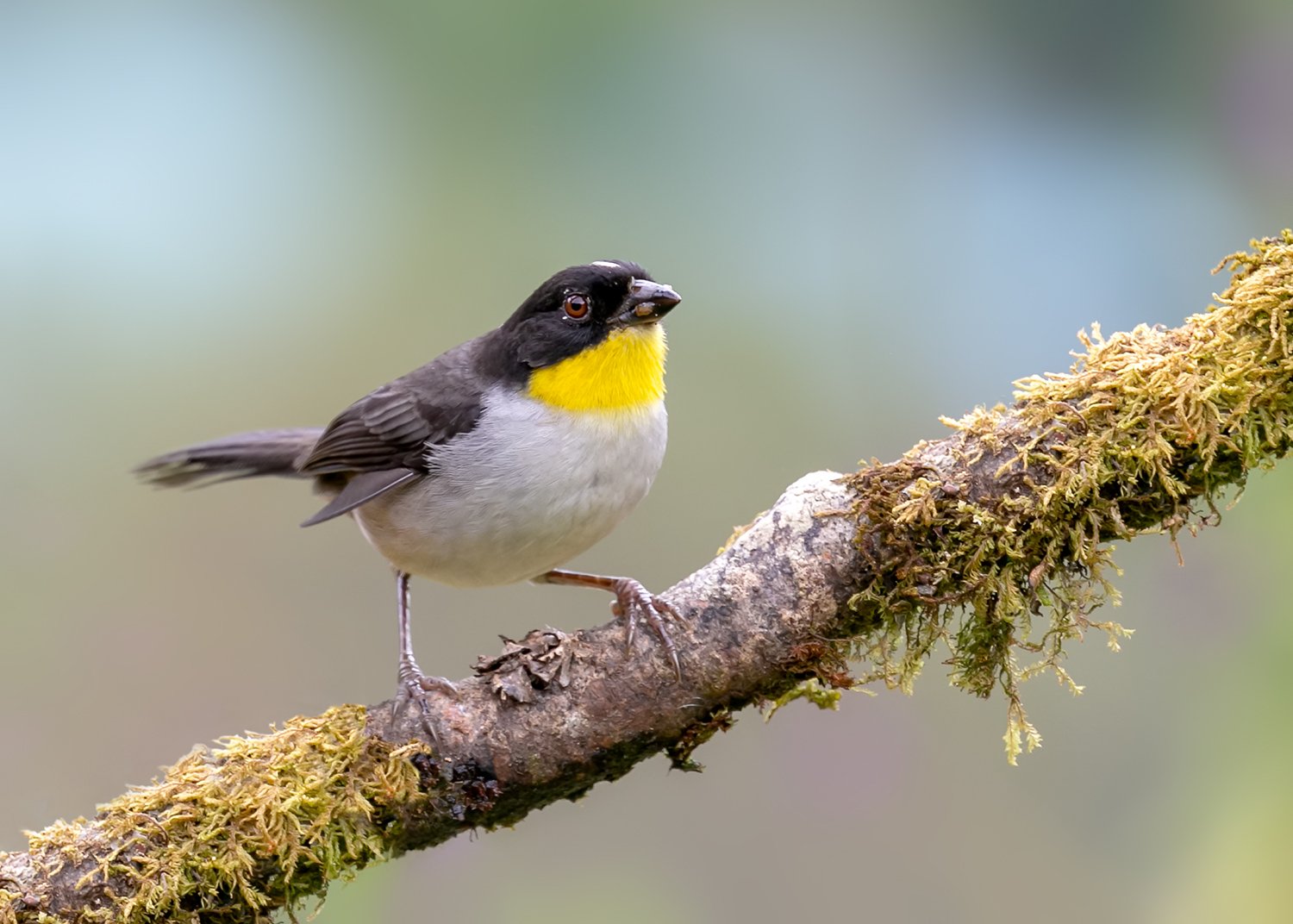
The White-naped Brushfinch is a large brushfinch with a black head and a narrow white stripe down the centre of the crown and nape. It lives low in dense vegetation along forest edges and in rough scrub in the mountains, from southern Mexico to Panama. Birds in Mexico have entirely yellow underparts; further south only the throat is yellow and the rest of the underparts are grey.
Voice
The call is a high, sharp tseet. The song is a short series of high, squeaky and twittering notes, often given in duet.
Recording: Max Noack — CC BY-NC-SA 4.0 · shortened to the first 60 s, mono · xeno-canto
Identification
17–19 cm. Head black with a narrow white central crown stripe continuing onto the nape. Upperparts, wings and tail dark grey to slate. In southern Mexico the throat and underparts are entirely yellow. From Chiapas and Guatemala to Panama only the throat is bright yellow and the breast and belly are grey to dingy white. Bill black, legs dark. The sexes are alike; juveniles are more olive-brown, with streaked underparts.
Confusion species
Rufous-capped Brushfinch Atlapetes pileatus of the Mexican highlands has a rufous cap without a white stripe and an olive-grey back. Chestnut-capped Brushfinch Arremon brunneinucha has a chestnut crown, a white throat and a black breast band. Costa Rican Brushfinch Arremon costaricensis has grey head stripes and a white throat.
Habitat
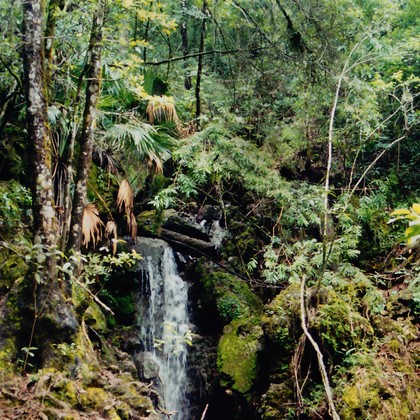
Edges of cloud forest and montane rainforest, scrubby clearings, rough field margins, hedgerows and shade coffee, mostly between about 900 and 2500 m. It forages low in the vegetation and on the ground for insects, seeds and small fruits, often in pairs.
Where the bird is most at home, classified by the vegetation units of Mexico and Central America.



Range and movements
In the guide area in the highlands of south-eastern Mexico (Veracruz, Oaxaca and Chiapas) and on through Guatemala, Honduras, El Salvador, Nicaragua and Costa Rica to western Panama. Outside the guide area in Colombia.
- Resident
- dark = core range, pale = thinly spread
How and when to look
Regularly seen in scrub along forest edges and roads in the highlands of Chiapas, for example around San Cristóbal de las Casas, and in the central highlands of Costa Rica, where it also visits large gardens and coffee plantations.
Conservation status
Not threatened (LC). Fairly common and tolerant of semi-open, human-modified landscapes.
Scientific name
Atlapetes albinucha | (d'Orbigny, ACVMD & de Lafresnaye, 1838)
D'Orbigny, ACVMD & de Lafresnaye described the species in 1838 as Embernagra albinucha; because it was later moved to another genus, the author and year stand in brackets. The genus Atlapetes was introduced in 1831 by Wagler. Atlapetes combines the Titan Atlas of Greek myth, who was turned into a mountain, with Greek petēs 'flier': a 'mountain flier', after the montane habitat. albinucha is Latin, from albus 'white' and Medieval Latin nucha 'nape', after the white nape stripe. The specimen the first description was based on came from Caribbean slope of Mexico.