All species › Passerines › Wagtails and pipits › Yellowish Pipit
Position in the tree Birds Aves › Birds with a flexible palate Neognathae › All other modern birds Neoaves › Landbirds Telluraves › Falcons, parrots and passerines Australaves › Falcons and passerines Eufalconimorphae › Parrots and passerines Psittacopasserae
Yellowish Pipit | Anthus chii
Gele pieper | Bisbita amarillento
The Yellowish Pipit is a small, streaked pipit of short grassland in the lowlands. It is widespread in South America and reaches the northern limit of its range in Panama. It was formerly treated as one species with Peruvian Pipit Anthus lutescens of the Pacific coast of Peru and Chile.
Voice
The song is given in a song flight: the bird rises with a series of short, high notes and then parachutes down with a long, buzzy, descending trill, tsi-tsi-tsi-dzeeeeew. The call is a thin, short tsip.
Recording: Guillermo Menéndez (gmmv80) — CC BY-NC-SA 4.0 · converted to mono · xeno-canto
Identification
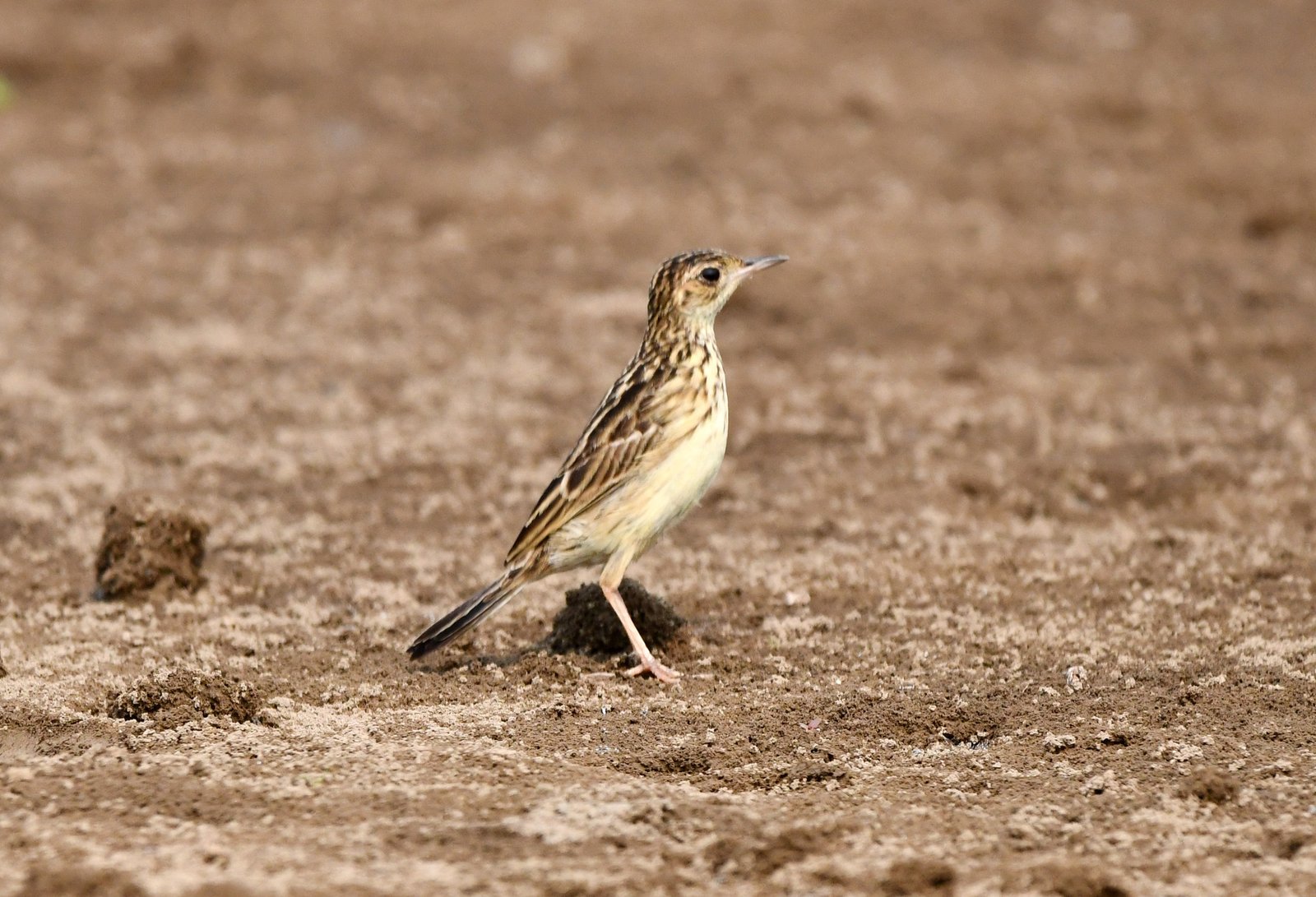
13–14 cm. Small and slender, with a thin bill, pale flesh-coloured legs and a long hind claw. Upperparts brown with broad black and buff streaks. Underparts pale yellowish white, with fine dark streaks on the breast and a yellow wash that can almost disappear in worn birds. A faint pale supercilium and eye-ring. Outer tail feathers whitish. The sexes are alike.
Confusion species
No other pipit occurs regularly in Panama; American Pipit Anthus rubescens reaches Central America this far south only rarely and is larger, greyer and less streaked above. Wedge-tailed Grass Finch Emberizoides herbicola also lives in savannas and is streaked, but has a thicker bill and a long, pointed tail and often perches on grass stems rather than walking on the ground. Grassland Yellow Finch Sicalis luteola is also streaked with a yellow wash, but has a short conical bill.
Habitat
Short grassland, pastures, savannas, grassy airfields, edges of rice fields and dried-out saltmarsh and salt pans in the lowlands. It walks on the ground in the short grass, searching for small insects and seeds. It nests in a scrape on the ground, hidden under a grass tussock.
Where the bird is most at home, classified by the vegetation units of Mexico and Central America.


Range and movements
Widespread in South America east of the Andes, from Colombia, Venezuela and the Guianas to Bolivia, Paraguay, Uruguay and northern Argentina. In the guide area only in Panama, mainly in the Pacific lowlands from Chiriquí to Coclé, Herrera and Panamá province; rare or local elsewhere.
- Resident
- Summer visitor (c. Apr–Sep)
- Passage (Mar–Apr, Oct–Nov)
- dark = core range, pale = thinly spread
How and when to look
Found in the pastures, rice fields and salt pans around Aguadulce in Coclé and in the lowlands of Chiriquí. In the breeding season most easily detected by its song flight.
Conservation status
Not threatened (LC). Common in South America; in Panama locally fairly common in open lowlands, where it benefits from pastures and rice fields.
Scientific name
Anthus chii | Vieillot, 1818
Vieillot described the species in 1818 and placed it straight away in the genus where it still stands. The genus Anthus was introduced in 1805 by Bechstein. Anthus is the Latin word for a small bird of grasslands mentioned by Pliny the Elder. chii comes from Azara's 'Alondra Chií' from Paraguay; Azara named the bird after its clear call 'chií'. The specimen the first description was based on came from Paraguay (after Azara).