All species › Passerines › Wagtails and pipits › Sprague's Pipit
Position in the tree Birds Aves › Birds with a flexible palate Neognathae › All other modern birds Neoaves › Landbirds Telluraves › Falcons, parrots and passerines Australaves › Falcons and passerines Eufalconimorphae › Parrots and passerines Psittacopasserae
Sprague's Pipit | Anthus spragueii
Prairiepieper | Bisbita llanero
Sprague's Pipit is a shy, solitary pipit of short to medium-height native grassland. It breeds on the northern prairies of North America and winters, among other places, in the grasslands of northern and central Mexico. It has declined sharply through the loss of native grassland.

Voice
In winter mainly the flight call when flushed: a sharp, shrill squeet, often given twice. The song, a high, descending series of tinkling notes delivered in a long song flight, is rarely heard away from the breeding grounds.
Recording: Jacob Saucier — CC BY-NC-SA 4.0 · converted to mono · xeno-canto
Identification
15–17 cm. Slender, with a thin bill with a pale lower mandible and long, pale pink legs. Upperparts buff with conspicuously scaly feathers marked black and pale; crown and nape finely streaked. The face is pale and plain, making the large dark eye stand out. Underparts whitish with a buff breast and a fine necklace of dark streaks across the breast. Outer tail feathers largely white, clearly visible when the bird flushes. The sexes are alike.
Confusion species
American Pipit Anthus rubescens is darker and greyer above with an almost unstreaked back, has dark legs, constantly pumps its tail and lives in flocks on bare fields and shores. Savannah Sparrow Passerculus sandwichensis, Baird's Sparrow Centronyx bairdii and Grasshopper Sparrow Ammodramus savannarum occur in the same grasslands but have a short, thick conical bill and no white in the tail.
Habitat
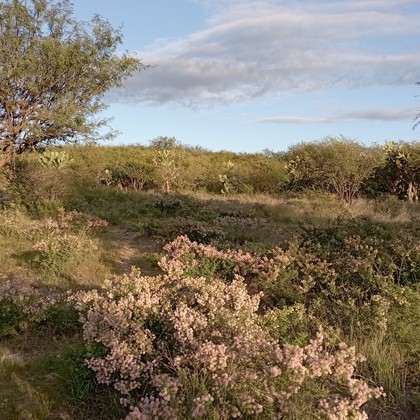
In winter native grassland with short to medium-height grass and few shrubs, especially in the semi-desert grasslands of the Chihuahuan plateau; also lightly grazed pastures. It avoids cropland, tall grass and shrubby terrain. It walks hidden in the grass and is usually seen only when flushed: it rises high, circles and then plunges steeply back into the grass. It eats insects and seeds.
Where the bird is most at home, classified by the vegetation units of Mexico and Central America.


Range and movements
Breeds on the northern prairies of southern Canada and the northern United States. Winters from southern Arizona and Texas to northern and central Mexico. In the guide area mainly in Chihuahua, Durango, Coahuila, Nuevo León and Tamaulipas, more scarcely south to Jalisco, Guanajuato, Querétaro, Mexico City and Puebla and west to Sonora.
- Winter visitor (c. Oct–Mar)
- dark = core range, pale = thinly spread
How and when to look
In winter found in the grasslands of Janos in Chihuahua and El Tokio in Nuevo León. Best searched for by walking slowly through short grassland and listening for the shrill call of a flushed bird.
Conservation status
Vulnerable (VU). The population has declined sharply through conversion of native grassland to cropland, both on the breeding grounds and in the wintering areas in Mexico; shrub encroachment and overgrazing also play a part.
Scientific name
Anthus spragueii | (Audubon, 1844)
Audubon described the species in 1844 as Alauda spragueii; because it was later moved to another genus, the author and year stand in brackets. The genus Anthus was introduced in 1805 by Bechstein. Anthus is the Latin word for a small bird of grasslands mentioned by Pliny the Elder. spragueii honours the American illustrator Isaac Sprague (1811–1895), who accompanied Audubon on his 1843 Missouri River expedition, where the species was discovered. The specimen the first description was based on came from near Fort Union, North Dakota, USA.