All species › Woodpeckers and allies › Woodpeckers › Yucatan Woodpecker
Position in the tree Birds Aves › Birds with a flexible palate Neognathae › All other modern birds Neoaves › Landbirds Telluraves › Raptors, owls, kingfishers and woodpeckers Afroaves › Mousebirds, rollers and woodpeckers Coraciimorphae › Trogons and cavity nesters Cavitaves › Hornbills, kingfishers and woodpeckers Picocoraciae › Kingfishers, bee-eaters and woodpeckers Picodynastornithes
Yucatan Woodpecker | Melanerpes pygmaeus
Yucatánspecht | Carpintero yucateco
The Yucatan Woodpecker is one of the smallest Melanerpes woodpeckers in the guide area and occurs nowhere else. It resembles a small, short-billed Golden-fronted Woodpecker and lives in dry forest, scrub and coastal scrub of the Yucatán Peninsula and a few islands.

Voice
A rolling churr and chattering calls, higher and faster than those of Golden-fronted Woodpecker.
Recording: Roland Rumm — CC BY-NC-SA 4.0 · converted to mono · xeno-canto
Identification
16–18 cm. Head and underparts pale grey, the belly often washed yellow and the undertail coverts sometimes tinged red. Feathers around the base of the bill yellow. The male has a red cap from above the eye to the nape; in the female only the back of the head is red. Back, wings and tail barred black and white, rump white. Bill short and black.
Confusion species
Golden-fronted Woodpecker Melanerpes aurifrons, which lives in the same area, is clearly larger, with a longer, heavier bill and less yellow around the base of the bill; its voice also differs. Ladder-backed Woodpecker Dryobates scalaris has a black-and-white striped head.
Habitat
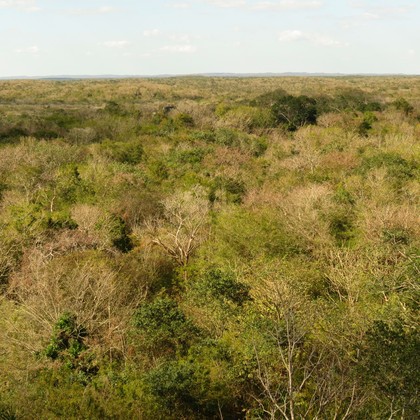
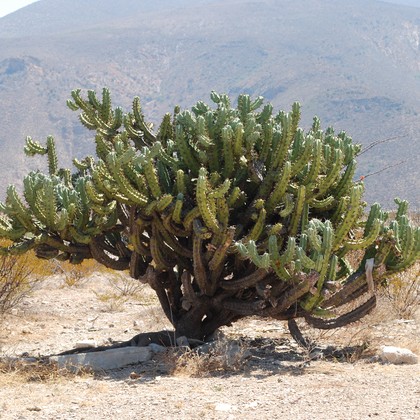
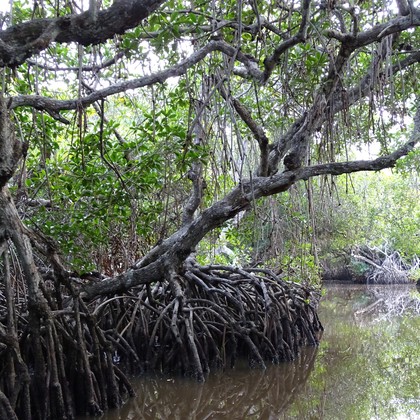
Seasonally dry forest, low scrub and coastal scrub, edges of dry forest, clearings and heavily degraded former forest; sometimes in more humid forest and in villages. It searches branches and trunks for insects and also eats fruit.
Where the bird is most at home, classified by the vegetation units of Mexico and Central America.



Range and movements
Endemic to the guide area: the whole Yucatán Peninsula in Mexico (Yucatán, Campeche and Quintana Roo), northern and central Belize and north-eastern Guatemala. The nominate form lives on Cozumel, rubricomus on the mainland and tysoni on Guanaja in the Bay Islands of Honduras.
- Resident
- dark = core range, pale = thinly spread
How and when to look
In coastal scrub at Río Lagartos and Celestún and on Cozumel. Where Golden-fronted Woodpecker also occurs, size and bill length help to separate them.
Conservation status
Not threatened. Fairly common in dry forest and scrub; tolerates degraded forest.
Scientific name
Melanerpes pygmaeus | (Ridgway, 1885)
Ridgway described the species in 1885 as Centurus rubriventris pygmaeus; because it was later moved to another genus, the author and year stand in brackets. The genus Melanerpes was introduced in 1832 by Swainson. Melanerpes is Greek, from melas 'black' and herpēs 'creeper': 'black creeper'. pygmaeus is Latin for 'dwarf', after its small size: it is the smallest Melanerpes of the region. The specimen the first description was based on came from Cozumel, Mexico.