All species › Birds of prey › Kites, Old World vultures, eagles and hawks › Zone-tailed Hawk
Position in the tree Birds Aves › Birds with a flexible palate Neognathae › All other modern birds Neoaves › Landbirds Telluraves › Raptors, owls, kingfishers and woodpeckers Afroaves › Hawks and owls Hieraves
Zone-tailed Hawk | Buteo albonotatus
Bandstaartbuizerd | Aguililla aura
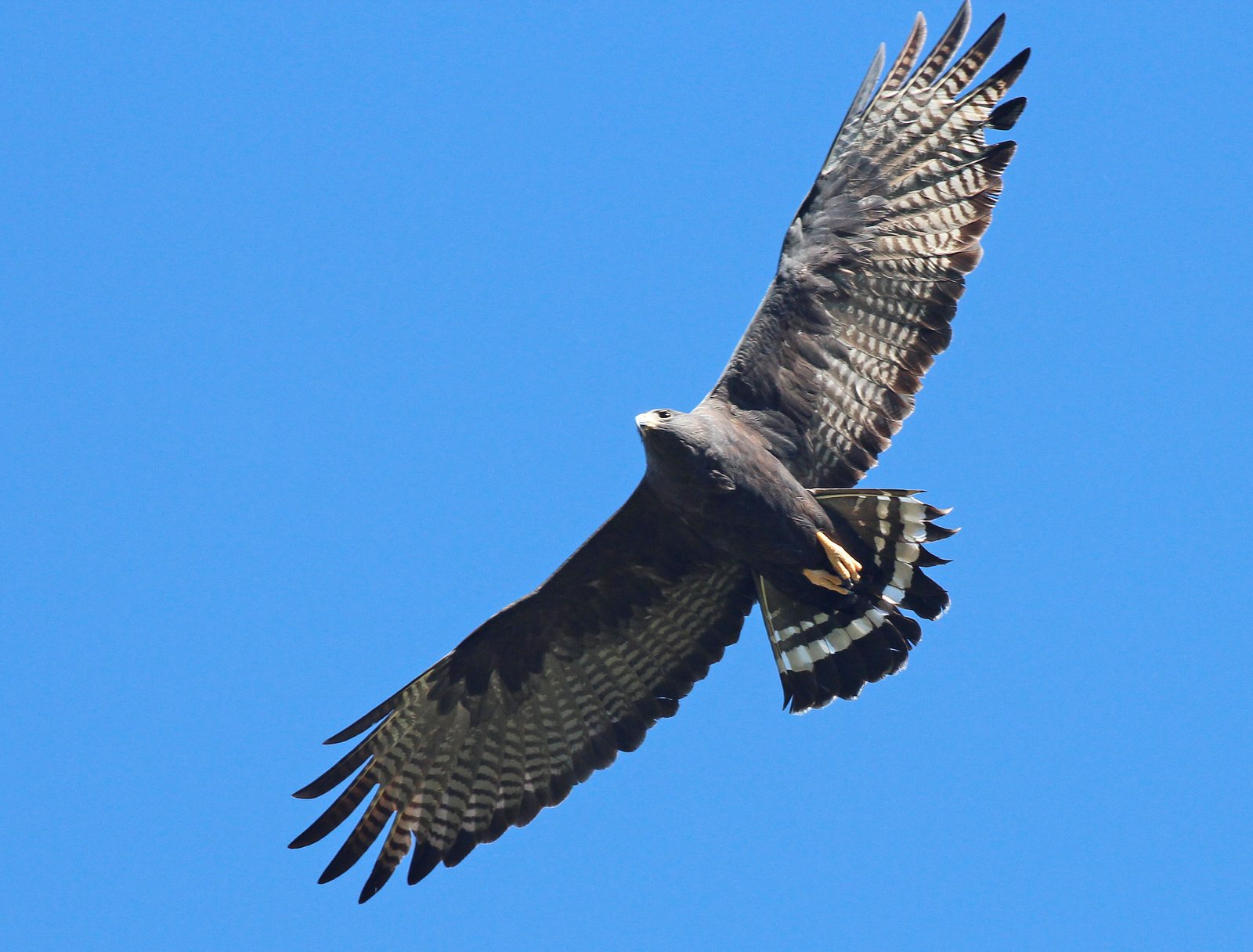
The Zone-tailed Hawk is a black buteo with long, narrow wings that resembles a Turkey Vulture in colour, posture and flight: it soars with its wings held in a V, rocks slightly and often flies among the vultures. In this way it approaches lizards, birds and small mammals unnoticed before diving on them. In the guide area it is widespread but nowhere common, from the canyons of northern Mexico to the lowlands of Panama.
Voice
A long, whistled and somewhat quavering kreeeeah, softer and less hoarse than the call of the Red-tailed Hawk, mainly in flight near the nest.
Recording: Matt Wistrand — CC BY-NC-SA 4.0 · converted to mono · xeno-canto
Identification
45–56 cm, with long, narrow wings and a fairly long tail. Adults are black, with a yellow cere and yellow legs. From below the flight feathers are grey with fine dark bars and a broad dark trailing edge, so the underwing is two-toned as in the Turkey Vulture. The male's tail has one broad white or grey band and one or two narrower ones; the female has more, narrower bands. Juveniles are blackish-brown with small white spots on breast and belly and a grey, finely barred tail. Male and female differ only in the tail; the female is larger.
Confusion species
The Turkey Vulture Cathartes aura has a bare red head, grey in young birds, no white tail bands and a weak bill; the Zone-tailed Hawk has a feathered black head with a yellow cere. The Common Black Hawk Buteogallus anthracinus has broad, rounded wings and a short tail with one broad white band, and does not soar like a vulture. The Great Black Hawk Buteogallus urubitinga is larger, with broad wings and a white tail base. The dark morph of the Short-tailed Hawk Buteo brachyurus is smaller, with shorter wings and a paler patch at the base of the primaries.
Habitat
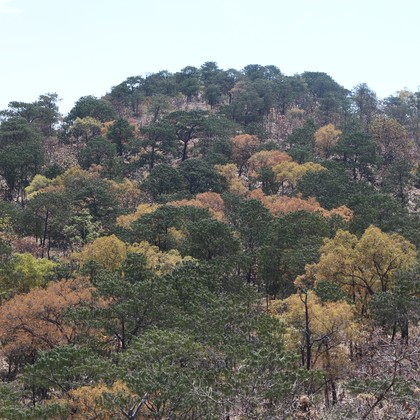
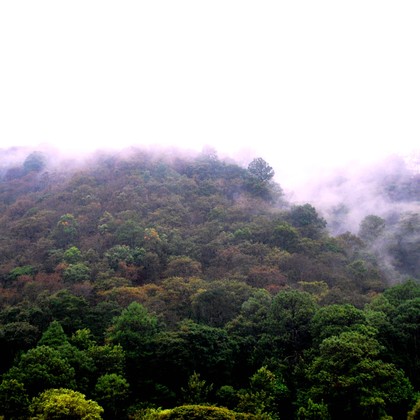
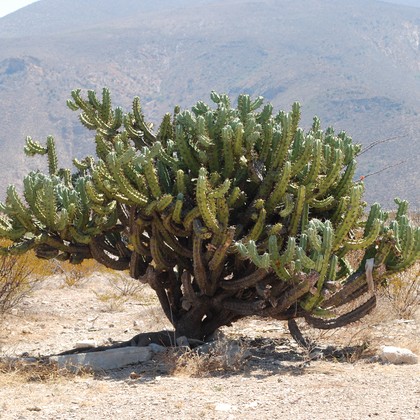
Canyons and rocky slopes with trees, riparian woodland along rivers in arid country, oak and pine-oak woodland in the mountains, tropical dry forest and thorn scrub; in Central America also forest edge and semi-open country in the lowlands and foothills. Soars low over slopes and forest edges. Nests high in a tree, often beside a stream or on a steep slope.
Where the bird is most at home, classified by the vegetation units of Mexico and Central America.




Range and movements
Scattered throughout the guide area. Breeds in northern Mexico in Sonora, Chihuahua, Coahuila and Nuevo León; these birds move away in winter, when the species is more numerous in western and southern Mexico, from Baja California Sur, Sinaloa and Nayarit to Oaxaca, Chiapas and the Yucatán Peninsula. Year-round in much of Mexico and, scarce and local, through Guatemala, Belize, El Salvador, Honduras, Nicaragua and Costa Rica to Panama. Outside the guide area it breeds in the south-western United States and occurs patchily in South America as far as Bolivia and Paraguay.
- Resident
- Summer visitor (c. Apr–Sep)
- Winter visitor (c. Oct–Mar)
- Passage (Mar–Apr, Oct–Nov)
- dark = core range, pale = thinly spread
How and when to look
Among Turkey Vultures soaring low over a slope or canyon it stands out by its feathered black head, yellow legs and white tail bands. In winter it is regularly seen along the Pacific coast of Nayarit and Jalisco and in Baja California Sur.
Conservation status
Not threatened. Rather scarce but widespread; locally declining in the guide area through the clearance of riparian woodland.
Scientific name
Buteo albonotatus | Kaup, 1847
Kaup described the species in 1847 and placed it straight away in the genus where it still stands. The genus Buteo was introduced in 1799 by De Lacépède. Buteo is the Latin word for a buzzard. albonotatus is Latin, from albus 'white' and notatus 'marked', after the white tail bands. The specimen the first description was based on came from Mexico (unspecified).