All species › Birds of prey › Kites, Old World vultures, eagles and hawks › Red-shouldered Hawk
Position in the tree Birds Aves › Birds with a flexible palate Neognathae › All other modern birds Neoaves › Landbirds Telluraves › Raptors, owls, kingfishers and woodpeckers Afroaves › Hawks and owls Hieraves
Red-shouldered Hawk | Buteo lineatus
Roodschouderbuizerd | Aguililla pecho rojo
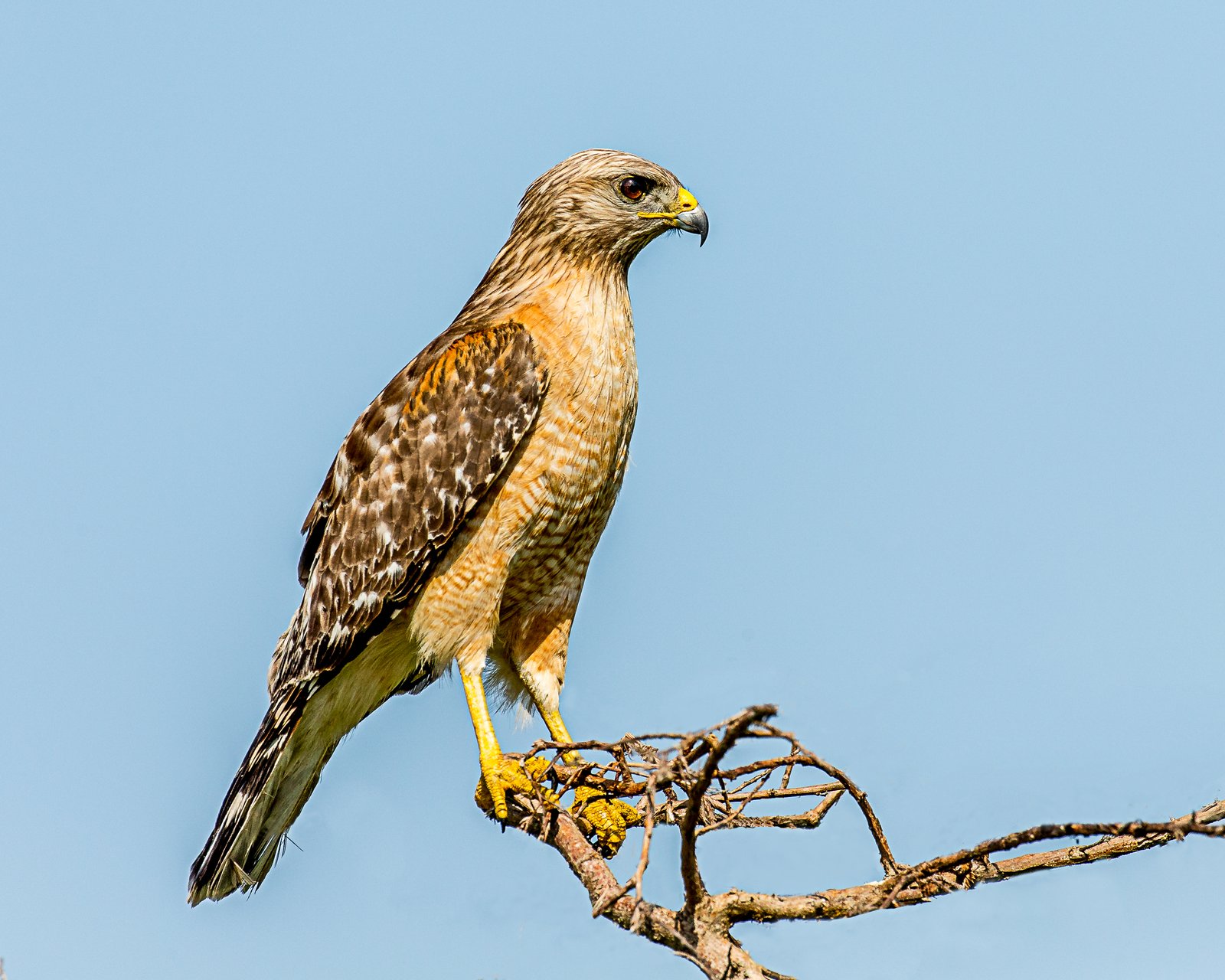
The Red-shouldered Hawk is a medium-sized buteo of wooded river valleys and humid forest, with rufous-barred underparts, rufous shoulders and a black tail crossed by narrow white bars. It hunts from a branch for mice, lizards, snakes, frogs and crayfish. In the guide area it lives at the southern edge of its range: as a resident in north-eastern Mexico and northern Baja California, and in winter scattered as far as central Mexico.
Voice
A loud, shrill kee-ah, the second syllable dropping, often repeated five to ten times, especially in flight over the breeding wood in late winter and spring.
Recording: Jim Berry — CC BY-NC-SA 4.0 · shortened to the first 60 s, mono · xeno-canto
Identification
43–61 cm, with broad wings and a medium-length tail. Adults have a brown head, rufous breast and belly finely barred with white, and rufous lesser wing coverts that show as a red shoulder patch. The upperwing is chequered black and white and the black tail has three or four narrow white bands. In flight all plumages show a narrow pale crescent just inside the wingtip, translucent against the light. Birds from Baja California are redder and more uniform on the breast than those from north-eastern Mexico. Juveniles are brown above and white with brown streaks below. Male and female are alike; the female is larger.
Confusion species
The Broad-winged Hawk Buteo platypterus is smaller, with more pointed wings lacking a pale crescent and a tail with one or two broad white bands. The Grey Hawk Buteo plagiatus is grey with fine white barring below and has no red shoulders. The Red-tailed Hawk Buteo jamaicensis is larger, with a white breast, a dark belly band and a dark bar along the leading edge of the underwing. Young Cooper's Hawks Astur cooperii are also streaked, but have short, rounded wings and a long tail.
Habitat
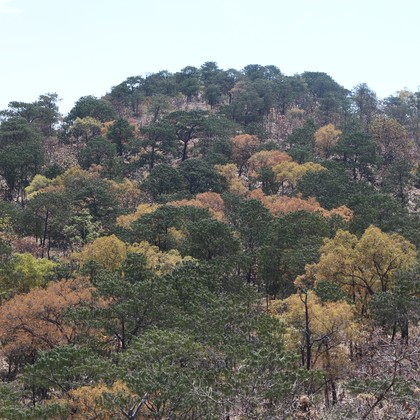
Wooded river valleys and riparian woodland with tall trees, oak woodland and humid broadleaf forest; in Baja California also trees along streams in chaparral country. Outside the breeding season also wooded pasture, parks and gardens. Hunts from a branch at the edge of a clearing or beside water. Nests high in a tree, usually near water.
Where the bird is most at home, classified by the vegetation units of Mexico and Central America.




Range and movements
Resident in north-eastern Mexico, in Coahuila, Nuevo León and Tamaulipas, south into Veracruz, and in northern Baja California. In winter, from October to March, scattered through interior Mexico, from Chihuahua and Durango to Jalisco, Michoacán, Guanajuato and the Valley of Mexico, and scarce in Baja California Sur. Further south in the guide area only as a vagrant. Outside the guide area in the eastern United States and south-eastern Canada and in California.
- Resident
- dark = core range, pale = thinly spread
How and when to look
In the river valleys around Monterrey and along the rivers of Tamaulipas it is present all year and easiest to find in late winter, when a pair circles calling over the wood. In northern Baja California it perches in oaks and cottonwoods along streams in the valleys.
Conservation status
Not threatened. Local in the guide area; sensitive to the clearance of riparian woodland and the drying-out of streams.
Scientific name
Buteo lineatus | (Gmelin, 1788)
Gmelin described the species in 1788 as Falco lineatus; because it was later moved to another genus, the author and year stand in brackets. The genus Buteo was introduced in 1799 by De Lacépède. Buteo is the Latin word for a buzzard. lineatus is Latin for 'lined, striped', after the fine streaks and barring of the plumage. The specimen the first description was based on came from Long Island, New York, USA.