The habitats of North Africa and the Middle East
Every species in this guide is linked to the habitats where it most occurs in North Africa and the Middle East. The classification was written for this guide itself: ten main groups, from forest to built-up areas, and beneath them a series of more specific formations — from maquis and steppe to sand desert, oasis and coral coast. Each bird has at most three of these formations: not everywhere it has ever been seen, but where it truly belongs.
Select a habitat to read its description.
Forest and scrub A
Forest is scarce and highly fragmented in North Africa and the Middle East. It is confined to the wetter slopes of the mountains along the Mediterranean, the highlands of south-western Arabia and narrow strips along rivers and in oases. Precisely for that reason these woodlands hold many species that are absent elsewhere in the region, including endemics of the Atlas Mountains and the Arabian highlands, and they serve as important stopover sites for migrants.
-
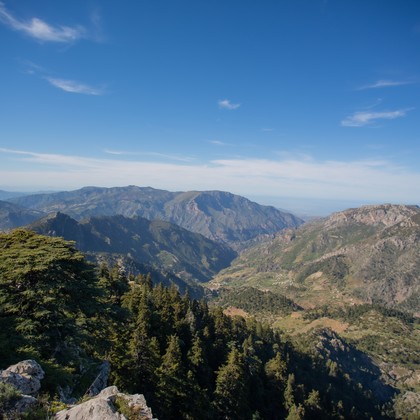 Mediterranean forest and maquis A1
Talassemtane National Park, Rif, Morocco
95 species
Along the Mediterranean, the hills and lower mountain slopes carry forests of holm oak, cork oak and Aleppo pine, interspersed with maquis: dense evergreen scrub of mastic, strawberry tree and wild olive, among others. This formation occurs in northern Morocco, Algeria and Tunisia, on the Jebel Akhdar in Cyrenaica (Libya) and in the hills of Lebanon, Syria, Israel and northern Jordan. In spring, breeding birds such as Sardinian Warbler (Curruca melanocephala), Moussier's Redstart (Phoenicurus moussieri) and African Blue Tit (Cyanistes teneriffae) are in song, while summer visitors such as Common Nightingale (Luscinia megarhynchos), European Turtle Dove (Streptopelia turtur) and Eurasian Scops Owl (Otus scops) return from Africa. Levaillant's Woodpecker (Picus vaillantii) lives in the west, Syrian Woodpecker (Dendrocopos syriacus) and Masked Shrike (Lanius nubicus) in the Levant. In winter, European Robin (Erithacus rubecula), Song Thrush (Turdus philomelos) and Redwing (Turdus iliacus) from Europe swell the numbers in the scrub.
-
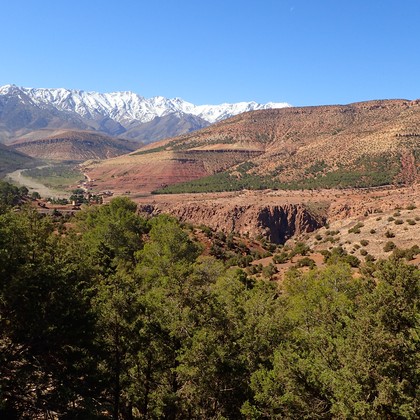 Subtropical montane and juniper forest A2
Azgour, High Atlas, Morocco
62 species
Higher in the mountains, Mediterranean woodland gives way to montane forests of cedar, fir and juniper. Extensive forests of Atlas cedar grow in the Middle and High Atlas of Morocco and in the Algerian Atlas, and remnants of the cedar forest survive in Lebanon. In south-western Arabia, juniper forests cover the slopes of the Asir Mountains in Saudi Arabia and the highlands of Yemen; Socotra has montane woodland with its own endemics. The Atlas holds Atlas Pied Flycatcher (Ficedula speculigera), Levaillant's Woodpecker (Picus vaillantii) and the rare Algerian Nuthatch (Sitta ledanti), while Syrian Serin (Serinus syriacus) occurs in Lebanon and neighbouring ranges. The Arabian juniper forests are home to Asir Magpie (Pica asirensis), Arabian Woodpecker (Dendrocoptes dorae), Yemen Thrush (Turdus menachensis), Philby's Partridge (Alectoris philbyi) and Arabian Grosbeak (Rhynchostruthus percivali). Most species are resident; in harsh winters some move down to lower slopes.
-
 Riverine and riparian forest A3
Jordan River at Bethany, Jordan
63 species
Along rivers, streams and springs, a narrow strip of woodland of poplar, willow, tamarisk and rank vegetation grows in an otherwise dry landscape. Examples are the Euphrates poplar woods along the Euphrates and Tigris in Iraq and Syria, the tamarisk thickets of the Jordan Valley, the vegetation along the Nile and the trees in the wadis of south-western Arabia. These green ribbons are vital for migrants: in spring and autumn, Semi-collared Flycatcher (Ficedula semitorquata), Eurasian Golden Oriole (Oriolus oriolus), Willow Warbler (Phylloscopus trochilus) and many Acrocephalus warblers stop over here. Breeding birds include Black Francolin (Francolinus francolinus), Dead Sea Sparrow (Passer moabiticus) and Palestine Sunbird (Cinnyris osea); in the wadis of south-western Arabia, African species such as Grey-headed Kingfisher (Halcyon leucocephala) and Red-eyed Dove (Streptopelia semitorquata) are added.
Savanna and thorn scrub B
Savanna and thorn scrub form the transition between desert and forest: open landscapes with scattered trees and shrubs, mainly acacias, over grass and bare ground. In the region they lie mainly in the south and east of the Arabian Peninsula, where African and Asian bird species meet. The bird community depends strongly on rainfall and is supplemented in winter by migrants from Central Asia.
-
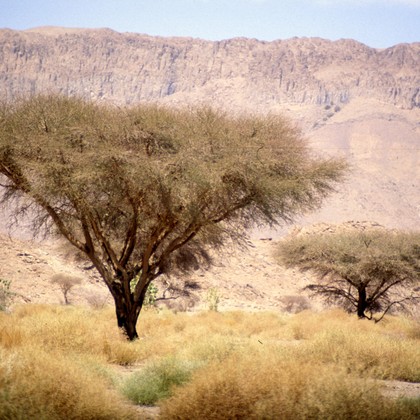 Acacia savanna B1
Hoggar, Tamanrasset, Algeria
64 species
Acacia savanna consists of open grassland with scattered umbrella acacias and other thorny trees. In the region this formation lies mainly in south-western Arabia: the Tihama coastal plain and the foothills of the mountains in Yemen and south-western Saudi Arabia, and the lower parts of Dhofar in Oman. The bird community is largely African in character, with species such as Arabian Bustard (Ardeotis arabs), African Grey Hornbill (Lophoceros nasutus), Abyssinian Roller (Coracias abyssinicus), Rüppell's Weaver (Ploceus galbula), Arabian Golden Sparrow (Passer euchlorus) and Black Scrub Robin (Cercotrichas podobe). Large raptors such as Bateleur (Terathopius ecaudatus) and Lappet-faced Vulture (Torgos tracheliotos) forage here. The summer monsoon rains trigger the breeding season; White-throated Bee-eater (Merops albicollis) is a summer visitor that arrives from Africa at that time.
-
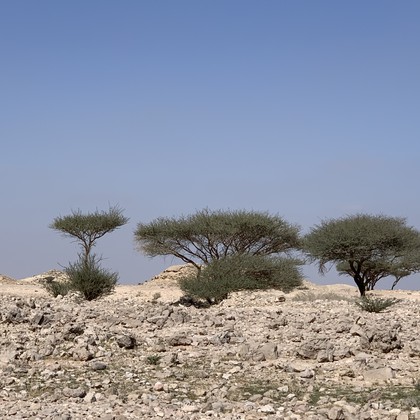 Thorn scrub of the Arabian plains B2
Jebel Hafeet Desert Park, Al Ain, UAE
44 species
On the dry plains of eastern Arabia grows an open thorn scrub of acacias, ghaf (Prosopis cineraria) and other drought-resistant shrubs, often on sand or gravel. This formation extends across the United Arab Emirates, Oman, Qatar, Bahrain, Kuwait and eastern Saudi Arabia into southern Iraq. Resident species include Arabian Babbler (Argya squamiceps), Grey Francolin (Ortygornis pondicerianus), Arabian Green Bee-eater (Merops cyanophrys), Black-crowned Sparrow-Lark (Eremopterix nigriceps) and Pallid Scops Owl (Otus brucei). In winter the scrub changes character markedly: Grey Hypocolius (Hypocolius ampelinus), Turkestan Shrike (Lanius phoenicuroides), Isabelline Shrike (Lanius isabellinus), Plain Leaf Warbler (Phylloscopus neglectus) and Hume's Whitethroat (Curruca althaea) then arrive from Asia, and in spring and autumn large numbers of songbirds pass through.
Steppe and semi-desert C
Steppe and semi-desert cover large parts of the region between the forested mountains and the true desert. They are open, treeless landscapes of grasses, cushion-forming dwarf shrubs and herbs, where rainfall is too low for forest but sufficient for a closed or semi-closed vegetation. Larks, wheatears, sandgrouse, bustards and raptors dominate, and in winter many migrants from Europe and Asia stay here.
-
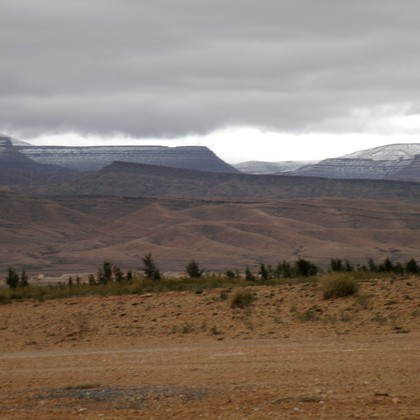 Alfa steppe and high plateau C1
Near Bou Saâda, Algeria
43 species
On the high plateaus between the Tell Atlas and the Saharan Atlas in Algeria, and in eastern Morocco and central Tunisia, lies an extensive steppe dominated by tussocks of alfa grass (Stipa tenacissima), alternating with wormwood and bare plains. Winters are cold with night frost, summers hot and dry. Characteristic breeding birds are Dupont's Lark (Chersophilus duponti), Thick-billed Lark (Ramphocoris clotbey), Temminck's Lark (Eremophila bilopha), Red-rumped Wheatear (Oenanthe moesta), Black-bellied Sandgrouse (Pterocles orientalis) and Houbara Bustard (Chlamydotis undulata). Lesser Kestrel (Falco naumanni) and Lanner Falcon (Falco biarmicus) hunt over the plains. Winter rains are followed in spring by a short, intense breeding season. In winter, Eurasian Dotterel (Eudromias morinellus) and Great Grey Shrike (Lanius excubitor) are among the species staying here, and flocks of larks and sandgrouse roam the plains.
-
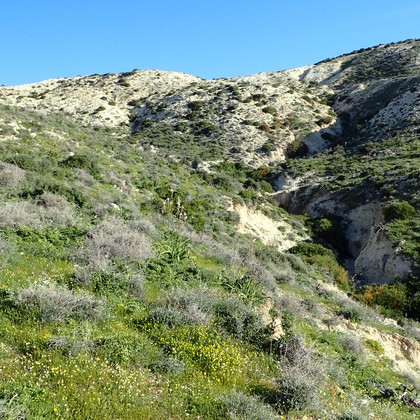 Garrigue and herbaceous steppe C2
Near Petra tou Romiou, Cyprus
91 species
Garrigue is a low, open vegetation of aromatic dwarf shrubs such as thyme, sage and thorny burnet, often on limestone and interspersed with bare rock and grassy patches. Inland it grades into herbaceous steppe of grasses and annual plants. This formation occurs in Morocco, in the Levant (Israel, Lebanon, Syria and Jordan) and in the Syrian and Iraqi steppe. In spring the landscape flowers briefly but profusely, and Calandra Lark (Melanocorypha calandra), Bimaculated Lark (Melanocorypha bimaculata), Eastern Black-eared Wheatear (Oenanthe melanoleuca) and Sardinian Warbler (Curruca melanocephala) are in song. Morocco holds a small population of Great Bustard (Otis tarda) and wintering Little Bustard (Tetrax tetrax), and Northern Bald Ibis (Geronticus eremita) forages there in coastal steppe. In winter, Finsch's Wheatear (Oenanthe finschii), Short-eared Owl (Asio flammeus) and large flocks of larks and pipits stay here; Sociable Lapwing (Vanellus gregarius) winters in the Syrian and Iraqi steppe.
Grassland and high mountains D
Above the treeline of the highest mountains lie open grasslands, scree slopes and alpine vegetation. In the region this is a small and highly fragmented area, spread over the High Atlas, the mountains of Lebanon and Mount Hermon, and the highlands of Yemen and south-western Saudi Arabia. The climate is cool to cold, with snow in winter in the northern ranges, and the bird community is a mix of widespread mountain species and local endemics.
-
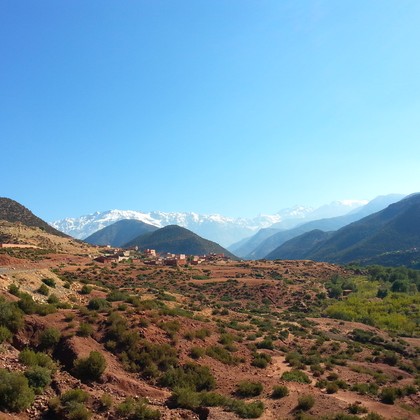 Grassland and alpine vegetation of the high mountains D1
Jebel Toubkal, Morocco
26 species
Above the treeline, forest gives way to short grassland, cushion-forming thorny shrubs, scree slopes and rocky plateaus. In the High Atlas of Morocco, with Toubkal as North Africa's highest summit, this zone begins at around 2,500 to 3,000 metres; it also occurs on the highest parts of the Lebanese mountains and Mount Hermon and, in a subtropical form, on the high plateaus of Yemen and the Asir Mountains. The Atlas holds breeding Seebohm's Wheatear (Oenanthe seebohmi), Horned Lark (Eremophila alpestris), African Crimson-winged Finch (Rhodopechys alienus), Red-billed Chough (Pyrrhocorax pyrrhocorax) and Alpine Chough (Pyrrhocorax graculus), and Bearded Vulture (Gypaetus barbatus) patrols the slopes. Buff-breasted Wheatear (Oenanthe bottae) and Yemen Linnet (Linaria yemenensis) live in the Arabian highlands. Breeding takes place in the short summer; in winter snow covers the ground in the northern ranges and many birds move to lower slopes.
Desert E
Desert covers most of North Africa and the Arabian Peninsula, from the Sahara in Morocco, Algeria, Libya and Egypt to the Arabian deserts, including the Rub' al Khali in Saudi Arabia, Oman, Yemen and the United Arab Emirates. Rainfall is scant and erratic, and temperatures range from night frost in winter to extreme summer heat. The avifauna is poor in species but highly specialised, with larks, wheatears, sandgrouse and bustards. Wadis and oases are vital resting and drinking places for migrants.
-
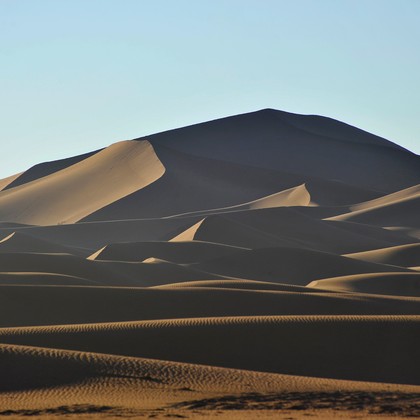 Sand desert E1
Erg Chegaga, Morocco
15 species
Sand desert consists of vast dune fields (ergs) and sand plains with very sparse cover of tough grasses and scattered shrubs. Major sand seas lie in Algeria (Grand Erg Occidental and Oriental), eastern Morocco (Erg Chebbi), the Great Sand Sea on the Egypt–Libya border, and on the Arabian Peninsula in the Rub' al Khali, the Nafud of Saudi Arabia and the Wahiba Sands of Oman. Breeding depends strongly on rainfall and mostly takes place in late winter and spring. Characteristic species include Greater Hoopoe-Lark (Alaemon alaudipes), Cream-coloured Courser (Cursorius cursor), Desert Sparrow (Passer simplex), African Desert Warbler (Curruca deserti), Egyptian Nightjar (Caprimulgus aegyptius), Spotted Sandgrouse (Pterocles senegallus) and Houbara Bustard (Chlamydotis undulata). Asian Desert Warbler (Curruca nana) and MacQueen's Bustard (Chlamydotis macqueenii) winter in Arabia, and countless migrants cross the sand in spring and autumn.
-
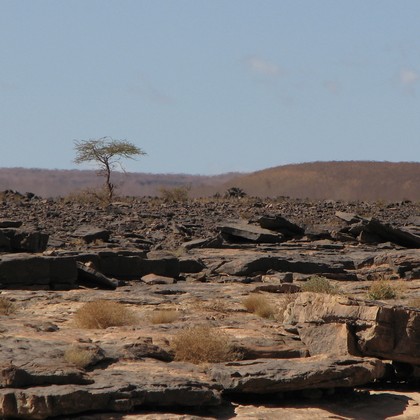 Stone desert E2
Reg in the Sahara, Morocco
41 species
Stone desert comprises the bare gravel plains (reg) and rocky plateaus (hamada) that cover a larger area of the Sahara and Arabia than the dunes. Vegetation is limited to low shrublets and short-lived herbs after rain. Examples include the hamadas of eastern Morocco and Algeria, the Libyan plateaus, Egypt's Eastern Desert, the Negev in Israel, the basalt desert of eastern Jordan and much of central Saudi Arabia. Typical breeders are Thick-billed Lark (Ramphocoris clotbey), Temminck's Lark (Eremophila bilopha), Desert Lark (Ammomanes deserti), Crowned Sandgrouse (Pterocles coronatus), White-crowned Wheatear (Oenanthe leucopyga), Trumpeter Finch (Bucanetes githagineus) and Brown-necked Raven (Corvus ruficollis); Lappet-faced Vulture (Torgos tracheliotos) forages here for carrion. After wet winters larks breed in larger numbers. During migration Isabelline Wheatear (Oenanthe isabellina) and Northern Wheatear (Oenanthe oenanthe) rest on the plains, and Steppe Eagle (Aquila nipalensis) passes through, partly wintering in Arabia.
-
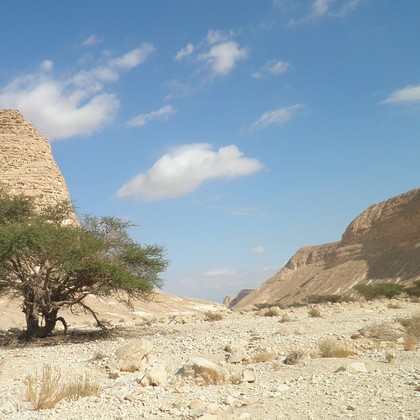 Wadis and dry riverbeds E3
Nahal Barak, Arava, Israel
97 species
Wadis are dry riverbeds that carry water only briefly after heavy rain. Groundwater supports acacias, Ziziphus and tamarisks, offering shade, food and nest sites in an otherwise barren landscape. Wadis are characteristic of Sinai in Egypt, the Negev and Arava in Israel, southern Jordan, the Hajar Mountains of Oman, western Saudi Arabia and Yemen. Typical species are Arabian Babbler (Argya squamiceps), White-spectacled Bulbul (Pycnonotus xanthopygos), Palestine Sunbird (Cinnyris osea), Namaqua Dove (Oena capensis), Sand Partridge (Ammoperdix heyi), Lichtenstein's Sandgrouse (Pterocles lichtensteinii), Pallid Scops Owl (Otus brucei) and Pharaoh Eagle-Owl (Bubo ascalaphus). In spring and autumn migrants such as Ménétries's Warbler (Curruca mystacea) and Lesser Whitethroat (Curruca curruca) refuel in the acacias. Most breeding takes place in spring, in some species partly dependent on rain.
-
 Oasis and date-palm groves E4
Figuig oasis, Morocco
86 species
Oases are places where spring or ground water allows agriculture in the midst of the desert. Date palms form a tall canopy above irrigation channels, fruit trees, vegetable gardens and small fields. Well-known oases lie in the Drâa and Tafilalt areas of Morocco, around Biskra and Ghardaïa in Algeria, around Tozeur and Kebili in Tunisia, at Siwa, Dakhla and Kharga in Egypt, at Al-Ahsa in Saudi Arabia and around Al Ain in the United Arab Emirates. Residents include House Bunting (Emberiza sahari), Rufous-tailed Scrub Robin (Cercotrichas galactotes), Laughing Dove (Spilopelia senegalensis), Common Bulbul (Pycnonotus barbatus), Grey Francolin (Ortygornis pondicerianus) and, in the east, White-eared Bulbul (Pycnonotus leucotis). Oases are above all important stopover sites: in spring and autumn Willow Warbler (Phylloscopus trochilus), Garden Warbler (Sylvia borin), European Pied Flycatcher (Ficedula hypoleuca), Red-backed Shrike (Lanius collurio) and Eurasian Hoopoe (Upupa epops) rest here before or after crossing the desert.
Rocky terrain F
Rocky terrain includes high mountains, bare rock massifs, gorges and sea cliffs. Key ranges are the Atlas in Morocco and Algeria, the Ahaggar and Tassili n'Ajjer in the Sahara, the Sinai mountains, Mount Lebanon and the Anti-Lebanon, the Asir and Hejaz ranges of Saudi Arabia, the Yemen highlands and the Hajar Mountains of Oman and the United Arab Emirates. Cliffs provide nest sites for vultures, eagles, falcons, owls, swifts and crag martins. This is also the realm of wheatears, rock thrushes and partridges, including several species found only in this region.
-
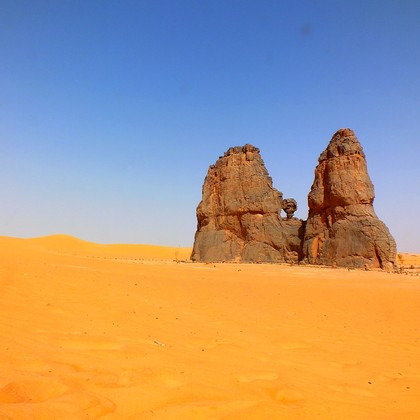 Mountains and rock formations F1
Tassili n'Ajjer, Algeria
98 species
This formation covers mountain slopes, rock massifs and high plateaus above the tree line, with bare rock, scree and low, often spiny cushion plants. In Morocco's High Atlas, which rises above 4,000 metres, Atlas Crimson-winged Finch (Rhodopechys alienus), Horned Lark (Eremophila alpestris), Red-billed Chough (Pyrrhocorax pyrrhocorax), Alpine Chough (Pyrrhocorax graculus), Moussier's Redstart (Phoenicurus moussieri), Atlas Wheatear (Oenanthe seebohmi) and Barbary Partridge (Alectoris barbara) breed, and Bearded Vulture (Gypaetus barbatus) still occurs. Sinai Rosefinch (Carpodacus synoicus) lives in the mountains of Sinai, the Negev and southern Jordan, Chukar (Alectoris chukar) in Lebanon, and Arabian Partridge (Alectoris melanocephala) and Philby's Partridge (Alectoris philbyi) in the south-west of the Arabian Peninsula. Socotra (Yemen) holds its own endemics, such as Socotra Bunting (Emberiza socotrana) and Socotra Buzzard (Buteo socotraensis). Many mountain birds move lower in winter, when Alpine Accentor (Prunella collaris) and Wallcreeper (Tichodroma muraria) also appear on lower crags.
-
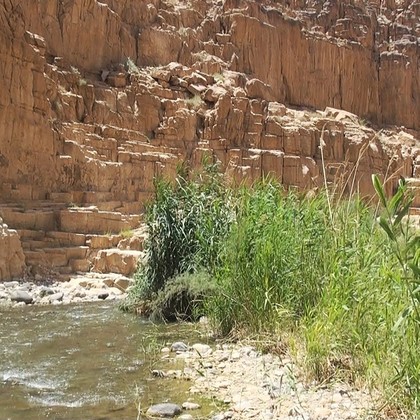 Gorges and canyons F2
Wadi Mujib, Jordan
48 species
Gorges and canyons are deeply incised valleys with sheer rock walls, sometimes with a permanent stream fringed by oleander, tamarisk or reeds. Well-known examples are the Todra and Dadès gorges in Morocco, the gorges of the Aurès in Algeria, Wadi Mujib and the Petra area in Jordan, the cliffs around Ein Gedi by the Dead Sea in Israel and the Qadisha Valley in Lebanon. Characteristic species are Tristram's Starling (Onychognathus tristramii), Fan-tailed Raven (Corvus rhipidurus), Pale Crag Martin (Ptyonoprogne obsoleta), Little Swift (Apus affinis), Bonelli's Eagle (Aquila fasciata), Griffon Vulture (Gyps fulvus), Desert Owl (Strix hadorami) and Mourning Wheatear (Oenanthe lugens); in Morocco also Black Wheatear (Oenanthe leucura) and, along mountain streams, White-throated Dipper (Cinclus cinclus). Most species are resident and breed in spring in crevices and on ledges. Updrafts along the walls attract passing raptors during migration.
-
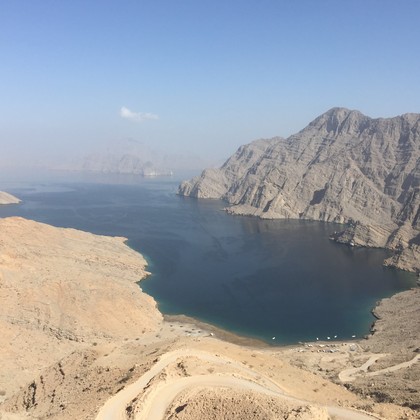 Coastal cliffs and islands F3
Khasab, Musandam, Oman
28 species
Coastal cliffs and islands include sea cliffs along the Mediterranean and Atlantic coasts and the many small islands in the Mediterranean, the Red Sea, the Persian Gulf and the Arabian Sea. They matter above all as predator-free breeding sites for seabirds. On Morocco's Atlantic coast Northern Bald Ibis (Geronticus eremita) nests on sea cliffs near Souss-Massa, and Eleonora's Falcon (Falco eleonorae) on the islands off Essaouira. Audouin's Gull (Ichthyaetus audouinii), European Shag (Gulosus aristotelis) and European Storm Petrel (Hydrobates pelagicus) breed on Mediterranean islets. In the Red Sea, White-eyed Gull (Ichthyaetus leucophthalmus), Bridled Tern (Onychoprion anaethetus), Brown Booby (Sula leucogaster) and Red-billed Tropicbird (Phaethon aethereus) are typical; in the Persian Gulf Socotra Cormorant (Phalacrocorax nigrogularis) breeds. Eleonora's Falcon and Sooty Falcon (Falco concolor) breed in late summer, when migrating songbirds are available as prey.
Inland waters and marsh G
Fresh water is scarce in North Africa and the Middle East, and where it occurs it attracts large numbers of birds. Key waters are the Nile and its delta, the Euphrates and Tigris with the Mesopotamian Marshes in Iraq, the Jordan Valley, the wetlands of Morocco, Algeria and Tunisia and the salt flats and lagoons along the coasts. Reservoirs and fishponds have also become increasingly important. These waters are vital staging and wintering areas for ducks, waders, herons, pelicans and cranes on the flyways between Eurasia and Africa.
-
 Rivers and the Nile Delta G1
River Nile, Egypt
83 species
This formation covers flowing rivers with their banks, sandbars, riverine woodland and the wet farmland of river deltas. The Nile forms a green ribbon through Egypt and fans out into the Nile Delta with canals, rice fields and lagoons. In the east the Euphrates and Tigris flow through Syria and Iraq; the Jordan and Moroccan rivers such as the Moulouya and Sebou are also important. Characteristic species are Pied Kingfisher (Ceryle rudis), Egyptian Goose (Alopochen aegyptiaca), Spur-winged Lapwing (Vanellus spinosus), White-throated Kingfisher (Halcyon smyrnensis), Senegal Coucal (Centropus senegalensis) in the Nile Delta, Iraq Babbler (Argya altirostris) in Iraq and Great Stone-curlew (Esacus recurvirostris) on sandbars. In winter large numbers of Black-headed Gulls (Chroicocephalus ridibundus), Whiskered Terns (Chlidonias hybrida), herons and ducks gather here, and river valleys serve as flyways for swallows and wagtails.
-
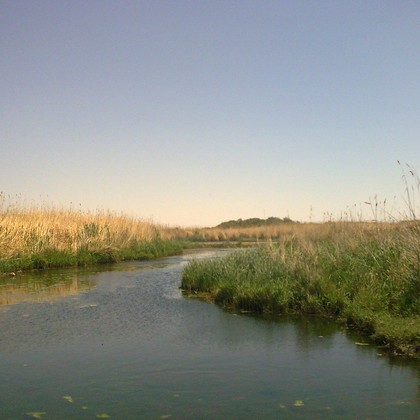 Reedbeds and marshland G2
Azraq Wetland Reserve, Jordan
135 species
Reedbeds and marshland are shallow, vegetated waters with stands of reed, rushes, papyrus or bulrush, interspersed with open pools and wet meadows. The largest wetland is the Mesopotamian Marshes of southern Iraq. Other key sites include the Hula Valley in Israel, the Nile Delta lagoons such as Manzala and Burullus in Egypt, Ichkeul in Tunisia, the wetlands around El Kala in Algeria and Merja Zerga in Morocco. Basra Reed Warbler (Acrocephalus griseldis) and Iraq Babbler (Argya altirostris) breed in Iraq; other characteristic species are Purple Heron (Ardea purpurea), Little Bittern (Botaurus minutus), Western Marsh Harrier (Circus aeruginosus), Ferruginous Duck (Aythya nyroca), Marbled Duck (Marmaronetta angustirostris) and Great Reed Warbler (Acrocephalus arundinaceus), with Red-knobbed Coot (Fulica cristata) in Morocco. In winter large numbers of ducks and herons stay in these marshes, and tens of thousands of Common Cranes (Grus grus) winter in the Hula Valley.
-
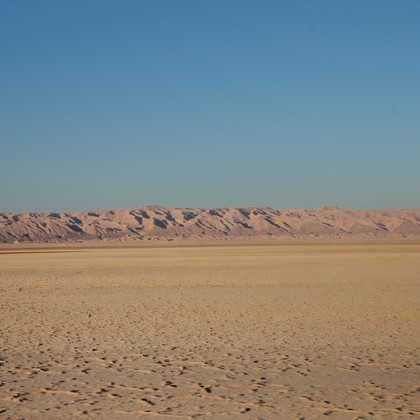 Salt lakes, chotts and sabkhas G3
Chott el Djerid, Tunisia
53 species
Salt lakes, chotts and sabkhas are flat, saline depressions that flood after winter rain and dry out to salt crusts in summer. Vegetation is limited to salt-tolerant plants along the margins. Large chotts lie in Tunisia (Chott el Djerid) and Algeria (Chott Melrhir); sabkhas and coastal lagoons occur along the Libyan coast, the coasts of the Gulf states, Lake Bardawil in northern Sinai and Wadi El Natrun in Egypt, and Syria holds the salt lake Sabkhat al-Jabbul. After wet winters Greater Flamingo (Phoenicopterus roseus) breeds here, sometimes in large colonies. Other characteristic species are Pied Avocet (Recurvirostra avosetta), Black-winged Stilt (Himantopus himantopus), Kentish Plover (Anarhynchus alexandrinus), Slender-billed Gull (Chroicocephalus genei), Gull-billed Tern (Gelochelidon nilotica), White-headed Duck (Oxyura leucocephala) and Lesser Short-toed Lark (Alaudala rufescens). During migration and winter large numbers of waders such as Little Stint (Calidris minuta) and Dunlin (Calidris alpina) rest here.
-
 Reservoirs and artificial waters G4
Lake Qaraoun, Beqaa, Lebanon
106 species
This formation covers reservoirs, fishponds, sewage lagoons, irrigation basins and other man-made waters. Large reservoirs include Lake Nasser in Egypt, Lake Assad in Syria and the reservoirs of Iraq, Morocco and Tunisia. In Israel fishponds in the Hula and Beit She'an valleys are important feeding areas, and in the Gulf states sewage lagoons in the desert attract many birds. Characteristic species are Great Crested Grebe (Podiceps cristatus), Black-necked Grebe (Podiceps nigricollis), Tufted Duck (Aythya fuligula), White-headed Duck (Oxyura leucocephala), Marbled Duck (Marmaronetta angustirostris), Black-headed Gull (Chroicocephalus ridibundus) and Osprey (Pandion haliaetus). During migration Great White Pelican (Pelecanus onocrotalus), White Stork (Ciconia ciconia) and Common Crane (Grus grus) use these waters as stopover sites. In winter large numbers of ducks and grebes stay here, and because of their desert setting they regularly attract vagrants from Asia and North America.
Sea and coast H
North Africa and the Middle East are bordered by very different seas: the Atlantic Ocean along Morocco, the Mediterranean, the warm and saline Red Sea, the shallow Persian Gulf and the Gulf of Oman with the Arabian Sea. This main group covers the open sea, mangrove forests, lagoons with beaches and tidal flats, and coral coasts. For birds these coasts are of great importance as breeding sites for seabirds and terns and as wintering and staging areas for waders and gulls.
-
 Open sea H1
Bab-el-Mandeb, Red Sea
61 species
The open sea comprises the waters beyond sight of land, where birds live almost entirely on the water or in the air and come ashore only to breed, often on barren islands. In the Mediterranean this includes Scopoli's Shearwater (Calonectris diomedea), Yelkouan Shearwater (Puffinus yelkouan), Audouin's Gull (Ichthyaetus audouinii) and Eleonora's Falcon (Falco eleonorae), which breeds late in summer and hunts migrating songbirds. Along the Atlantic coast of Morocco, Northern Gannet (Morus bassanus), Great Skua (Stercorarius skua) and Grey Phalarope (Phalaropus fulicarius) pass in autumn and winter. In the Red Sea, the Gulf of Oman and the Arabian Sea tropical species occur, such as Red-billed Tropicbird (Phaethon aethereus), Masked Booby (Sula dactylatra), Persian Shearwater (Puffinus persicus) and Wilson's Storm Petrel (Oceanites oceanicus). Socotra Cormorant (Phalacrocorax nigrogularis) breeds in large colonies on islands in the Persian Gulf. Many species are best seen from boats or during seawatches from headlands.
-
 Mangrove H2
Khor Kalba, UAE
24 species
Mangrove in this region consists almost entirely of low forests of Grey Mangrove (Avicennia marina), growing in sheltered, muddy bays and creeks in the intertidal zone. It occurs along the Red Sea in Egypt, Saudi Arabia and Yemen, along the Persian Gulf in the United Arab Emirates, Qatar and Bahrain among others, and along the coast of Oman. Mangroves provide shelter and feeding sites for herons and high-tide roosts for waders, which are most numerous from autumn to spring. Characteristic species are Striated Heron (Butorides striata), Western Reef Heron (Egretta gularis), Goliath Heron (Ardea goliath), Crab-plover (Dromas ardeola), Terek Sandpiper (Xenus cinereus), Clamorous Reed Warbler (Acrocephalus stentoreus) and Collared Kingfisher (Todiramphus chloris), which in the region is almost confined to mangroves. Osprey (Pandion haliaetus) and Eurasian Whimbrel (Numenius phaeopus) are also regularly seen.
-
 Lagoons, beaches and tidal flats H3
Khenifiss National Park, Morocco
123 species
This formation comprises sandy beaches, coastal lagoons, salt pans, mudflats and tidal flats. Important areas lie on the Atlantic coast of Morocco, in the Gulf of Gabès in Tunisia, in the lagoons of the Nile Delta in Egypt, along the Persian Gulf in Kuwait, Bahrain and the Emirates, and on the coast of Oman. From autumn to spring large numbers of waders winter here, such as Dunlin (Calidris alpina), Little Stint (Calidris minuta), Bar-tailed Godwit (Limosa lapponica), Grey Plover (Pluvialis squatarola) and Kentish Plover (Anarhynchus alexandrinus); many more pass through on migration. Shallow saline lagoons attract Greater Flamingo (Phoenicopterus roseus), Pied Avocet (Recurvirostra avosetta) and Eurasian Spoonbill (Platalea leucorodia). In summer Little Tern (Sternula albifrons), Gull-billed Tern (Gelochelidon nilotica), Caspian Tern (Hydroprogne caspia) and Slender-billed Gull (Chroicocephalus genei) breed on beaches and islets, and in the Gulf also Crab-plover (Dromas ardeola) and Saunders's Tern (Sternula saundersi).
-
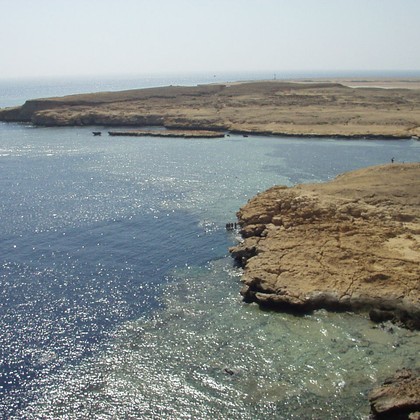 Coral coast H4
Ras Muhammad, Sinai, Egypt
10 species
The coral coast consists of rocky and sandy shores with fringing reefs, coral islets and shallow clear waters. This formation is especially typical of the Red Sea, along the coasts of Egypt, Israel (Eilat), Saudi Arabia and Yemen, and also occurs in parts of the Persian Gulf and along Oman. On bare coral islets colonies of Bridled Tern (Onychoprion anaethetus), White-cheeked Tern (Sterna repressa), Lesser Crested Tern (Thalasseus bengalensis), Roseate Tern (Sterna dougallii) and Brown Noddy (Anous stolidus) breed in summer, often together with Brown Booby (Sula leucogaster). White-eyed Gull (Ichthyaetus leucophthalmus) is endemic to the Red Sea and Gulf of Aden; Sooty Gull (Ichthyaetus hemprichii) occurs more widely in the region. Western Reef Heron (Egretta gularis) and Striated Heron (Butorides striata) feed along the reefs. Outside the breeding season many terns disperse out to sea.
Farmland I
Agriculture has a very long history in North Africa and the Middle East: crops have been grown for thousands of years in the Fertile Crescent, the Nile Valley and the Maghreb. This main group covers fields and irrigated farmland as well as orchards, olive groves and date plantations. In a dry region, irrigated crops and shaded orchards form green islands that attract resident birds as well as large numbers of migrants and winter visitors.
-
 Fields and irrigated farmland I1
Akka oasis, Morocco
179 species
This formation includes cereal fields, pastures, fallow land and irrigated farmland, from the plains of Morocco and Tunisia to the Nile Valley and Delta in Egypt, the Euphrates and Tigris basin in Iraq and the centre-pivot irrigated fields of Saudi Arabia. Resident species include Crested Lark (Galerida cristata), Zitting Cisticola (Cisticola juncidis), Spanish Sparrow (Passer hispaniolensis) and Western Cattle Egret (Ardea ibis), which often feeds behind ploughs and livestock. In winter Common Crane (Grus grus), Northern Lapwing (Vanellus vanellus), Eurasian Skylark (Alauda arvensis), Meadow Pipit (Anthus pratensis) and raptors such as Western Marsh Harrier (Circus aeruginosus) and Common Kestrel (Falco tinnunculus) appear. During spring and autumn migration White Stork (Ciconia ciconia), Western Yellow Wagtail (Motacilla flava) and Rosy Starling (Pastor roseus) rest on the fields. In Morocco, Little Bustard (Tetrax tetrax) and Great Bustard (Otis tarda) also occur on open farmland.
-
 Orchards, olive and date plantations I2
Orchards near Meknes, Morocco
117 species
Orchards, olive groves and date palm plantations form a semi-open, man-made wooded landscape. Olive groves are widespread in Morocco, Tunisia and the Levant; date palms dominate the oases of the Sahara and the Arabian Peninsula, the Nile Valley and southern Iraq. Many resident birds, such as Eurasian Collared Dove (Streptopelia decaocto), Laughing Dove (Spilopelia senegalensis), Eurasian Hoopoe (Upupa epops) and bulbuls (White-spectacled Bulbul, Pycnonotus xanthopygos, in the Levant and Arabia; Common Bulbul, Pycnonotus barbatus, in the Maghreb), find food and nest sites here. In summer European Turtle Dove (Streptopelia turtur), Eurasian Golden Oriole (Oriolus oriolus) and Woodchat Shrike (Lanius senator) breed, and in the Levant also Olive-tree Warbler (Hippolais olivetorum). During migration plantations are important stopover sites for songbirds. In winter Hypocolius (Hypocolius ampelinus), a Middle Eastern speciality, is found mainly in date palm plantations around the Persian Gulf.
Built-up areas J
Built-up areas include towns, villages, gardens and parks. In a largely arid region irrigated gardens and parks provide water, shade and food, and buildings serve as nest sites for species that naturally breed on cliffs. Towns along the coasts and in oases also attract migrants that rest there temporarily. In addition, non-native species have become established in many cities of the region, especially around the Persian Gulf and in Israel.
-
 Gardens, parks and buildings J1
Koutoubia gardens, Marrakesh, Morocco
139 species
This formation includes city parks, villa gardens, cemeteries, hotel grounds, villages and urban development, from Casablanca and Cairo to Tel Aviv, Riyadh and Dubai. Common residents are House Sparrow (Passer domesticus), Rock Dove (Columba livia), Eurasian Collared Dove (Streptopelia decaocto), Laughing Dove (Spilopelia senegalensis) and White Wagtail (Motacilla alba), and in the Levant and Arabia White-spectacled Bulbul (Pycnonotus xanthopygos) and Palestine Sunbird (Cinnyris osea). Buildings provide nest sites for Common Swift (Apus apus), Pallid Swift (Apus pallidus), Western House Martin (Delichon urbicum) and Lesser Kestrel (Falco naumanni). Non-native species such as House Crow (Corvus splendens), Common Myna (Acridotheres tristis) and Rose-ringed Parakeet (Psittacula krameri) have become numerous in many cities along the Red Sea and the Persian Gulf. In spring and autumn migrants such as Common Chiffchaff (Phylloscopus collybita), Eurasian Blackcap (Sylvia atricapilla) and Spotted Flycatcher (Muscicapa striata) use green gardens and parks as stopover sites; in winter Black Redstart (Phoenicurus ochruros) and European Robin (Erithacus rubecula), among others, spend the season there.
Classification: Sayre, R. et al. (2013), <em>A New Map of Standardized Terrestrial Ecosystems of Africa</em> (NatureServe / USGS / American Association of Geographers), based on the macrogroups of the International Vegetation Classification (IVC). Formations outside the scope of this vegetation classification (open sea, coastal rocks, farmland, built-up land) follow a separate classification written for this guide. The names and descriptions were translated and written for this guide.