All species › Storks › Storks › Abdim's Stork
Abdim's Stork | Ciconia abdimii
Abdims ooievaar | Cigüeña de Abdim
A small, dark stork with white belly and lower back, which in the region breeds only in Yemen and southwestern Saudi Arabia. There, like the White Stork in the Maghreb, it likes to nest in villages: in trees, on roofs and on pylons. It is the Arabian outpost of an African rainy-season migrant.

Voice
Mostly silent. At the colony and roost a soft, whistling two-note squeak and bill-clattering.
No recording with a suitable Creative Commons licence is available for this species yet.
Identification
Head, neck, breast, wings and tail are blackish brown with green and purple gloss; belly, lower back and rump are white. The bare face is blue, with a red patch in front of the eye and red throat skin, brightest in the breeding season. The rather short bill is grey-green with a reddish tip; the legs are dull greyish pink with pink joints and toes. Juveniles are duller brown, with a greyish face. In flight the white lower back is striking; the legs barely project beyond the tail.
Confusion species
Black Stork (Ciconia nigra) is larger, with a long red bill, red legs and a dark back. African Openbill (Anastomus lamelligerus) is all dark, including belly and back, and has a heavy bill with a gap. Glossy Ibis (Plegadis falcinellus) is smaller and has a long, decurved bill.
Habitat
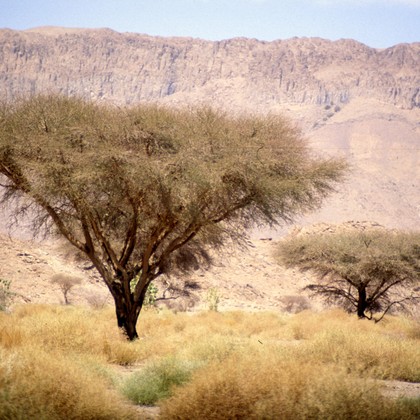
Fields, pastures and open grassy plains, especially after rain, where it catches locusts, caterpillars and other large insects; also around sewage lagoons, rubbish dumps and in acacia savanna. Breeds in loose colonies in villages and small towns, in trees, on roofs and on power pylons.
Where the bird is most at home, classified by the habitats of North Africa and the Middle East.


Range and movements
In the region confined to the southwest of the Arabian Peninsula: breeds patchily in Yemen, in the Tihama and the western highlands, and in southwestern Saudi Arabia in Jizan province (including around Sabya) and the Asir foothills, with groups of up to a few dozen. Elsewhere a rare vagrant, with scattered records in Oman (Dhofar), the Emirates, Egypt (Lake Nasser) and Israel. Beyond the region it breeds in the Sahel from Senegal to Ethiopia and Somalia and moves to East and southern Africa after breeding.
- Resident
- Summer visitor (c. Oct–Mar)
- Winter visitor (c. Apr–Sep)
- Passage (Mar–Apr, Oct–Nov)
- dark = core range, pale = thinly spread
How and when to look
The sewage lagoons and rubbish dump at Sabya and the Heritage Village in Jizan are reliable sites in June–August. In Yemen the birds can be seen on fields and in villages along the Tihama.
Conservation status
Not globally threatened and widespread in Africa, though numbers are declining locally because of locust control with poisons and loss of grassland. The small Arabian population depends on the rains and on villagers' willingness to tolerate the nests.
Scientific name
Ciconia abdimii | Lichtenstein, 1823
Lichtenstein described the species in 1823 and placed it straight away in the genus where it still stands. The genus Ciconia was introduced in 1760 by Brisson. Ciconia is the Latin word for 'stork'. abdimii honours Bey El-Arnaut Abdim (1780–1827), Ottoman Albanian governor of Wadi Halfa in Sudan. The specimen the first description was based on came from Dongola, Sudan.