All species › Passerines › Reed warblers › Basra Reed Warbler
Basra Reed Warbler | Acrocephalus griseldis
Basrakarekiet | Carricero de Basora
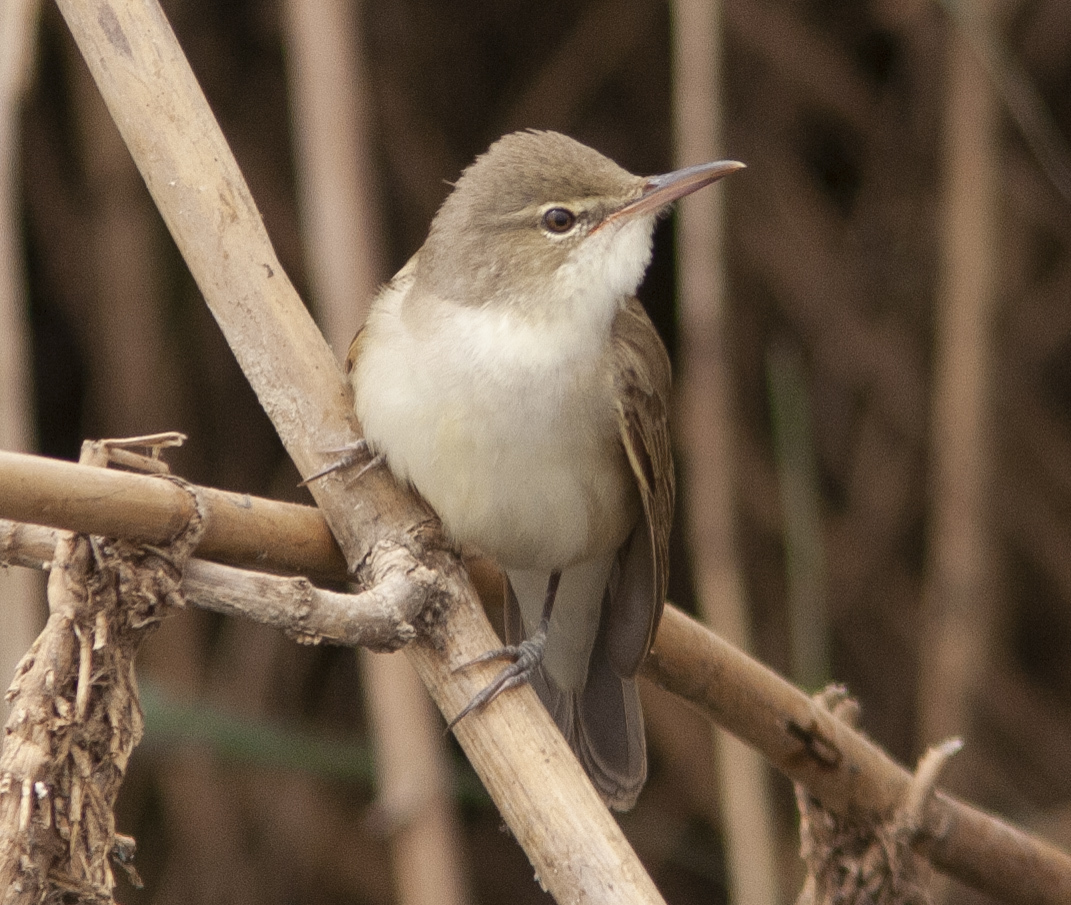
The Basra Reed Warbler is a medium-sized, cold grey-brown reed warbler with a long, slender bill, breeding almost exclusively in the marshes of Mesopotamia and thus one of the true specialities of the region. The entire world population migrates via the Arabian Peninsula and the Levant to East Africa.
Voice
The song resembles a softer, lower and more monotonous version of Great Reed Warbler's, with fewer harsh, grating notes: chuk-chuk-karra-karra-cheek, slowly repeated. The call is a hard chak and a rattling cherr.
Recording: Gregory Askew — CC BY-NC-SA 4.0 · converted to mono · xeno-canto
Identification
16–18 cm. Smaller and slimmer than Great Reed Warbler, larger than Eurasian Reed Warbler. Upperparts plain, cold olive-brown to grey-brown, without a warm tone on the rump; underparts strikingly white, with a pale grey to pale buff wash on the flanks. A narrow but distinct white supercilium to just behind the eye and a dark lore. The bill is long, straight and slender, with a dark upper mandible. Wings long; legs dark grey. Moves nimbly through reeds and bushes, often with slightly raised crown feathers.
Confusion species
Great Reed Warbler (Acrocephalus arundinaceus) is larger and warmer brown, with a stouter, thicker bill, buff flanks and a much heavier, grating song. Clamorous Reed Warbler (Acrocephalus stentoreus) is larger, with a longer, heavier bill, shorter wings and a darker, warmer brown plumage. Eurasian Reed Warbler (Acrocephalus scirpaceus), especially the greyer form fuscus, is smaller, with a shorter bill and a less distinct supercilium. Eastern Olivaceous Warbler (Iduna pallida) is smaller and sandier, with a broader bill and pale tail edges.
Habitat
In the breeding season extensive reed and reedmace marshes with open water, such as the Hawizeh, Central and Hammar marshes. On passage in reeds, tamarisks, bushes, oases, gardens, sewage works and rank edges of irrigated fields, often far from water.
Where the bird is most at home, classified by the habitats of North Africa and the Middle East.



Range and movements
Breeds almost exclusively in the marshes of southern Iraq (Hawizeh, Central and Hammar marshes) and adjacent southwest Iran; in Kuwait a fairly common passage migrant and local summer breeder. In 2007 a small group bred in the Hula Valley in northern Israel, the only breeding outside Mesopotamia; otherwise a scarce migrant in Israel. On passage scarce in Saudi Arabia (Riyadh, Eastern Province, the Red Sea coast and the Farasan Islands), Jordan, Syria and Yemen; a vagrant in Bahrain and the United Arab Emirates. Winters in East Africa, from South Sudan and Ethiopia to Kenya, Tanzania and Mozambique.
- Summer visitor (c. Oct–Mar)
- Passage (Mar–Apr, Oct–Nov)
- dark = core range, pale = thinly spread
How and when to look
In May or June in the reed marshes of southern Iraq, by boat from Chibayish, or in the reedbeds of Jahra in Kuwait. On passage at the ringing stations of Kuwait and Saudi Arabia; look for a reed warbler with a long, slender bill, white underparts and a distinct supercilium.
Conservation status
Endangered. The species declined sharply when the Mesopotamian marshes were drained in the 1990s; after partial reflooding since 2003 the population recovered in part, but drought, upstream dams and salinisation remain the main threats. Disturbance and trapping along the flyway also play a role.
Scientific name
Acrocephalus griseldis | (Hartlaub, 1891)
Hartlaub described the species in 1891 as Calamoherpe griseldis; because it was later moved to another genus, the author and year stand in brackets. The genus Acrocephalus was introduced in 1811 by Naumann & Naumann. Acrocephalus is Greek, from akros 'topmost, pointed' and kephalē 'head'; the Naumanns, who introduced the genus, called these birds Spitzkopf 'pointed head', so they read akros as 'pointed'. griseldis probably comes from Latin griseus 'grey', but the derivation remains uncertain. The specimen the first description was based on came from Nguru, Tanzania.