All species › Passerines › Bushshrikes › Black-Crowned Tchagra
Black-Crowned Tchagra | Tchagra senegalus
Zwartkruintsjagra | Chagra del Senegal
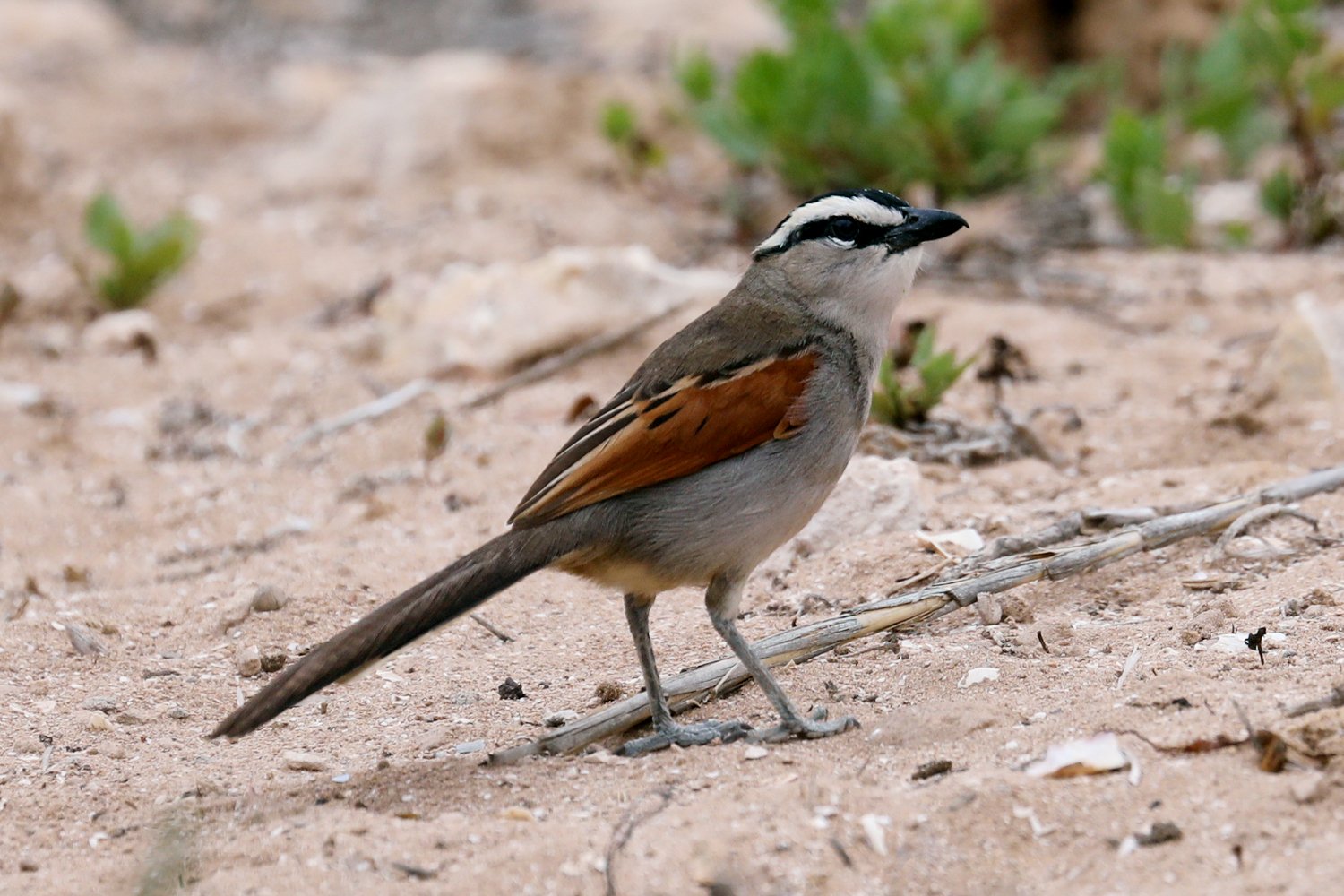
The Black-crowned Tchagra is an African bush-shrike that reaches the region with two isolated forms: in the Maghreb and in southwestern Arabia. It lives hidden in dense scrub, but gives itself away with a loud, melodious whistled song often delivered in a display flight.
Voice
A loud, flowing and descending whistled song, chee-charee, charoo, cheeroo-cheeroo-cheeroo, often in a display flight with rattling wings or from a lookout. Pairs also sing in duet, the female adding a purring chrrrr. Harsh, scolding calls when alarmed.
Recording: Étienne Leroy — CC BY-NC-SA 4.0 · converted to mono · xeno-canto
Identification
20–22 cm. The crown is black from forehead to nape, with a broad whitish to pale buff supercilium below it and a black eyestripe. The back is grey-brown, the wing bright rufous. The underparts are pale grey with a pale buff wash. The tail is long, black with broad white tips, conspicuous in flight. The bill is heavy and black. The sexes are alike. Juveniles have a brownish crown and a horn-coloured bill. Feeds much on the ground and then dashes low into cover.
Confusion species
Almost unmistakable in the region. Woodchat Shrike (Lanius senator) has a chestnut crown and nape, a black mask and black-and-white upperparts without a rufous wing. Rufous-tailed Scrub-Robin (Cercotrichas galactotes) behaves similarly and has a white supercilium, but is smaller, with a rufous tail with black-and-white tips held cocked, and lacks the black crown.
Habitat
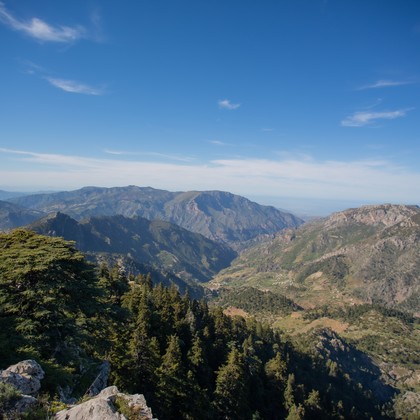
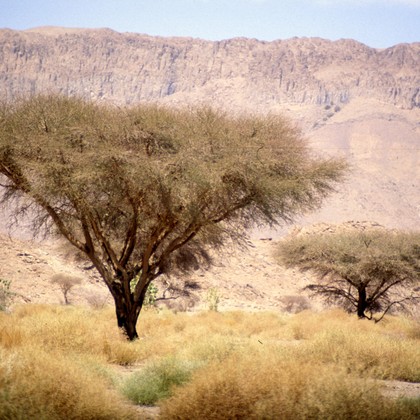
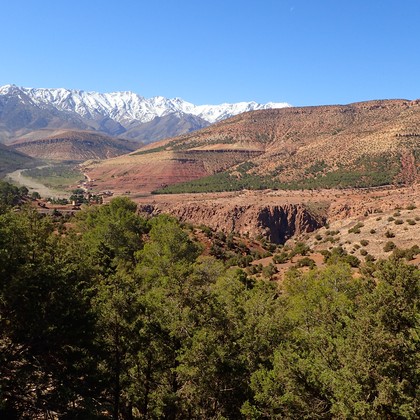
Dense scrub with clearings: maquis, argan woodland, jujube and tamarisk scrub, old olive groves, rough field edges and riverside thickets; in Arabia acacia savanna, vegetated wadis and the monsoon-fog woodland of Dhofar. Feeds on the ground and in low bushes on grasshoppers, beetles and caterpillars.
Where the bird is most at home, classified by the habitats of North Africa and the Middle East.
Range and movements
In northwest Africa the form cucullatus: in Morocco widespread in the Atlantic lowlands, the Souss and the foothills of the Rif and Atlas; in northern Algeria mainly along the coast of Kabylia and the northeast (Bejaia, Skikda, El Tarf); in Tunisia in the north, especially on Cap Bon and around Bizerte. For Libya there are only old records from the northwest. In Arabia the form percivali: in the mountains and foothills of southwestern Saudi Arabia (Asir) and Yemen, and common in Dhofar (southern Oman). Beyond the region across almost all of sub-Saharan Africa.
- Resident
- Summer visitor (c. Oct–Mar)
- Winter visitor (c. Apr–Sep)
- Passage (Mar–Apr, Oct–Nov)
- dark = core range, pale = thinly spread
How and when to look
In Morocco there is a good chance in the scrub around Oued Massa and in the argan woodland of the Souss; in Oman in the vegetated wadis near Salalah, such as Ayn Razat and Wadi Darbat. Listen in spring at dawn for the descending whistled song and look for a bird rising singing above the scrub and gliding down with spread tail.
Conservation status
Not globally threatened and common in Africa. The isolated North African population suffers from loss of scrub through clearance, overgrazing and coastal urbanisation; in Dhofar the species is common.
Scientific name
Tchagra senegalus | (Linnaeus, 1766)
Linnaeus described the species in 1766 as Lanius senegalus; because it was later moved to another genus, the author and year stand in brackets. The genus Tchagra was introduced in 1831 by Lesson. Tchagra is an imitative name, formed after the bird's call. senegalus means 'from Senegal', after the region the first described birds came from. The specimen the first description was based on came from Senegal.