All species › Birds of prey › Hawks, eagles and kites › Black Kite
Black Kite | Milvus migrans
Zwarte wouw | Milano negro
The Black Kite is the commonest large raptor of the region: a dark brown scavenger with a shallow-forked tail that breeds in North Africa, hangs over cities and harbours all year in Egypt and Yemen, and passes in tens of thousands in spring through Gibraltar, Sinai and Eilat. In this guide the Yellow-billed Kite (M. m. aegyptius) is included in this species.
Voice
Noisy at nests and feeding sites: a quavering, whinnying peeeh-i-i-i-i, starting with a high whistle and running into a rapid rattle. The Yellow-billed Kite often calls over cities and harbours.
Recording: Esperanza Poveda — CC BY-NC-SA 4.0 · converted to mono · xeno-canto
Identification
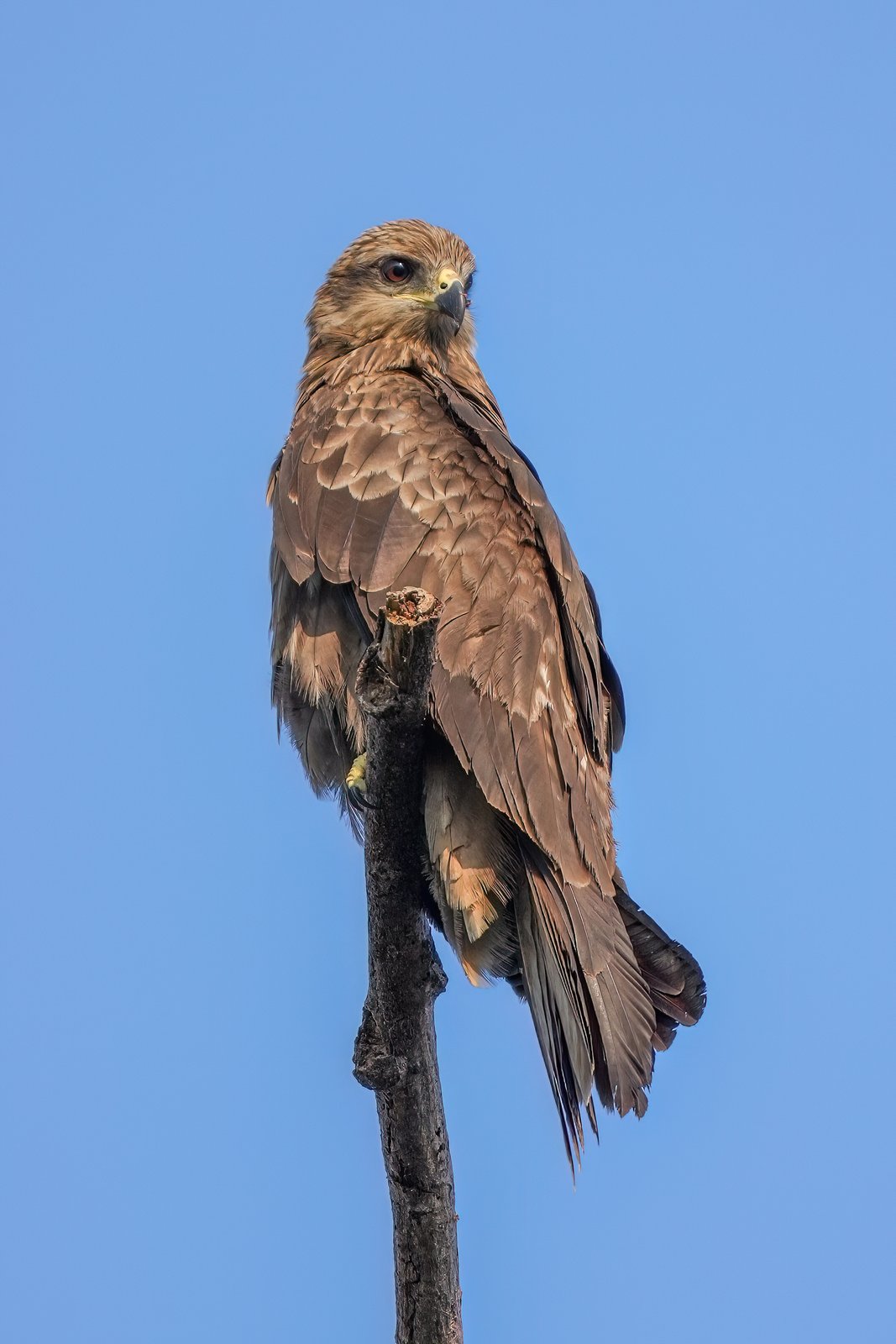
48–58 cm, wingspan 130–155 cm. Dark chocolate brown, finely streaked below, the head slightly paler grey-brown, the eye dark. In flight long, fairly narrow wings held slightly angled and somewhat drooping, with at most a vague paler area at the base of the primaries, and a fairly long, shallow-forked tail that looks square when spread. From above a pale band across the wing coverts. European birds have a black bill with a yellow cere; the Yellow-billed Kite of Egypt, southwest Arabia and Yemen has an all-yellow bill, warmer rufous-brown plumage and a slightly deeper tail fork. The juvenile is paler, with pale spots on the breast and coverts and a dark mask behind the eye.
Confusion species
Red Kite (Milvus milvus) is larger and more rufous, with a deeply forked rufous tail, a pale head and large white hand windows. Western Marsh Harrier (Circus aeruginosus) flies low with the wings in a V and has a rounded, unforked tail. Dark Common Buzzards (Buteo buteo) and young Lesser Spotted Eagles (Clanga pomarina) have broad wings and a short, rounded tail; on any dark raptor look for the kite tail that is constantly twisted.
Habitat
Very varied: river valleys, lakes and marshes with trees nearby, farmland, rubbish dumps, fishing harbours and towns. In Egypt and Yemen the Yellow-billed Kite lives close to people, over markets, slaughterhouses and rubbish tips, and along the Nile and the Red Sea coast. Nests in trees, in Arabia also in date palms and on rocks. Migrants rest in flocks along the Jordan Valley and at fish ponds.
Where the bird is most at home, classified by the habitats of North Africa and the Middle East.


Range and movements
In Morocco a numerous summer visitor and breeder in the north and on the Atlantic plains, scarcer in the Middle and High Atlas; scattered in northern Algeria and Tunisia, scarce in Libya. In the Levant a few pairs breed in northern Israel, Syria and Iraq. In Egypt the Yellow-billed Kite breeds commonly and all year in the Nile Delta and Nile Valley, with large numbers in Cairo, and along the Red Sea; also resident in the Tihama and Asir mountains of southwest Saudi Arabia and in Yemen, mainly on the coastal plains and in port towns. Tens of thousands of European birds cross at Gibraltar each year; in spring tens of thousands pass Eilat, mainly in March and April. Thousands winter in Israel, mainly in the Hula Valley and at dumps in the north. Elsewhere in Arabia and the Gulf states a scarce passage migrant and winter visitor. Beyond the region from Europe and Africa to Australia.
- Resident
- Summer visitor (c. Apr–Sep)
- Winter visitor (c. Oct–Mar)
- Passage (Mar–Apr, Oct–Nov)
- dark = core range, pale = thinly spread
How and when to look
In Cairo and Luxor there is no need to search: look up over the rooftops and the Nile. At Gibraltar and in the Rif in March and August hundreds cross at once; in the Hula Valley thousands sometimes gather in winter.
Conservation status
Not threatened and probably the most numerous large raptor in the world. Locally declining in North Africa through poisoning, shooting and electrocution, but the Yellow-billed Kite profits from urban waste. Migrants are shot along the route and killed by wind turbines and power lines.
Scientific name
Milvus migrans | (Boddaert, 1783)
Boddaert described the species in 1783 as Falco migrans; because it was later moved to another genus, the author and year stand in brackets. The genus Milvus was introduced in 1799 by De Lacépède. Milvus is the Latin word for the red kite. migrans is Latin for 'migrating', from migrare 'to migrate', after the movements of the northern populations. The specimen the first description was based on came from France.