All species › Passerines › Crows and jays › Brown-Necked Raven
Brown-Necked Raven | Corvus ruficollis
Bruinnekraaf | Cuervo desertícola
The raven of the desert: across the whole Sahara and the Arabian Peninsula this is the large black bird at oases, roadside restaurants, camel camps and rubbish dumps. It is slimmer and more lightly built than Northern Raven, and shares the edges of its range with that species in the Maghreb, the Levant and northern Iraq, which makes separating them one of the classic identification questions of the region.

Voice
The call is a drawn-out, nasal, fairly high aaarrgh or kraaah, often with a plaintive ending, usually repeated two or three times. Also a dry rattle, a short barking kok at the nest and soft muttering between partners. It sounds thinner and higher than the deep kronk of Northern Raven.
Recording: David Darrell-Lambert — CC BY-NC-SA 4.0 · converted to mono · xeno-canto
Identification
A slim, long-winged raven with a long, relatively slender bill whose culmen curves clearly only close to the tip. The plumage is black with a purple gloss; head, neck, mantle and upper breast have a bronze-brown wash that is obvious in strong sunlight and on worn birds (spring and summer), but barely noticeable on freshly moulted birds in shade. The throat feathers are short and smooth, without a shaggy beard. In flight it shows long, narrow wings and a wedge-shaped tail with a less pointed tip than Northern Raven; the tail projects clearly beyond the wingtips, also in a perched bird. Juveniles are duller black and almost lack the brown wash.
Confusion species
Northern Raven (Corvus corax) is larger and heavier, with a deep, strongly curved bill, a shaggy throat beard, a more pointed wedge-shaped tail and a deep, croaking call; the two species meet on the edge of the Sahara in Morocco and Algeria, in the Levant and in northern Iraq. Fan-tailed Raven (Corvus rhipidurus) is stockier, with broad wings and a short tail that barely extends beyond the wingtips in a perched bird. House Crow (Corvus splendens) is much smaller and has a grey neck and breast. Hybrids with Pied Crow (Corvus albus) are known from the Horn of Africa, so a bird with pale patches on the neck in the region is not automatically a Pied Crow.
Habitat
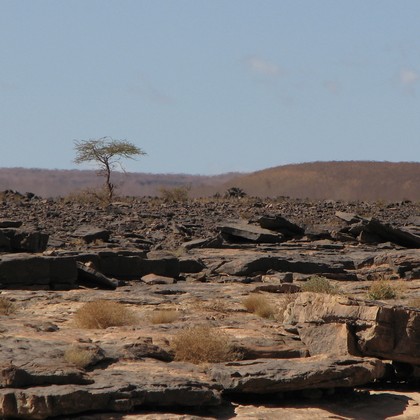
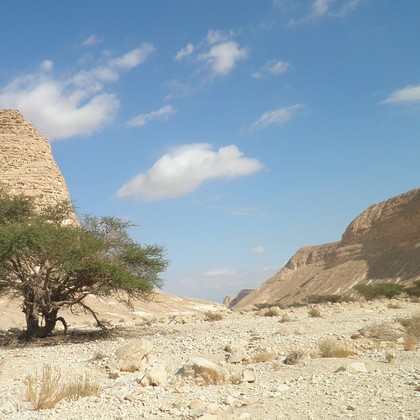
Stony and sandy desert, semi-desert with acacias, wadis, oases and date palm groves, and the edges of villages, camps and roads. Often close to people: rubbish dumps, slaughter sites, petrol stations and camel markets attract flocks, outside the breeding season sometimes hundreds of birds. Nests in an acacia, a palm, on a rock ledge or on a pylon. On Socotra also on the coastal plain and in the mountains.
Where the bird is most at home, classified by the habitats of North Africa and the Middle East.

Range and movements
Occupies almost the whole arid part of the region. In Morocco south of the High Atlas (Souss, Anti-Atlas, the Saharan zone and Western Sahara to Dakhla), in Algeria, southern Tunisia and Libya throughout the Sahara including the mountain massifs (Hoggar, Tassili, Akakus), in Egypt in the deserts on both sides of the Nile, along the Red Sea and in Sinai. In the Middle East in the Negev, the Arava and the Judean Desert (Israel and Judea and Samaria), in eastern and southern Jordan, the Syrian Desert, western and southern Iraq, and across the Arabian Peninsula: Saudi Arabia, Yemen (also Socotra, where it is common), Oman, the United Arab Emirates and more scarcely in Kuwait, Qatar and Bahrain. Beyond the region from the Cape Verde Islands and Mauritania through the Sahel to Sudan, Eritrea, Ethiopia, Somalia and northern Kenya, and east through Iran to Pakistan and Central Asia.
- Resident
- Winter visitor (c. Apr–Sep)
- Passage (Mar–Apr, Oct–Nov)
- dark = core range, pale = thinly spread
How and when to look
A rubbish dump or a roadside restaurant on a desert road is the place to see flocks and to pick up the brown wash in sunlight. To learn the difference from Northern Raven, the Moroccan Souss and the southern side of the Atlas, or the Negev highlands, offer both species side by side: concentrate on bill shape and call.
Conservation status
Not globally threatened, and widespread and locally numerous in the region. The species benefits from refuse, settlements and roads in the desert and has increased in many places. Poisoning of "pest" birds and electrocution on pylons are local threats.
Scientific name
Corvus ruficollis | Lesson, 1831
Lesson described the species in 1831 and placed it straight away in the genus where it still stands. The genus Corvus was introduced in 1758 by Linnaeus. Corvus is the Latin word for 'raven'. ruficollis is Latin for 'red-necked', from rufus 'reddish brown' and collum 'neck'. The specimen the first description was based on came from Cape Verde.