All species › Passerines › Swallows and martins › Brown-Throated Martin
Brown-Throated Martin | Riparia paludicola
Vale oeverzwaluw | Avión paludícola africano
The Brown-throated Martin is a small, uniformly brown African martin that in this region lives only in Morocco, as its own subspecies mauritanica, far separated from the populations south of the Sahara. There it is a resident of rivers and reservoirs that breeds early in the year.
Voice
A soft, high twitter and a dry svrr or chrr in flight, softer than in Bank Swallow; at the colony a constant, scratchy chatter.
Recording: Ken Behrens — CC BY-NC-SA 4.0 · converted to mono · xeno-canto
Identification
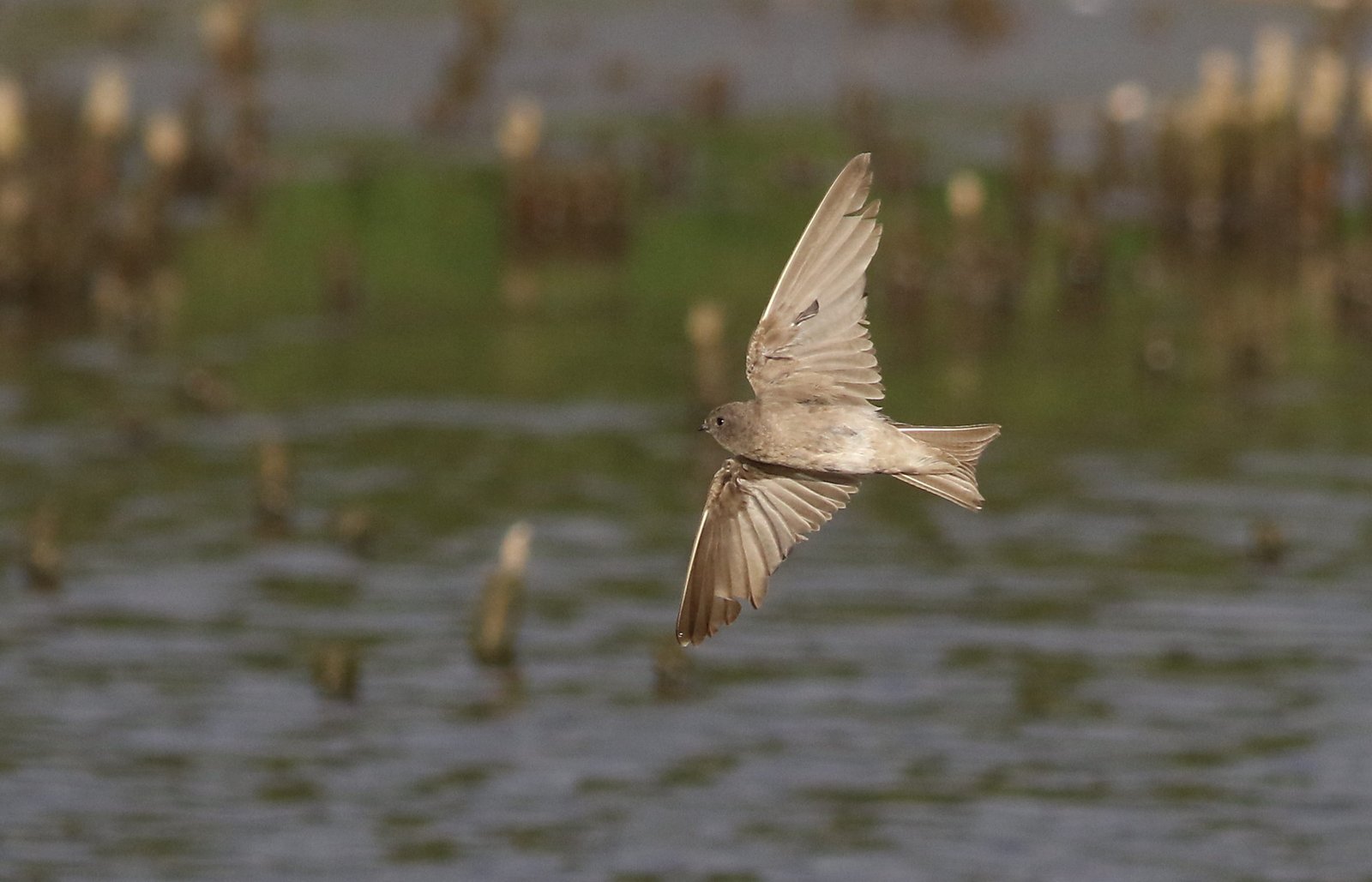
11–12 cm. Small and compact, with short, broad wings and a short, shallowly notched tail without white spots. Uniform grey-brown above; throat and breast dull grey-brown, without a band, merging without a sharp border into an off-white belly and white undertail coverts. The underwing is dark grey-brown. The Moroccan form is somewhat paler and smaller than most African forms. The flight is low, fluttering and jerky, often just above the water. Sexes alike; juveniles have cinnamon fringes on rump and wing coverts.
Confusion species
Bank Swallow (Riparia riparia) has a white throat with a sharp brown breast band below; with juvenile Bank Swallows check carefully for the white throat above the faint band. Pale Crag Martin (Ptyonoprogne obsoleta) and Eurasian Crag-Martin (Ptyonoprogne rupestris) are bulkier, have a square tail with white spots and hunt along cliff faces rather than low over water. Grey-throated Martin (Riparia chinensis), an Asian vagrant in the east of the region, is smaller and greyer with a whiter belly.
Habitat
Rivers and stream valleys with steep loam and sand banks, river mouths, reservoirs and ponds in open country with fields and orchards. Breeds colonially in self-dug burrows in riverbanks, but also in artificial embankments and even in holes in concrete. Outside the breeding season it hunts in flocks over water and damp fields.
Where the bird is most at home, classified by the habitats of North Africa and the Middle East.


Range and movements
In this region only in Morocco, west and north of the Atlas: in the Souss-Massa area (Oued Massa, Oued Souss), near Essaouira (Oued Ksob), around Marrakech (Oued Tensift, Lalla Takerkoust reservoir), on the Atlantic plain from Casablanca and Rabat to the Gharb and the Loukkos at Larache, and locally inland to Fès. In Egypt birds have been seen since 2023 at Abu Simbel on Lake Nasser; in Israel one record, in July 2015 in the Judean Desert. Beyond the region widespread in sub-Saharan Africa and on Madagascar.
- Resident
- Winter visitor (c. Apr–Sep)
- Passage (Mar–Apr, Oct–Nov)
- dark = core range, pale = thinly spread
How and when to look
Easiest at the mouth of the Oued Massa in Souss-Massa National Park or at the Oued Ksob near Essaouira, where it hunts over the water all year. From February to April the colonies in the banks are active; keep your distance from the burrows.
Conservation status
Not globally threatened. The Moroccan subspecies has a small, isolated range and is vulnerable to river canalisation, sand extraction and rivers drying out in dry years; fortunately it also uses artificial banks.
Scientific name
Riparia paludicola | (Vieillot, 1817)
Vieillot described the species in 1817 as Hirundo paludicola; because it was later moved to another genus, the author and year stand in brackets. The genus Riparia was introduced in 1817 by Forster. Riparia comes from Latin riparius 'of the riverbank', from ripa 'riverbank', after the nest burrows these martins dig in steep banks. paludicola is Latin for 'marsh-dweller', from palus, paludis 'marsh' and -cola 'dweller', from colere 'to inhabit'. The specimen the first description was based on came from South Africa.