All species › Waders, gulls and terns › Sandpipers and snipes › Common Greenshank
Common Greenshank | Tringa nebularia
Groenpootruiter | Archibebe claro
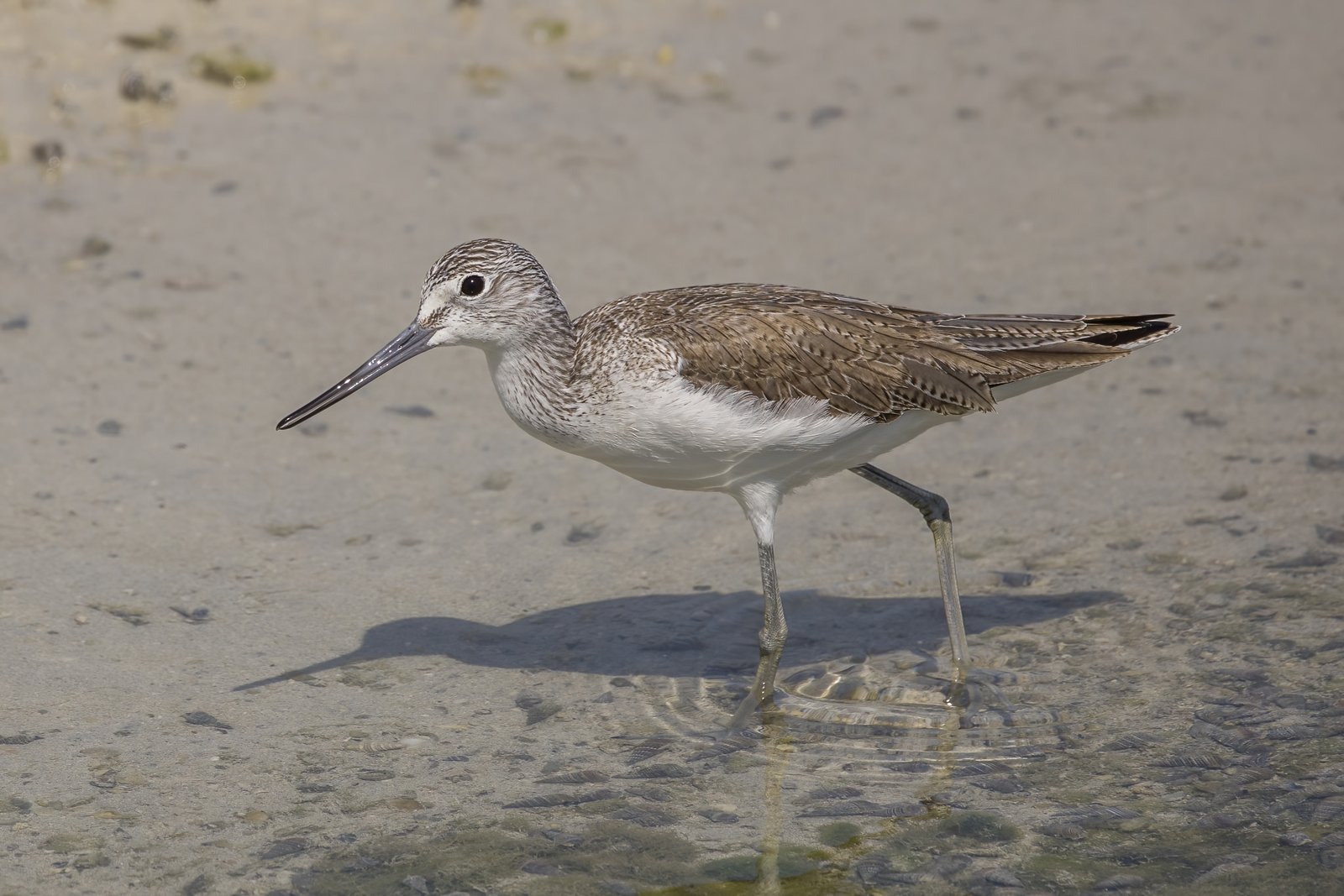
The largest and most widespread Tringa of the region: a grey-and-white, long-legged bird with a slightly upturned bill, whose loud three-note call rings out wherever there is water, from the Atlantic coast of Morocco to the mangroves of the Red Sea and the creeks of Oman. It winters widely and often singly, and is found on the coast as well as inland.
Voice
A loud, ringing, clear tew-tew-tew of three equal notes at the same pitch, often given on take-off; one of the characteristic sounds of coast and marsh in winter. When alarmed a rapid chuk-chuk-chuk.
Recording: Eetu Paljakka — CC BY-NC-SA 4.0 · converted to mono · xeno-canto
Identification
Large, with a long bill, grey at the base and dark towards the tip, slightly upturned, and long grey-green legs. In winter plumage pale grey above with fine dark shaft streaks and white edges, head and neck lightly streaked and underparts pure white; in breeding plumage more heavily streaked with black spots on the scapulars. In flight a long white wedge running from the rump far up the back, a dark, plain upperwing and a pale, finely barred tail; the toes project just beyond the tail.
Confusion species
Marsh Sandpiper (Tringa stagnatilis) is much smaller and more delicate, with a needle-fine straight bill and a higher, thinner call. Spotted Redshank (Tringa erythropus) in winter plumage has red legs and a straight bill with red at the base. Lesser Yellowlegs (Tringa flavipes), a vagrant, is smaller, with yellow legs and a square white rump without a back wedge.
Habitat
A wide range of waters: tidal flats, lagoons, creeks and mangroves on the coast, salt pans, riverbanks, fish ponds, sewage ponds, reservoirs and pools in wadis and oases. It hunts small fish and shrimps actively, running through shallow water with the bill half submerged.
Where the bird is most at home, classified by the habitats of North Africa and the Middle East.


Range and movements
Passage migrant and winter visitor throughout the region. In the Maghreb widespread along the coast and on inland wetlands of Morocco, Western Sahara, Algeria and Tunisia, with the largest numbers on the Atlantic lagoons and in the Gulf of Gabès; scarce on the Libyan coast. Egypt: along the Nile, on the delta lakes and along the Red Sea, including the mangroves of the south. In the Levant and Iraq a common passage migrant and winter visitor. Widespread in Arabia: in the Emirates a very common passage migrant and winter visitor from August to April, with a few oversummering; also along the coasts of Kuwait, Bahrain, Qatar, Saudi Arabia, Oman and Yemen, on Socotra, and inland at sewage works and irrigation pools. On passage also in the oases of the Sahara and the Arabian deserts. Breeds from Scotland and Fennoscandia through the taiga to Kamchatka; also winters in western Europe, sub-Saharan Africa, South Asia and Australia.
- Resident
- Summer visitor (c. Apr–Sep)
- Winter visitor (c. Oct–Mar)
- Passage (Mar–Apr, Oct–Nov)
- dark = core range, pale = thinly spread
How and when to look
Listen at any water for the three-note call: you often hear a Common Greenshank before you see it. In the Gulf states and Oman small groups stand in creeks and mangroves in winter, as at Khor Kalba and in Dhofar; in the Maghreb the lagoons of Merja Zerga and Oualidia are good sites. Watch it hunt: dashing through the shallows with a sweeping bill.
Conservation status
Not globally threatened (LC), with a large, stable population in the boreal zone. In the region coastal wetlands and mangroves suffer from development and pollution, but the species is adaptable and also uses artificial waters such as fish ponds, salt pans and sewage works.
Scientific name
Tringa nebularia | (Gunnerus, 1767)
Gunnerus described the species in 1767 as Scolopax nebularia; because it was later moved to another genus, the author and year stand in brackets. The genus Tringa was introduced in 1758 by Linnaeus. Tringa is the Neo-Latin name Aldrovandi gave to the green sandpiper, after Ancient Greek trungas, a thrush-sized, white-rumped, tail-bobbing wading bird mentioned by Aristotle. nebularia is Latin, from nebula 'mist', after the damp, misty marshland where the bird breeds. The specimen the first description was based on came from Trondheim, Norway.