All species › Passerines › Larks › Dunn's Lark
Dunn's Lark | Eremalauda dunni
Dunns leeuwerik | Alondra de Dunn
Dunn's Lark is a stocky, sandy, heavy-billed lark of the southern Sahara and the Sahel. It wanders in search of places where rain has fallen and grass has sprung up, and then breeds quickly. In the region it reaches only the far south-western edge: the south of Western Sahara, with an occasional influx as far as the Tafilalt.

Voice
The song, given in a high song flight or from the ground, consists of short, pleasant, twittering and trilling phrases. The call is a soft, rolling prrt.
Recording: Tim Jones — CC BY-NC-SA 4.0 · converted to mono · xeno-canto
Identification
14–15 cm, stocky and large-headed, with a heavy, pale pinkish-horn conical bill and a fairly short tail. Upperparts sandy to pale rufous, crown and mantle finely streaked dark. The face is pale, with a white eye-ring and a thin dark line below the eye and along the gape. Underparts whitish with a buff wash across the breast, finely streaked at the sides. The tail is largely blackish with sandy central feathers and looks dark in flight. The long tertials almost cover the primaries. Sexes alike.
Confusion species
Arabian Lark (Eremalauda eremodites), until recently treated as a subspecies, lives only east of the Gulf of Suez and does not overlap with this species. Bar-tailed Lark (Ammomanes cinctura) has a much smaller bill, unstreaked upperparts and a rufous tail with a sharp black terminal band. Desert Lark (Ammomanes deserti) is larger and unstreaked and lives on rocky slopes. Greater Short-toed Lark (Calandrella brachydactyla) and Mediterranean Short-toed Lark (Alaudala rufescens) have a much finer bill and a paler tail with white sides.
Habitat
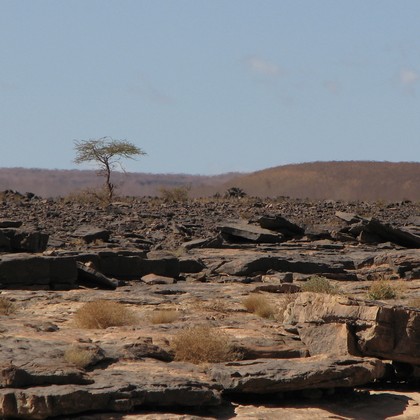
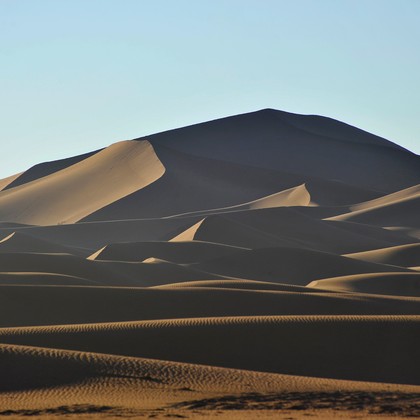
Flat, open gravel and sand plains with scattered grass tufts and low shrubs, especially where rain has recently fallen. Avoids rocky terrain and high dunes.
Where the bird is most at home, classified by the habitats of North Africa and the Middle East.
Range and movements
In the region only in Morocco. In the south of Western Sahara, along the road from Dakhla to Aousserd and around Aousserd, it was discovered in the early 2000s; the first breeding was confirmed there in 2007 and it has been seen there annually since. In 2010 a small group appeared in the Tafilalt near Merzouga, where breeding was also proved by a nest and fed young; a few further records followed there until 2012, and in spring 2019 another small influx. There are no confirmed records from Algeria, Tunisia, Libya or Egypt west of the Gulf of Suez. Beyond the region it lives in the southern Sahara and the Sahel from Mauritania and northern Senegal through Mali, Niger and Chad to Sudan.
- Resident
- Summer visitor (c. Oct–Mar)
- Winter visitor (c. Apr–Sep)
- Passage (Mar–Apr, Oct–Nov)
- dark = core range, pale = thinly spread
How and when to look
The road from Dakhla to Aousserd is the well-known site, especially in years with winter rain. Drive slowly and stop at grassy gravel plains; the birds walk unobtrusively between the grass tufts and stand out by their heavy bill and dark tail when they fly up.
Conservation status
Not threatened. Because of its nomadic habits, numbers and trend are poorly known. In Morocco the species is rare and fluctuating; overgrazing of the grassy plains can limit breeding success after rain.
Scientific name
Eremalauda dunni | (Shelley, 1904)
Shelley described the species in 1904 as Calendula dunni; because it was later moved to another genus, the author and year stand in brackets. The genus Eremalauda was introduced in 1926 by Sclater. Eremalauda combines Greek erēmos 'desert' with Latin alauda 'lark'. dunni honours Henry Nason Dunn, British army surgeon who collected birds in Sudan. The specimen the first description was based on came from Ogageh Wells, Kordofan, Sudan.