All species › Passerines › Kinglets › Goldcrest
Goldcrest | Regulus regulus
Goudhaantje | Reyezuelo sencillo
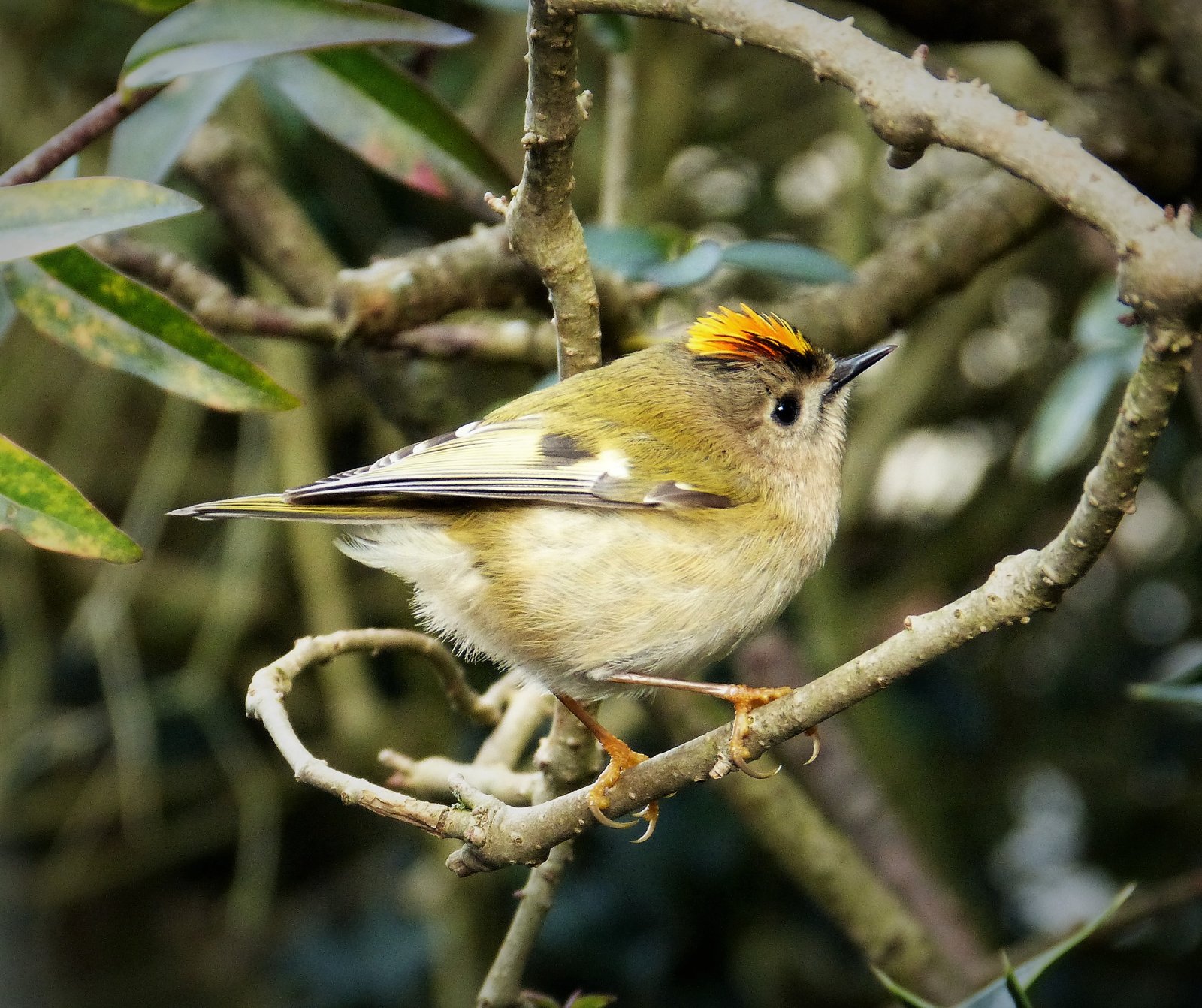
The Goldcrest, with the Common Firecrest the region's smallest bird, is a winter visitor here at the southern edge of its vast range. It appears in the cold months in the mountain forests of Lebanon, Syria and northern Israel, in varying numbers.
Voice
The call is a very high, thin sree-sree-sree, barely audible to some people. The song, sometimes heard in winter too, is a rhythmically repeated, high see-sesee-sesee-sesee ending in a short flourish.
Recording: Lars Edenius — CC BY-NC-SA 4.0 · converted to mono · xeno-canto
Identification
8.5–9.5 cm. Tiny and rotund, with a fine bill and a large dark eye. Upperparts dull olive-green, underparts dirty white with a yellowish or grey wash; two white wingbars and a dark patch behind the wingbar. The face is plain, with a pale eye-ring and no supercilium. The crown stripe is yellow, with orange in the centre in the male, bordered black on both sides. Juveniles lack the crown stripe. Birds in the region probably belong to the greyer eastern form buturlini.
Confusion species
Common Firecrest (Regulus ignicapilla) has a broad white supercilium and black eye-stripe, brighter green back and a bronze patch on the neck side. Small leaf warblers such as Yellow-browed Warbler (Phylloscopus inornatus) and Hume's Warbler (Phylloscopus humei) are larger and slimmer, with a long supercilium and no yellow or orange crown.
Habitat
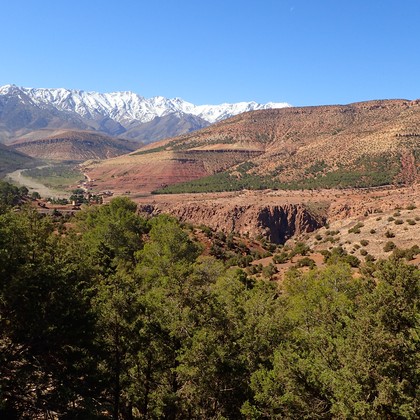
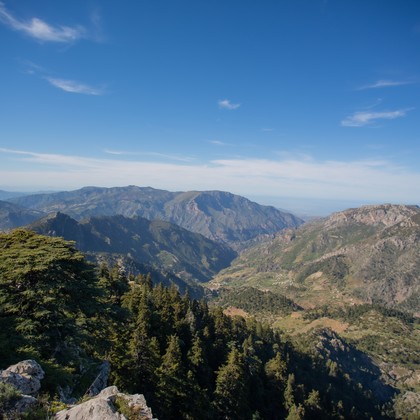
In winter in conifer forest of cedar, pine, fir and juniper in the mountains, and in mixed forest; in irruption years also in parks, gardens, scrub and even conifer plantations in the desert. Forages constantly on the move among the needles for small insects and spiders, often with tits.
Where the bird is most at home, classified by the habitats of North Africa and the Middle East.
Range and movements
A scarce but regular winter visitor to Lebanon (especially the cedar forests and conifer woodland of Mount Lebanon), western Syria and northern Israel, where Mount Hermon, the Golan and Upper Galilee are the regular sites; in some winters clearly more arrive and birds are also seen further south. Also rare in the mountains of northern Iraq. In Kuwait the species has been seen a few times since the first record in December 2013; in the Maghreb, Egypt and Jordan it is a rare vagrant. Beyond the region the Goldcrest breeds from Europe and Turkey through the Caucasus, Siberia and Central Asia to Japan; also in the Canary Islands and the Azores.
- Resident
- Summer visitor (c. Oct–Mar)
- Winter visitor (c. Apr–Sep)
- Passage (Mar–Apr, Oct–Nov)
- dark = core range, pale = thinly spread
How and when to look
In winter search the cedar forests of Lebanon, such as the Shouf Cedar Reserve, or the slopes of Mount Hermon; listen for the thin sree-sree-sree from the canopy and check mixed flocks with tits.
Conservation status
Not globally threatened. The number of winter visitors to the region fluctuates strongly with breeding success and hard winters in the north; as a tiny bird the Goldcrest is vulnerable to cold spells.
Scientific name
Regulus regulus | (Linnaeus, 1758)
Linnaeus described the species in 1758 as Motacilla Regulus; because it was later moved to another genus, the author and year stand in brackets. The genus Regulus was introduced in 1800 by Cuvier, GLCFD. Regulus is Latin for 'little king', a diminutive of rex 'king', after the golden crown stripe. The specific name repeats the genus name. The specimen the first description was based on came from Sweden.