All species › Grebes › Grebes › Great Crested Grebe
Great Crested Grebe | Podiceps cristatus
Fuut | Somormujo lavanco
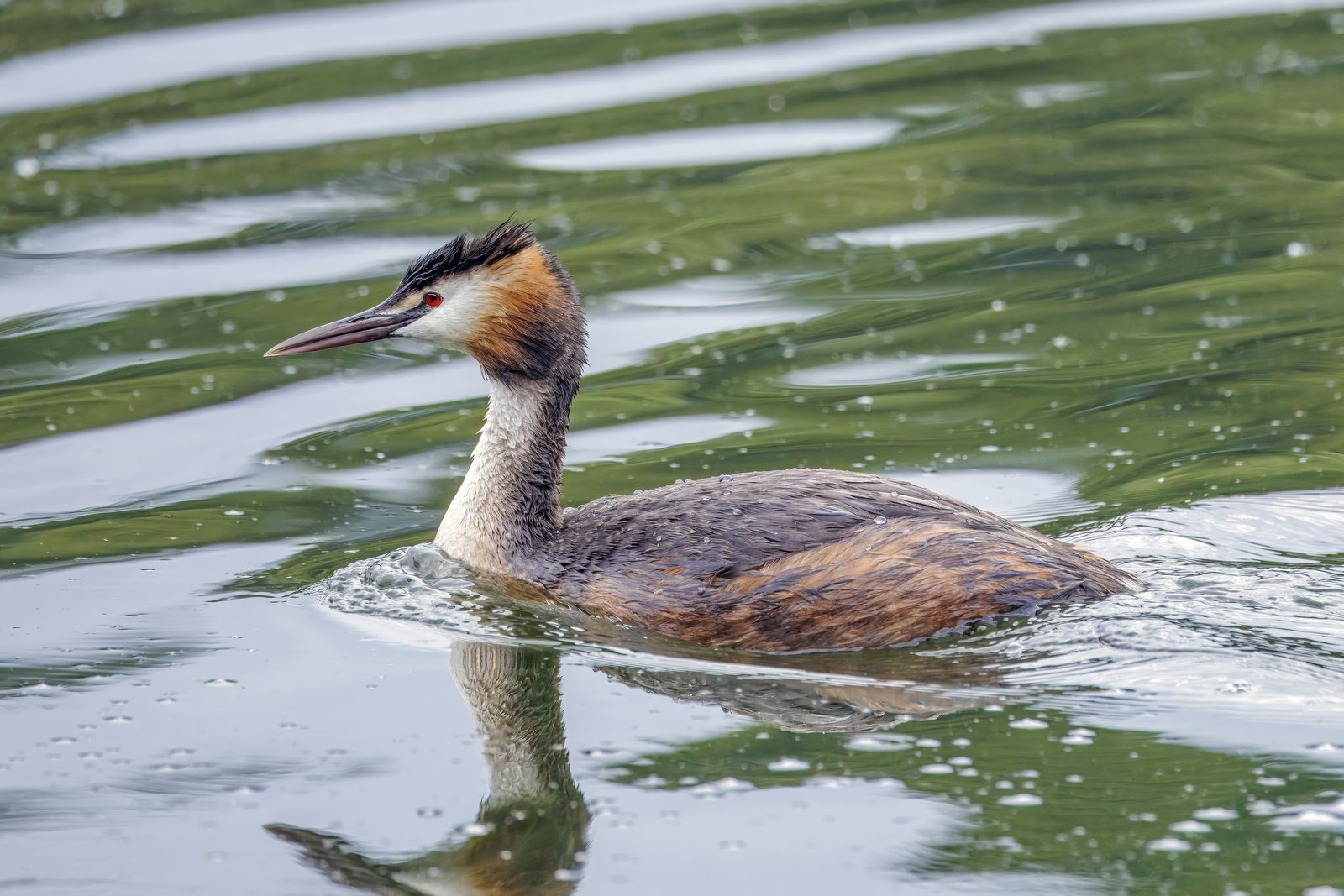
The Great Crested Grebe is the largest grebe in the region, a slender diver with a long white neck and, in breeding plumage, a chestnut ruff and double black crest. In North Africa and the Levant it breeds on reservoirs and lakes; in the rest of the region it is mainly a winter visitor to open water and coasts.
Voice
Noisy in the breeding season: a far-carrying, harsh ringing kroa-ah and a barking krrooh, often answered by the mate. Young beg persistently with a shrill peeuw-peeuw. Almost silent outside the breeding season.
Recording: Jarek Matusiak — CC BY-NC-SA 4.0 · converted to mono · xeno-canto
Identification
Slender and long-necked, with a dagger-shaped pink bill and a flat crown. In breeding plumage a double black crest and a rufous, black-edged ruff that is fanned in display. In winter a clean white face with dark crown, a white line over the eye and a silvery-white foreneck. Juveniles have a black-and-white striped head. In flight the white panels on the leading and trailing edges of the wing are obvious.
Confusion species
Red-necked Grebe (Podiceps grisegena), a rare winter visitor to the region, is more compact, with a shorter, thicker neck, a yellow bill base and, in winter, greyish cheeks without a white line over the eye. Eared Grebe (Podiceps nigricollis) and Little Grebe (Tachybaptus ruficollis) are far smaller and rounder. Winter birds at sea can suggest loons, which have a thicker neck and a heavier head and bill.
Habitat
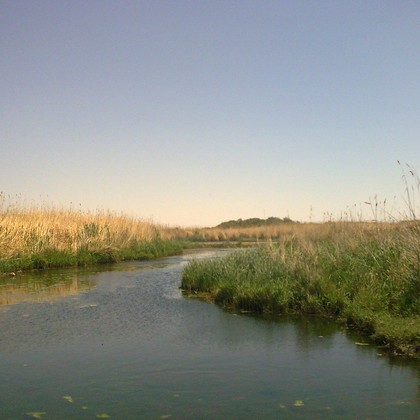
Breeds on open, fairly productive fresh waters with a fringe of reed or rushes to anchor the floating nest: natural lakes in the Atlas and the Maghreb, reservoirs, fishponds and the marshes of Iraq. In winter also on large reservoirs, coastal lagoons, harbours and sheltered bays, as along the Mediterranean and the Persian Gulf. It feeds mainly on fish, chased under water.
Where the bird is most at home, classified by the habitats of North Africa and the Middle East.


Range and movements
Breeds in Morocco, Algeria and Tunisia, scarcely in Egypt (Nile Delta lakes), in Israel, Syria and Iraq, and irregularly in Jordan and Lebanon. More numerous and widespread in winter: along Mediterranean coasts from Morocco to the Levant, on the lakes of the Nile Delta and the Fayoum, in Iraq and Kuwait, and scarcely along the Gulf coast to Bahrain, Qatar and the United Arab Emirates; a rare winter visitor to Saudi Arabia and Oman, and a vagrant to Yemen. Beyond the region it breeds from Europe to Central Asia and China, with separate populations in sub-Saharan Africa and in Australia and New Zealand.
- Resident
- Summer visitor (c. Oct–Mar)
- Winter visitor (c. Apr–Sep)
- Passage (Mar–Apr, Oct–Nov)
- dark = core range, pale = thinly spread
How and when to look
In the Maghreb the lakes of the Middle Atlas and the reservoirs of northern Tunisia are good for breeding pairs and their courtship display, which starts here as early as February and March. In winter the species is best seen from a harbour wall or beach in calm weather; look for the white necks among the waves.
Conservation status
Not threatened and numerous worldwide. In the region the breeding population depends on fluctuating water levels: in dry years lakes and reservoirs dry out and breeding fails. Drainage of marshes, disturbance by boats and drowning in fishing nets are local threats.
Scientific name
Podiceps cristatus | (Linnaeus, 1758)
Linnaeus described the species in 1758 as Colymbus cristatus; because it was later moved to another genus, the author and year stand in brackets. The genus Podiceps was introduced in 1787 by Latham. Podiceps is Latin, from podex, genitive podicis, 'rear end', and pes 'foot', after the legs set far back on the body. cristatus is Latin for 'crested', from crista 'crest'. The specimen the first description was based on came from Sweden.