All species › Pelicans, herons and ibises › Pelicans › Great White Pelican
Great White Pelican | Pelecanus onocrotalus
Roze pelikaan | Pelícano común
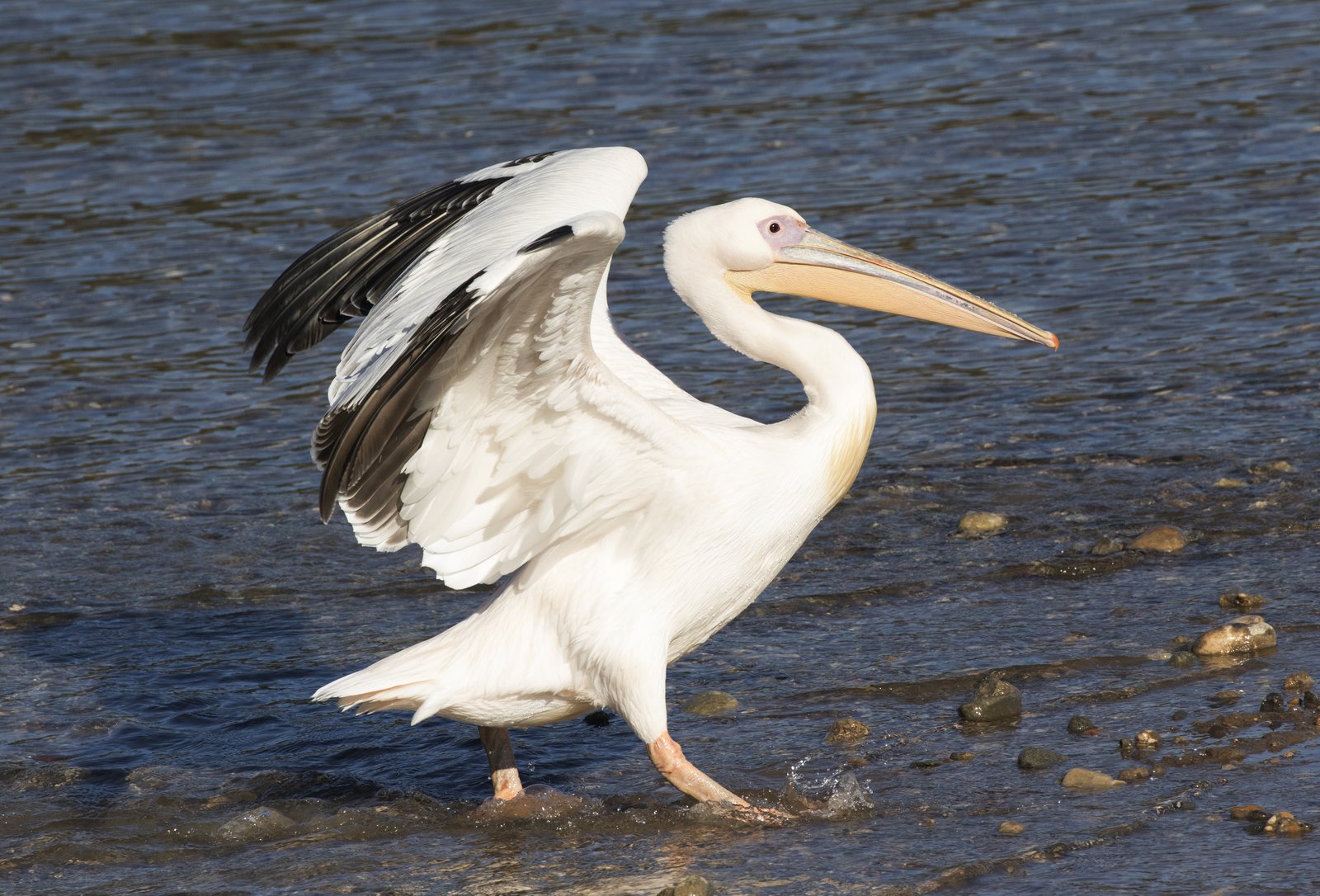
A huge white waterbird with black flight feathers and a yellow pouch, migrating to Africa in large, slowly circling flocks over Israel. Every autumn tens of thousands of pelicans from south-east Europe and Turkey rest on the fishponds and lakes of the Levant before crossing Sinai and the Sahara.
Voice
Almost silent away from colonies; at colonies and in squabbles over food a low, growling and grunting murmur.
Recording: Bram Piot — CC BY-NC-SA 4.0 · converted to mono · xeno-canto
Identification
Very large, with short legs, a long neck and an enormous bill with a yellow pouch. Adults are white, in spring with a pink flush and a short crest, a yellow breast patch and a bare pinkish-yellow face around the eye; legs pink to orange. In flight the all-black primaries and secondaries on the underwing contrast sharply with the white underwing coverts. Juveniles are grey-brown with a brown upper wing and become white over three to four years. Migrates in V's or loose flocks, circling high on thermals and then gliding a long way.
Confusion species
Dalmatian Pelican (Pelecanus crispus) is silvery grey-white with a curly crest, grey legs and a dirty-white underwing on which only the primaries are dark. Pink-backed Pelican (Pelecanus rufescens) is smaller and greyer, with a pink back, a small dark spot between eye and bill and an almost uniformly grey underwing. Flying pelicans at a distance can recall White Storks (Ciconia ciconia), which, however, have long legs and a slender neck.
Habitat
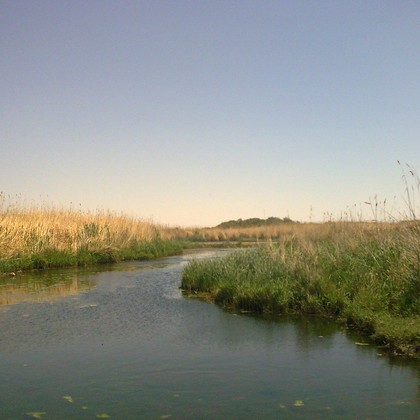
Large lakes, marshes, river deltas, reservoirs and fishponds with plenty of fish; on passage also storage reservoirs and coastal lagoons. Fishes in groups that drive fish into shallow water in a semicircle and plunge their bills in unison. Migrates by day using thermals over land, so migration follows the Levant land bridge and avoids open sea.
Where the bird is most at home, classified by the habitats of North Africa and the Middle East.


Range and movements
No longer breeds in the region; in the early twentieth century it bred on Bubiyan and Warba islands in Kuwait and near the Shatt al-Arab. The main flyway runs over Lebanon, Israel and the Palestinian territories, Jordan and Sinai to the Nile Valley and East Africa: in Israel tens of thousands rest in September – November in the Hula and Beit She'an valleys and at reservoirs on the coastal plain; in spring (March – May) they return more quickly, including over Eilat. In Egypt a passage migrant along the Gulf of Suez and the Nile and a scarce winter visitor. Smaller numbers pass through Syria and Iraq, where a few also winter in the marshes. In Kuwait, the Emirates, Oman, Saudi Arabia and Yemen a scarce migrant and winter visitor. Virtually absent from the Maghreb, with a few records in Morocco and Western Sahara, possibly from the breeding colonies on the Banc d'Arguin in Mauritania. Beyond the region it breeds in south-east Europe (mainly the Danube Delta), Turkey, Central Asia and patchily in sub-Saharan Africa; European birds winter in East Africa.
- Resident
- Summer visitor (c. Oct–Mar)
- Winter visitor (c. Apr–Sep)
- Passage (Mar–Apr, Oct–Nov)
- dark = core range, pale = thinly spread
How and when to look
Early October is the time to visit the Hula Valley: from the bunds around Agamon Hula and at the fishponds of the Beit She'an Valley thousands can be seen, and on warm afternoons flocks spiral up in great columns on thermals. At the Mishmar HaSharon reservoir on the coastal plain the birds have been fed with fish since the 1990s.
Conservation status
Not globally threatened. On the flyway it conflicts with fish farmers in Israel, who see their ponds raided; supplementary feeding with rejected fish at a reservoir has reduced the conflict. Further threats are power lines, avian influenza, loss of stopover sites and disturbance on the breeding grounds.
Scientific name
Pelecanus onocrotalus | Linnaeus, 1758
Linnaeus described the species in 1758 and placed it straight away in the genus where it still stands. He introduced the genus Pelecanus in that same work. Pelecanus is the Latin form of the Greek pelekan 'pelican', which itself derives from pelekys 'axe'. onocrotalus is the Latin name of the pelican, taken from the Greek onokrotalos, from onos 'donkey' and krotalon 'rattle': literally 'one who brays like a donkey', for the harsh call. The specimen the first description was based on came from Africa and Asia (later restriction to the Caspian Sea suggested).