All species › Waterfowl › Ducks, geese and swans › Greater Scaup
Greater Scaup | Aythya marila
Topper | Porrón bastardo
A bulky diving duck of northern coastal waters that reaches the region only at its edge. Most records come from Israel; there are also single records in the United Arab Emirates and the Maghreb, nearly always among Tufted Ducks.
Voice
Usually silent in winter; the female gives a low, harsh karr-karr.
Recording: Andrew Spencer — CC BY-NC-SA 3.0 · converted to mono · xeno-canto
Identification
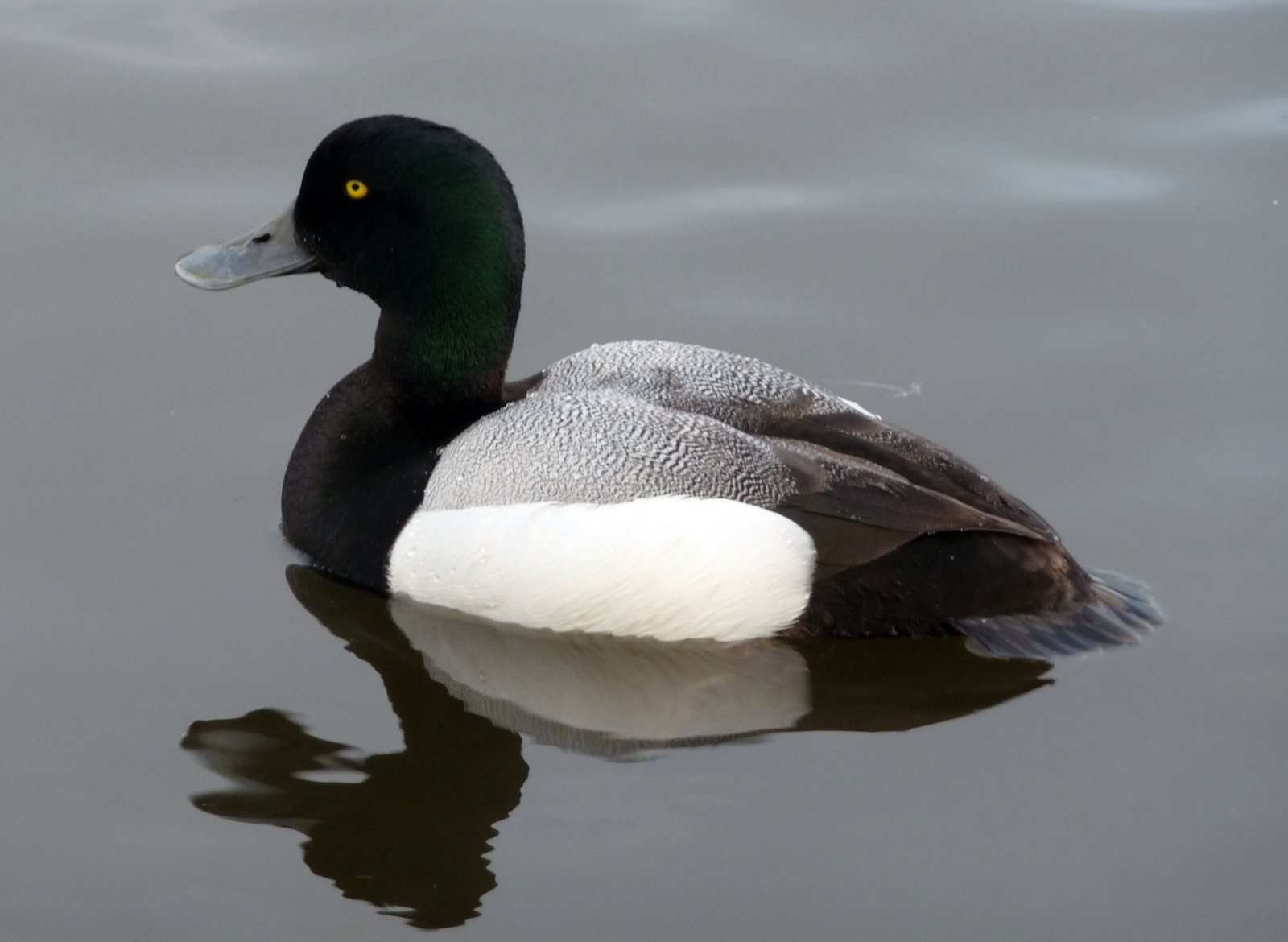
About 46 cm, larger and heavier than Tufted Duck, with a rounded head without a tuft and a broad blue-grey bill with a small black nail. The male has a black head glossed green, black breast and rear, a pale grey, finely vermiculated back and white flanks; the eye is yellow. The female is brown with a grey-flecked back and a large, sharply defined white blaze around the bill base; in winter often a pale patch on the ear coverts. In flight a broad white wingbar that extends well into the primaries.
Confusion species
The female Tufted Duck (Aythya fuligula) can also show white at the bill base, but the patch is smaller, the back darker and there is a short tuft. Lesser Scaup (Aythya affinis) is smaller, with an angular head, a smaller bill nail and a white wingbar confined to the secondaries. Hybrids of Tufted Duck with Common Pochard (Aythya ferina) can resemble Greater Scaup; check head shape, bill nail and the grey back.
Habitat
In the normal wintering range mainly shallow coastal waters, bays and estuaries, where it dives for mussels. In the region it appears mainly on inland lakes, fishponds and reservoirs and in coastal lagoons, usually in flocks of Tufted Ducks.
Where the bird is most at home, classified by the habitats of North Africa and the Middle East.


Range and movements
In the region a rare visitor: most often in Israel, with one or a few birds on lakes and fishponds in most winters; a few records in the United Arab Emirates, Tunisia, Algeria and Morocco, and single records elsewhere in the Middle East. The species breeds on the tundra and in the taiga from Iceland and Scandinavia to Alaska and winters along the coasts of north-west Europe, the Baltic, the Black and Caspian Seas, East Asia and North America.
- Winter visitor (c. Oct–Mar)
- dark = core range, pale = thinly spread
How and when to look
In winter in Israel search the Tufted Ducks on lakes and fishponds for a larger bird with a pale grey back or a large white blaze. At distance a first-winter male is the trickiest: then the rounded head and the bill nail help.
Conservation status
Not threatened, though the world population is declining. In the region a rare winter visitor, most often in Israel, and it does not breed there.
Scientific name
Aythya marila | (Linnaeus, 1761)
Linnaeus described the species in 1761 as Anas Marila; because it was later moved to another genus, the author and year stand in brackets. The genus Aythya was introduced in 1822 by Boie. Aythya is from Greek aithuia, an unidentified diving seabird mentioned by Aristotle and Hesychius. marila is Greek for 'charcoal embers' or 'coal dust'. The specimen the first description was based on came from Lapland.