All species › Passerines › Chats and flycatchers › Hume's Wheatear
Hume's Wheatear | Oenanthe albonigra
Humes tapuit | Collalba de Hume
Hume's Wheatear is a large, glossy black-and-white wheatear of bare rocky mountains. In the region it is the characteristic wheatear of the Hajar Mountains of northern Oman and the United Arab Emirates.

Voice
The song is a short, clear, melodious whistled phrase of a few rolling notes, often repeated from a rock pinnacle, for instance chew-wee-chew-wee-cheew. The call is a hard chak and a whistled hweet.
Recording: David Darrell-Lambert — CC BY-NC-SA 4.0 · converted to mono · xeno-canto
Identification
16.5–17 cm. Large and bulky, with a big, round head and a strong bill. Head, throat, upper breast, mantle and wings glossy blue-black; the border with the pure white belly lies high on the breast and is sharp. Rump, uppertail coverts and much of the tail white, with black central feathers and a narrow black terminal band forming an inverted T. Undertail coverts white. Sexes alike, the female sometimes slightly less glossy. Juveniles are a duller blackish-brown.
Confusion species
Variable Wheatear (Oenanthe picata), a rare winter visitor, is smaller, with a smaller head, dull black and a broader terminal band; the female is brown. Mourning Wheatear (Oenanthe lugens) is smaller and has a white crown, white wing panels in flight and buff undertail coverts. The male Hooded Wheatear (Oenanthe monacha) has a white crown and an almost entirely white tail. The male Pied Wheatear (Oenanthe pleschanka) has a white crown and nape.
Habitat
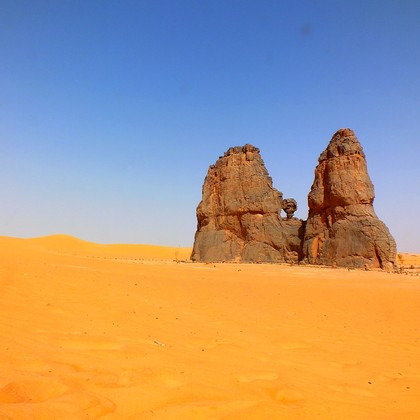
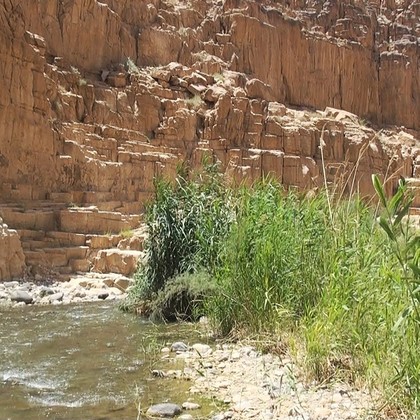
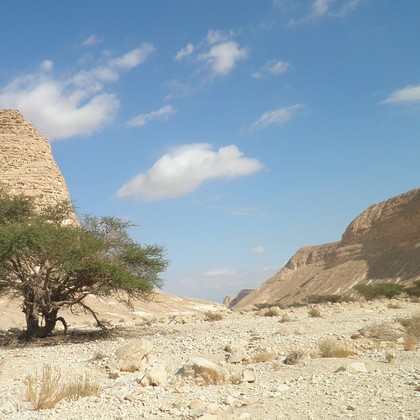
Bare, steep rock slopes, gorges and scree with little vegetation, from the foot of the mountains to about 2000 m; also in rocky wadis with scattered shrubs and at quarries.
Where the bird is most at home, classified by the habitats of North Africa and the Middle East.
Range and movements
Resident in the Hajar Mountains of northern Oman, including Musandam, and in the adjacent mountains of the United Arab Emirates (Jebel Hafeet near Al Ain, the mountains of Ras al-Khaimah and Fujairah). Not recorded elsewhere in the region. Beyond the region in southern and south-eastern Iran, southern Afghanistan and western Pakistan.
- Resident
- Winter visitor (c. Apr–Sep)
- Passage (Mar–Apr, Oct–Nov)
- dark = core range, pale = thinly spread
How and when to look
On Jebel Hafeet near Al Ain, along the mountain road, or in the wadis of the Hajar Mountains in Oman: it sits conspicuously on rock pinnacles and boulders and can be seen all year.
Conservation status
Not globally threatened. In the region confined to the Hajar Mountains, but common and little threatened there; local disturbance from quarrying and road building.
Scientific name
Oenanthe albonigra | (Hume, 1872)
Hume described the species in 1872 as Saxicola Alboniger; because it was later moved to another genus, the author and year stand in brackets. The genus Oenanthe was introduced in 1816 by Vieillot. Oenanthe was used by Aristotle for a bird that can no longer be identified; the word comes from the Greek oinos, oinoē 'wine, vine' and anthos 'flower, bloom'. albonigra is Latin for 'white and black', from albus 'white' and niger 'black'. The specimen the first description was based on came from the hills between Kalat and Sindh, Pakistan.