All species › Parrots › Parrots › Monk Parakeet
Monk Parakeet | Myiopsitta monachus
Monniksparkiet | Cotorra argentina
The Monk Parakeet is the only parrot that builds its own nest of twigs, often a communal structure in which several pairs each have their own chamber. The species comes from South America and is an introduced species in this region, with by far the largest population in Israel.
Voice
A loud, harsh and rather barking kwak-kwak-kwarr, lower, hoarser and more irregular than the shrill screech of Rose-ringed Parakeet. At the colony chattering and screeching all day, also from inside the nest.
Recording: Joan Theng — CC BY-NC-SA 4.0 · shortened to the first 60 s, mono · xeno-canto
Identification
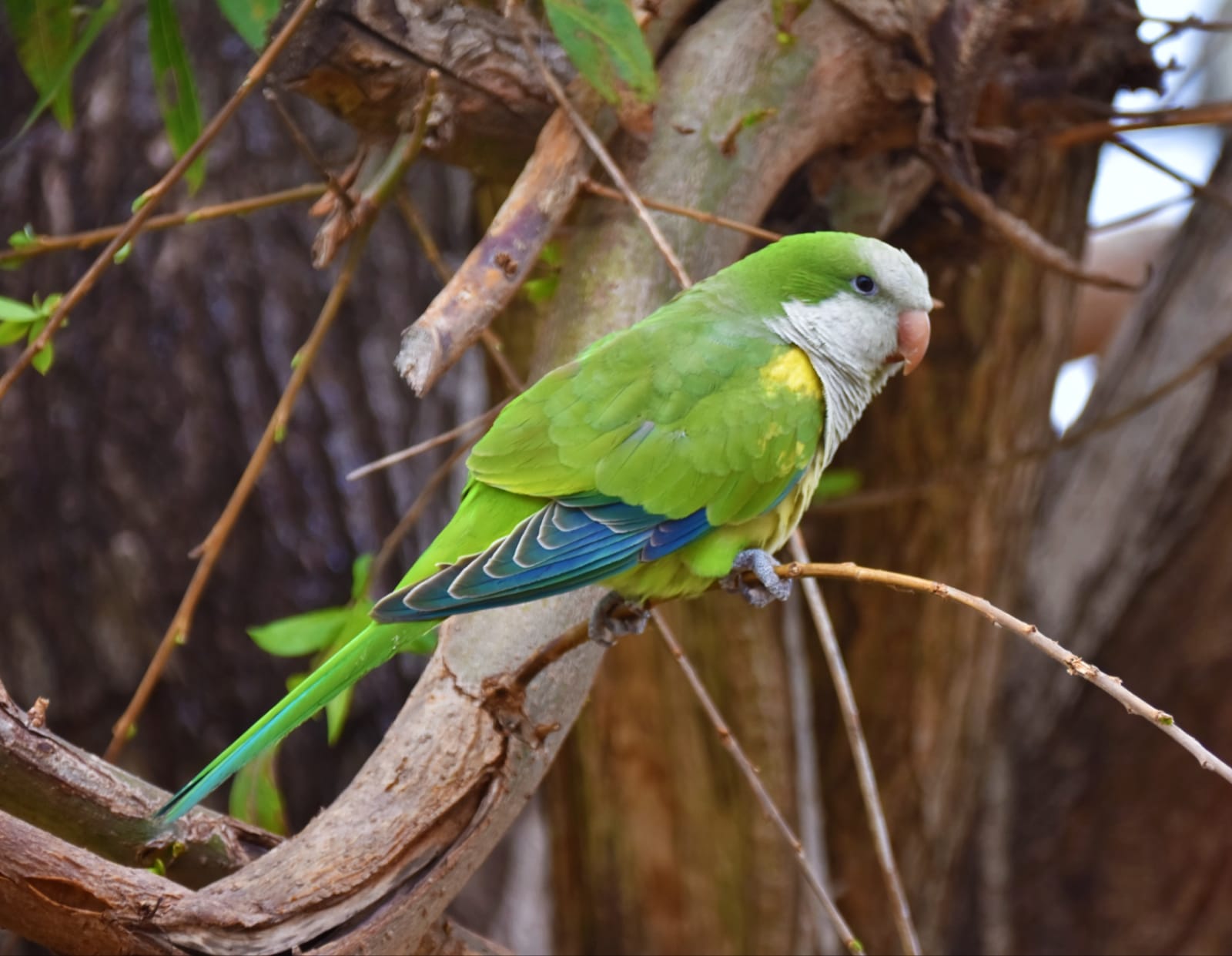
28–30 cm, wingspan 48–53 cm. A stocky, relatively short-tailed parakeet. Forehead, cheeks and throat pale grey, the breast grey with fine scaling formed by paler fringes; the grey face and scaly breast together are diagnostic. Upperparts and tail bright grass-green, belly yellow-green, flight feathers deep blue. The bill is orange-brown to horn, never red. In flight the blue of the flight feathers stands out; the tail is wedge-shaped and shorter than in the other parakeets. The sexes are alike.
Confusion species
Rose-ringed Parakeet (Psittacula krameri) is slimmer and brighter green, with a red bill, a much longer pointed tail and no grey on head and breast. Alexandrine Parakeet (Psittacula eupatria) is larger still and longer-tailed, with a heavy red bill and a maroon shoulder patch. Both nest in tree holes; only the Monk Parakeet builds a stick nest.
Habitat
Almost entirely tied to built-up areas and their immediate surroundings: city parks, avenues with palms and eucalyptus, gardens, sports grounds, orchards and irrigated farmland on the urban fringe. The nest hangs high in a palm, eucalyptus or conifer, or in the steelwork of a lamp post or pylon. Feeds much on the ground on seeds, and also on fruit, blossom and crops.
Where the bird is most at home, classified by the habitats of North Africa and the Middle East.


Range and movements
The native range is in south-central South America, from Bolivia and southern Brazil to Argentina; the species is therefore not native to this region. The population derives from escaped and released cage birds. Established in Israel since the late twentieth century and strongly increasing, mainly on the coastal plain around Tel Aviv and in the Sharon, and also in Samaria and Judea. In Morocco small colonies in and around Tangier, Casablanca, Rabat and in the northeast; in the UAE small numbers in Dubai and Abu Dhabi. Elsewhere in the region only odd escaped birds. Beyond the region established in southern Europe, the United States and elsewhere.
- Resident
- Summer visitor (c. Oct–Mar)
- Winter visitor (c. Apr–Sep)
- dark = core range, pale = thinly spread
How and when to look
Look for the nest, not the bird: a dark, untidy ball of twigs high in a palm or against a pylon in a park in Tel Aviv or another town on the Israeli coastal plain. There are almost always birds at the nest, and you can often see the scaly breast at close range.
Conservation status
Not globally threatened; locally an agricultural pest in South America. In this region an introduced species. In Israel introduced parakeets cause considerable damage to fruit growing and crops, and nests on power pylons can cause outages. Possible competition with native birds has hardly been studied.
Scientific name
Myiopsitta monachus | (Boddaert, 1783)
Boddaert described the species in 1783 as Psittacus monachus; because it was later moved to another genus, the author and year stand in brackets. The genus Myiopsitta was introduced in 1854 by Bonaparte. Myiopsitta combines Greek mus, muos 'mouse' with New Latin psitta 'parrot', alluding to the mouse-grey face and underparts. monachus is Late Latin for 'monk'. The specimen the first description was based on came from Montevideo, Uruguay.