All species › Passerines › Sunbirds › Nile Valley Sunbird
Nile Valley Sunbird | Hedydipna metallica
Nijlhoningzuiger | Suimanga del Nilo
The Nile Valley Sunbird is the smallest sunbird in the region and the male, with its long tail streamers, the most striking. It is the sunbird of the Egyptian Nile Valley and also occurs in the acacia wadis of south-west Arabia.

Voice
The call is a thin, high tsee or tchee-tchee; the song is a fast, high, rather scratchy twittering phrase, often ending in a short trill, given from a prominent twig.
Recording: Stanislas Wroza — CC BY-NC-SA 4.0 · shortened to the first 60 s, mono · xeno-canto
Identification
9–10 cm, the breeding male 15–17 cm owing to two greatly elongated central tail feathers. Short, slightly curved bill. The male is glossy metallic green on head, throat and back, with a violet-purple rump and a narrow violet-blue band across the breast, and bright yellow underparts; wings and tail are blackish. In non-breeding plumage (roughly July–December) the male is female-like but often retains some green gloss and sometimes the streamers. The female is grey-brown above and pale yellow below, with a faint pale supercilium and a short dark tail with white sides.
Confusion species
Pygmy Sunbird (Hedydipna platura), only a vagrant in the far south of Algeria, is very similar but the male lacks the violet-blue breast band and has a bronzy-green rather than violet rump. Palestine Sunbird (Cinnyris osea) and Arabian Sunbird (Cinnyris hellmayri) have a longer, more strongly curved bill, no tail streamers and, in females, no yellow underparts. The female Purple Sunbird (Cinnyris asiaticus) is also yellow below but has a longer curved bill and does not occur in Egypt or south-west Arabia.
Habitat
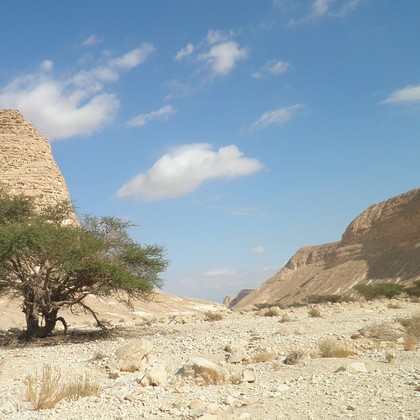
In Egypt gardens, parks, orchards and field edges with flowering shrubs in the Nile Valley, often at Calotropis and ornamental plants. In Arabia acacia wadis and dry wooded valleys at the foot of the mountains and on the Tihama coastal plain, up to about 1500 m.
Where the bird is most at home, classified by the habitats of North Africa and the Middle East.


Range and movements
In Egypt along the Nile from Cairo and Giza south to Aswan and Lake Nasser; scarce in the Delta. In Arabia in south-west Saudi Arabia (Tihama and the lower slopes of Asir), western Yemen and Dhofar in southern Oman. Beyond the region in Sudan, Eritrea, Ethiopia, Djibouti and northern Somalia.
- Resident
- Summer visitor (c. Apr–Sep)
- Winter visitor (c. Oct–Mar)
- Passage (Mar–Apr, Oct–Nov)
- dark = core range, pale = thinly spread
How and when to look
In Egypt it is easy to find in the gardens of Luxor and Aswan and on the Nile islands: check flowering shrubs and listen for the high twittering song. Males with streamers are mainly seen from February to June.
Conservation status
Not globally threatened (IUCN: Least Concern). Common in the Nile Valley, where it benefits from gardens and irrigated farmland; also locally common in south-west Arabia.
Scientific name
Hedydipna metallica | (Lichtenstein, 1823)
Lichtenstein described the species in 1823 as Nectarinia metallica; because it was later moved to another genus, the author and year stand in brackets. The genus Hedydipna was introduced in 1851 by Cabanis. Hedydipna comes from the Greek hēdudeipnos, 'dainty-supping, sweet-eating', from hēdus, 'sweet', and deipneō, 'to dine' — for the nectar-rich diet of these sunbirds. metallica is Latin for 'metallic', for the metallic sheen of the plumage. The specimen the first description was based on came from Dongola, Sudan.