All species › Waders, gulls and terns › Avocets and stilts › Pied Avocet
Pied Avocet | Recurvirostra avosetta
Kluut | Avoceta común
A slender black-and-white wader with a thin, strongly upturned bill, at home in the region mainly on salt pans, sebkhas and shallow lagoons. It breeds patchily from Morocco to Iraq and winters in large flocks along the Mediterranean, Morocco's Atlantic coast and the Persian Gulf.
Voice
A clear, fluty kloo-it or pleet, often repeated; when the nest is disturbed a shrill, persistent kloo-it kloo-it kloo-it above the intruder.
Recording: Dan — CC BY-NC-SA 4.0 · converted to mono · xeno-canto
Identification
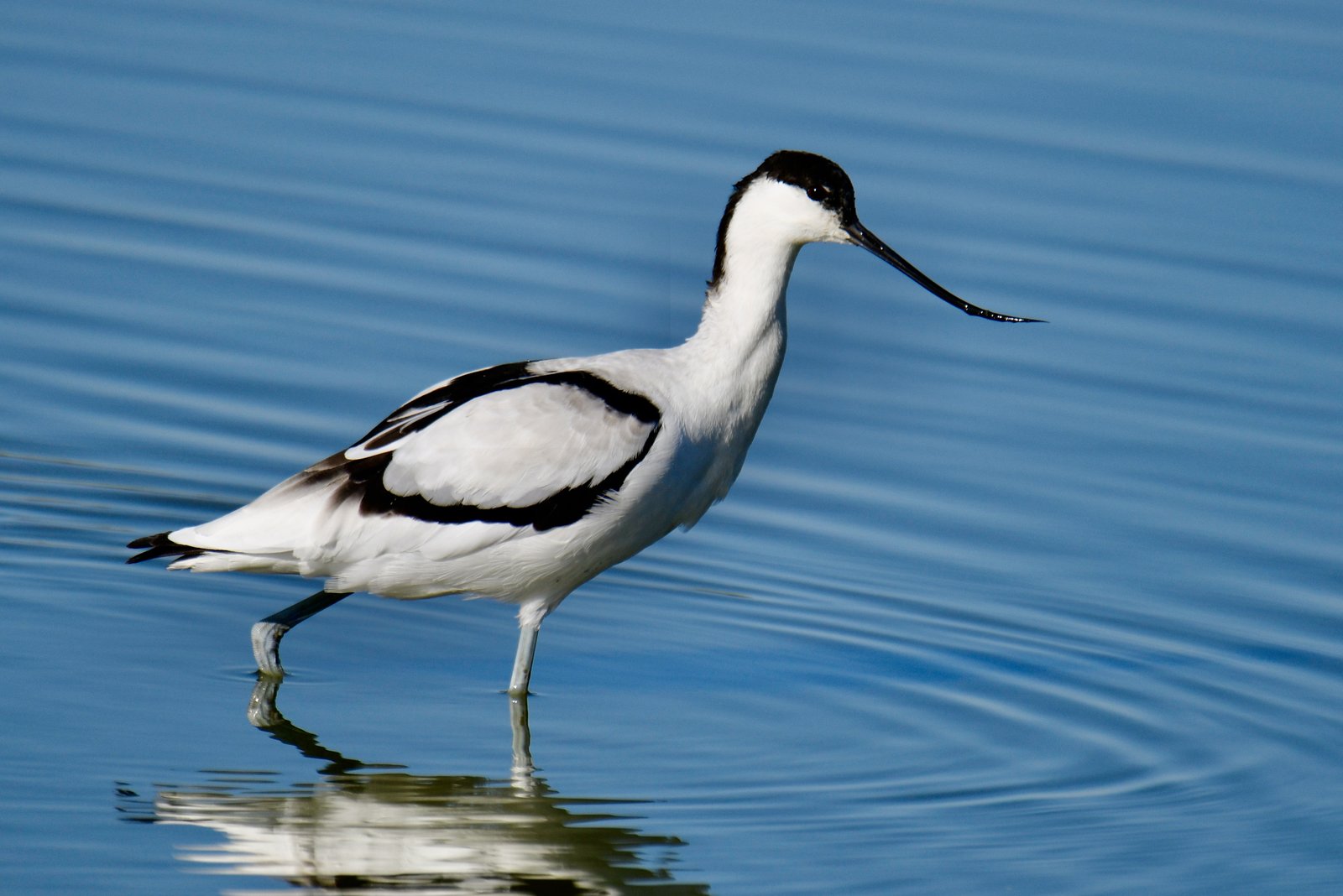
Large and slender, white with a black cap and hindneck, black scapular stripes and black wingtips, giving a crisp black-and-white pattern at rest and in flight. The black bill is long, thin and clearly upcurved; the long legs are blue-grey. Juveniles have the black areas brownish and the white parts slightly smudged. In flight the legs project well beyond the tail; the wings are white with three black bands.
Confusion species
With its upturned bill and pied pattern it is hard to confuse. Black-winged Stilt (Himantopus himantopus) has all-black wings, a straight bill and pink legs. Crab-Plover (Dromas ardeola) of the Arabian coasts is also black and white, but has a heavy straight bill and a white head. At a distance a resting flock can recall gulls until the birds start feeding.
Habitat
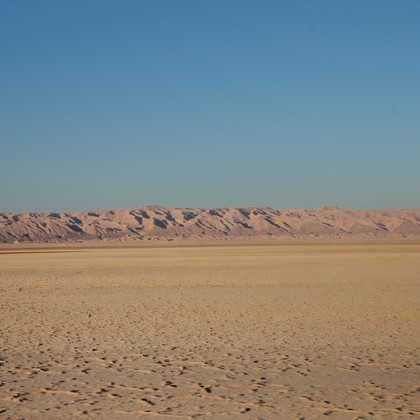
Salt pans, sebkhas and salt lakes with shallow brackish water and soft mud, coastal lagoons and tidal flats; less on fresh water. It feeds by sweeping the bill sideways through the surface layer, often wading belly-deep or swimming. Breeds in colonies on bare islets and bunds in salt pans.
Where the bird is most at home, classified by the habitats of North Africa and the Middle East.

Range and movements
Breeds patchily in North Africa: on the salt lakes and sebkhas of Morocco (including near Larache and Sidi Moussa), northern Algeria and Tunisia (chotts, Sfax and the Gulf of Gabès), locally on the Libyan coast, and in Egypt on the delta lakes and near Port Said. In the east it breeds in Israel (salt pans of Atlit and Eilat), Syria and southern Iraq, and in small numbers on the Gulf coast of Kuwait, Saudi Arabia and the Emirates. More numerous in winter: large flocks on Morocco's Atlantic coast (south to Khnifiss), in the Tunisian salt pans and on the Egyptian delta lakes, and along the Persian Gulf from Kuwait to Oman. Scarce on the Red Sea coast and in Yemen. Beyond the region it breeds from western Europe to Central Asia and Mongolia and winters in Africa, South Asia and eastern China.
- Resident
- Summer visitor (c. Apr–Sep)
- Winter visitor (c. Oct–Mar)
- Passage (Mar–Apr, Oct–Nov)
- dark = core range, pale = thinly spread
How and when to look
The Tunisian salt pans at Sfax and the lagoons at Port Said and El Malaha in Egypt hold hundreds to thousands in winter. At Eilat they feed almost year-round on the salt pans north of town, easily seen from the bunds. In the Gulf, the salt flats of Al Jahra (Kuwait) and the lagoons of Abu Dhabi are good sites.
Conservation status
Not globally threatened, and increasing in Europe after protection measures. In the region it depends on a limited number of salt pans and lagoons, threatened by coastal development, drainage, pollution and disturbance of breeding colonies; the decline of traditional salt production costs breeding habitat in places.
Scientific name
Recurvirostra avosetta | Linnaeus, 1758
Linnaeus described the species in 1758 and placed it straight away in the genus where it still stands. He introduced the genus Recurvirostra in that same work. Recurvirostra is Latin, from recurvus 'curved backwards' and rostrum 'bill', after the upturned bill. avosetta comes from avosetta, the Venetian name for the avocet; the word's further origin is uncertain. The specimen the first description was based on came from Italy.